


UK site owners have spent the past year watching AI answers take the click: impressions hold up in Search Console while visits from the same queries fall. Google’s 15 October update puts more AI Overviews links into its answers and moves them higher. Does that bring any of the traffic back? No published data shows it yet, so the answer has to come from your own Search Console and analytics figures.
The answer in brief
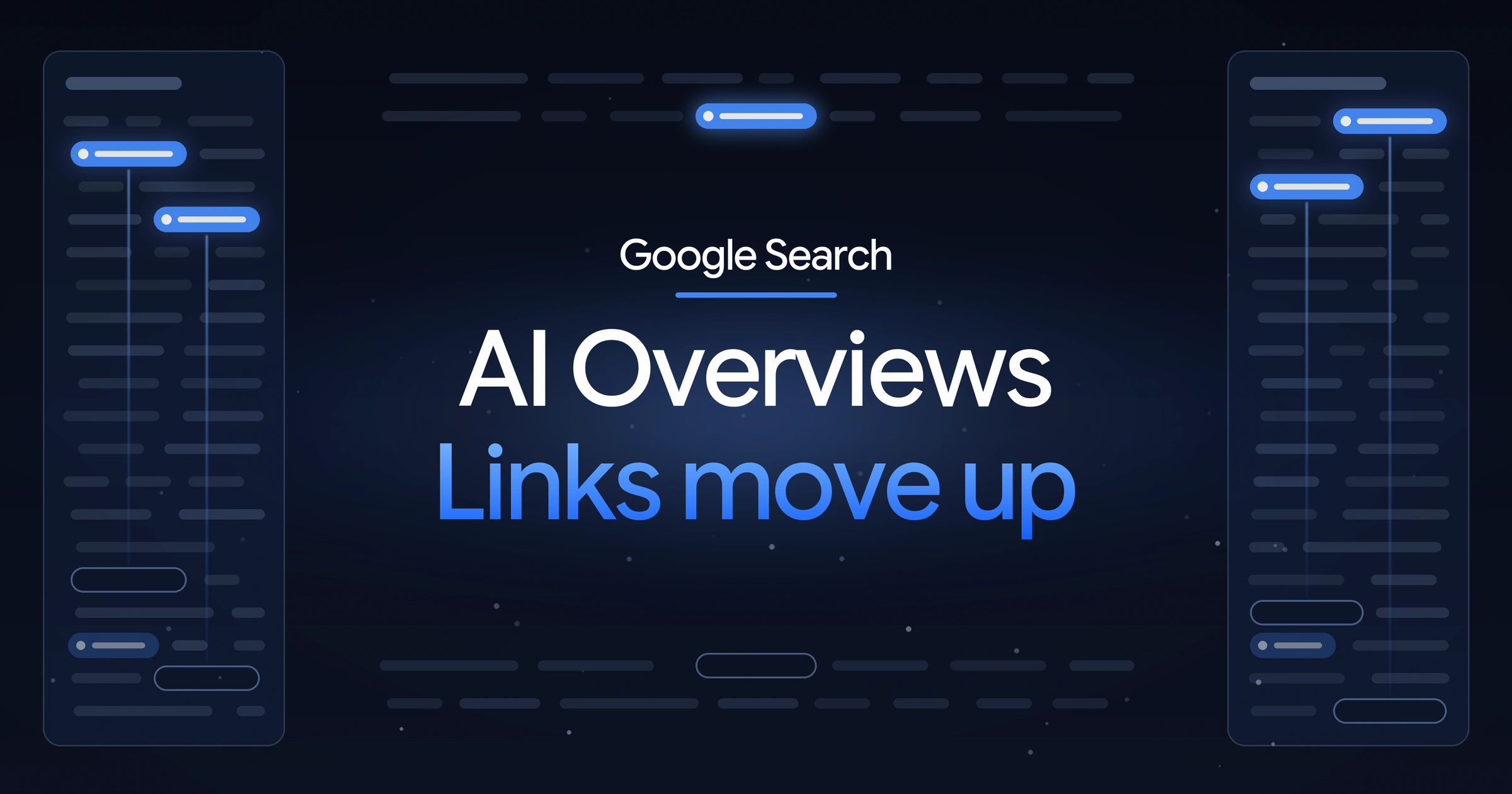
- As of 19 October 2026, no published data shows whether the 15 October changes lift clicks. On 15 October 2026 Google said AI Overviews links and AI Mode links now appear far more often, and that inline links will sit higher in answers. It published no click figures alongside the change, and the independent studies from earlier in 2026 point in different directions.
- The update changes what GEO (generative engine optimisation) is for. Being cited in an AI answer is no longer the only goal. Where your link sits in the answer, and whether readers have chosen you as a Preferred Source, now matter as well.
- Two of the five changes are tests: a section at the top of some answers for one or two official sites, and clickable creator names on video results in AI Mode.
- Google names no countries for any change. The only geographic statement is that news carousels are rolling out to “additional locations and languages globally”.
- Google says the number of people using Preferred Sources has grown more than sevenfold since the start of 2026. It gave no starting figure.
- Search Console’s generative AI report shows impressions but no clicks, so UK site owners still have to infer AI-driven clicks from other data.
What did Google change in AI Mode and AI Overviews on 15 October?
Google announced five changes to the links inside AI Overviews and AI Mode on 15 October 2026. Hema Budaraju, Vice President of Product Management for Search, set them out on Google’s Keyword blog. She signed a similar batch of five link features on 6 May 2026, so this is the second round of link changes this year.
If the table extends beyond the screen, scroll sideways to view all columns.
| Change | What Google says it does | Status in Google’s post | Surface named |
|---|---|---|---|
| Inline links | What Google says it doesMany more links embedded in the wording of answers, now shown higher up more often | Status in Google’s postLaunching | Surface namedAI experiences in general |
| Official sites section | What Google says it doesOne or two official links for a task, in a section at the top of the answer, each with a note on why it helps | Status in Google’s postTest announced, no start date | Surface namedSearch AI experiences |
| News carousels | What Google says it doesCarousels of timely articles that highlight the reader’s Preferred Sources, shown on a wider range of queries | Status in Google’s postStarting to roll out to more locations and languages | Surface namedAI Search features |
| Related article links | What Google says it doesLinks at the end of some answers gain image thumbnails and a larger, more clickable design | Status in Google’s postNo status given | Surface namedSome AI responses |
| Creator names | What Google says it doesCreator and publisher names on video results link to their Google Search profiles | Status in Google’s postTest running since the week of 12 October | Surface namedAI Mode only |
Source: Google, More ways to connect with the web from Search, 15 October 2026.
The post gives one adoption figure. Google says the number of people using Preferred Sources has grown more than sevenfold since the start of 2026, with no January baseline. Its earlier milestones counted something different, unique sources chosen, which passed 600,000 on 20 August 2026 according to PPC Land.
The post gives no click data. It does not say what share of answers now carry inline links, how much higher they sit, or how many visits they send. PPC Land flagged the same gap. Any effect on your traffic has to be measured on your own site.
Google’s own measure is a total. On 22 July 2026 Sundar Pichai told investors that Google was “now sending billions of clicks to websites every week through AI features in Search” (Alphabet Q2 2026 remarks). A large weekly total can sit alongside a lower click rate per search, so the figure says little about any one site.
Independent figures are mixed. Seer Interactive tracked 53 client accounts and found organic click-through on queries it labels as AI Overview queries rose from 1.31% in December 2025 to 2.36% in February 2026. That left them well below the 3.82% on queries without an overview, and Seer applied its labels retrospectively with no UK breakdown. Ahrefs estimated that a top-ranking desktop page earned 58% fewer clicks in December 2025 than it would have without an overview, a modelled figure rather than an observed one. Neither study covers the October changes.
Why does link placement matter more than link count?
Where AI Overviews links sit decides whether anyone sees them, and the evidence so far says most readers stop at the answer. In an observational study of browsing by 900 US adults in March 2025, Pew Research Center found people clicked a link inside a Google AI summary in about 1% of visits. They clicked a traditional result in 8% of visits when a summary appeared, against 15% when none did.
Position on the page explains much of that loss. Saharsh Agarwal of the Indian School of Business and Ananya Sen of Carnegie Mellon ran a randomised experiment that hid AI Overviews from some of 1,065 US desktop Chrome users. According to PPC Land’s report on the paper, overviews cut outbound organic clicks by 39.8%, and the effect was concentrated where the overview took the top slot on the page. Both studies measured US users.
Google’s own changes this year point the same way. In May 2026 it added desktop hover previews after finding that people hesitated when unsure where a link led, PPC Land reported. It also says readers click a link with the Preferred badge about twice as often. Moving inline links higher is the next step: the link appears while the reader is still deciding whether to read on.
That changes what GEO should count. A link in the opening lines of an answer and a link in the source panel both register as a citation in most tracking tools. On the evidence above, they are worth very different amounts. For your priority queries, record where your link appears as well as whether it appears.
How do you get linked early? Google attaches inline links to specific statements. In its May 2026 examples, a line about terrain on a California bike trip linked to a Pacific coast touring guide, and a line about daily mileage linked to a training blog. Our reading is that pages which answer one sub-question precisely, near the top of a section, are the natural targets. Google has published no ranking rule for inline links, so test that on your own queries.
Treat that as editing for readers rather than a technique Google rewards. Google’s guide to its generative AI features, last updated on 10 July 2026, says sites need no special markup, schema or AI text files, no splitting of content into chunks and no particular writing style. It also says Google Search ignores llms.txt files. Our guide to AI search visibility covers the eligibility checks that come before any of this.
For the few sites Google pays, being cited and shaping the answer are also priced differently. Its AI contribution pilot pays about 100 websites when their pages contribute significantly while AI Overviews, AI Mode or the Gemini app write a response, as The Information reported on 29 September 2026, according to PPC Land. Under Google’s terms, a link added after the response is generated earns nothing.
That scheme is separate from the News AI pilot, a licensing programme Google says now covers more than 400 publications, the Financial Times among them. It pays for content used in features such as article overviews on Google News and audio briefings.
UK sites also have a regulatory backstop. From 3 December 2026, the CMA’s publisher conduct requirement obliges Google to take reasonable steps to attribute content in AI Overviews and AI Mode clearly and accurately, with a clear way for UK users to reach it. The duty allows for design and source diversity, so it does not fix where links go. Google must publish the steps it takes, though, which should say more about placement than the 15 October post did.
What is the “official site” section and who could it help?
It is a planned test of a box at the top of some AI answers that names the one or two official places to complete a task. Google says each link will carry a note on why it is useful. It describes the test as an extension of what Search already does when someone types the name of the site they want. The post gives no examples, test size, markets or start date.
Search Engine Land illustrated it with an airline refund query, where only the airline can process the claim. For UK searchers, the natural candidates are tasks with one legitimate endpoint: renewing a passport, claiming a refund, paying a council bill or managing an energy account. Those are our examples. Google named none.
The winners would be the brands and public bodies that own the endpoint. If the test reaches the UK, the airline, bank, retailer or GOV.UK service could sit above the generated answer for its own task queries. As Google describes it, a third-party page could not compete for that slot.
The likely losers are sites that explain official tasks. UK personal finance, travel and legal sites have built large audiences on queries such as how to claim flight delay compensation, renew a photocard driving licence or appeal a parking fine. With the official link at the top and its own explanation beside it, the explainer loses the first click. PPC Land raised the same question, and Google’s post does not say whether explainers will appear alongside the official link.
There is a risk in the selection too. Google has not said how it decides what counts as official, and a wrong pick would send people to the wrong place with Google’s endorsement attached. It is also unclear whether independent advice bodies such as Citizens Advice or Which? would count as official alongside government and company sites.
If you own a task endpoint, make each task page unambiguous now. Name the task in the title and H1 in the words customers use, say in the opening line what the page lets them do, and keep one canonical URL per task. That is standard advice, and it carries more weight if Google starts labelling one or two pages as the official route. Google says its AI features need no special schema, so markup alone will not win the slot.
If you publish explainers, put your effort where an official page cannot follow. Cover the edge cases, first-hand experience of the process, templates and independent advice on whether the official route is worth taking. A generic walkthrough of a form is the content most exposed to a box that links straight to the form. Google’s AI guide draws the same line between commodity content and “unique expert or experienced takes”, and tells site owners: “Don’t just recycle what others on the internet have already said.” If AI drafts those explainers, Google’s guidance on generative AI content has said since 1 October 2026 that checking facts by hand is “critical”, and our fact-check guide covers what to check before publishing.
How do UK publishers get readers to pick them as a Preferred Source?
Ask them directly, and give them a link or button that does the work in one tap. UK readers can already choose Preferred Sources. Google began opening the feature to English-language users worldwide on 10 December 2025, and AI Mode began rolling out in the UK on 28 July 2025. According to PPC Land’s summary of Google’s documentation, preferences apply in Top Stories in every language Search supports, and in AI Overviews and AI Mode wherever those features run.
When a reader picks you, your stories appear more often for that reader in Top Stories, and your links in AI Overviews and AI Mode can carry a Preferred badge. The news carousels in the 15 October update highlight preferred sources as well. Google says people click a preferred source about twice as often, but it has not published the baseline for that comparison.
Check eligibility first:
- The site must be a domain or a subdomain. A subdirectory such as example.co.uk/news cannot be chosen on its own, according to Google’s publisher documentation.
- Since 27 May 2026 Google has said any site that publishes fresh content is eligible. Sites that are not updated regularly may not appear in the tool.
Then make the request easy:
- Add Google’s button. Since 20 August 2026 publishers can embed it with two lines of code. A reader who taps it adds your site and returns to the same point on your page. Put it where engaged readers already are: liveblogs, author boxes and the confirmation screen after someone subscribes.
- Use the deeplink where the button cannot go. The format is
https://www.google.com/preferences/source?q=yourdomain.co.uk. Put it in newsletters, WhatsApp channel posts, social posts and email signatures. - Tie the ask to the beat. Ask at the end of the coverage readers come back for, in their terms. A line under a piece on mortgage rates might read: “Following UK interest rates? Add us as a preferred source on Google to see more of our analysis when you search.” A Championship football desk can do the same after match reports. That is likely to work better than a pop-up on arrival.
Neither the button nor the link affects eligibility. They only reduce the effort for the reader. Readers can also do it unprompted, as Google’s help page describes: tap their profile picture on Google, open the search personalisation settings, choose Source preferences and tick your site. Once saved while signed in, the choice follows them to every browser they sign in to.
Measurement is thin. On 6 October 2026 Google began emailing some site owners a count of Preferred Source selections, with data as of 5 October and a survey on whether the figure belongs in Search Console. Search Console has no report for it. Keep that email and count button and link clicks in your own analytics. Treat those clicks as interest rather than confirmed selections, because only Google can see whether a reader finished. Then compare Google clicks before and after each push.
Be realistic about who benefits. A reader has to know you before they can pick you, so the feature rewards loyalty you already have and does little for a new site with no audience. Brands can use it too, because any site with fresh content is eligible, though a brand blog will compete for a reader’s short list against the publishers they already read.
What should site owners track in Search Console now?
Start with the Search generative AI performance report filtered to the United Kingdom, then read it against your ordinary click data. Search Console still reports no clicks from AI features, so you have to join the two yourself.
If the table extends beyond the screen, scroll sideways to view all columns.
| What to track | Where in Search Console | What it tells you | Limit |
|---|---|---|---|
| AI impressions by page, UK only | Where in Search ConsoleSearch generative AI performance report, country filter | What it tells youWhich pages appear in AI Overviews and AI Mode for UK searchers, and whether that changed after 15 October | LimitNo clicks or queries, no split between AI Overviews and AI Mode, and no position within the answer |
| Clicks and CTR on the same pages | Where in Search ConsolePerformance report, Web search type | What it tells youWhether rising AI visibility comes with more visits or fewer | LimitAI Mode clicks sit inside Web totals with no separate filter |
| Task pages against guide pages | Where in Search ConsolePerformance report, page filter on URL patterns | What it tells youWhether traffic moves from explainers to transactional pages if the official-site test reaches the UK | LimitNeeds URLs that separate the two |
| A marker on 15 October 2026 | Where in Search ConsoleCustom annotations on the Performance chart | What it tells youA fixed point for before-and-after comparisons | LimitOnly as complete as your own notes |
| Branded and non-branded clicks | Where in Search ConsoleBranded queries filter | What it tells youWhether loyalty features lift demand from people who already know you more than discovery | LimitEligible properties only |
| Preferred Source selections | Where in Search ConsoleEmail from Search Console, first sent 6 October 2026 | What it tells youHow many people chose your domain | LimitNot in the interface, and a single snapshot |
| Your AI inclusion setting | Where in Search ConsoleSettings, Search generative AI | What it tells youWhether your site is in or out of AI features | LimitWhole domain only for now, and child properties inherit a parent’s setting unless changed |
Sources: Search Engine Land on the report and control (31 August 2026); PPC Land on how the control works; Google Search Central on AI features in Search Console, the branded queries filter and custom annotations.
Compare like with like. Take four weeks either side of 15 October, match the weekdays, keep to UK traffic and set aside pages hit by other changes in the same period. Without that, a rise in clicks could be seasonal, a ranking update or your own work.
Do not divide total Google clicks by AI impressions and call the result an AI click-through rate. The clicks cover every kind of result and the impressions cover AI features alone, so the ratio means nothing. Search Console’s help pages add two more traps. Every link in an AI Overview is given the position of the overview as a whole, so a link that moves from the foot of an answer to its opening line keeps the same recorded position. In AI Mode, each follow-up question counts as a new query. Placement has to be checked by eye, which is what the weekly checks described below are for.
If the generative AI report is missing, Google says the usual reason is too few AI impressions, and a site excluded from the features will not have one either. Set the Search Console figures against outcomes in your own analytics: subscriptions for a publisher, enquiries or sales for a brand. That is the real test of whether AI visibility is worth defending.
Leave the AI inclusion setting alone unless the report gives you a reason. Since 31 August 2026 every site worldwide has had the control. Opting out removes the site from AI Overviews, AI Mode and Discover’s AI features within a day or two (cached content can take longer), leaves normal rankings untouched and does nothing about model training, which Google-Extended governs. In the week Google moved links higher, switching it off without data would be a guess.
Better reporting is due for UK publishers. From 3 December 2026, the CMA’s conduct requirement obliges Google to give publishers “clear and detailed metrics on user engagement” with their content in AI features shown to UK users. It also requires directory-level controls from that date and page-level controls from 3 March 2027. It is not yet known whether the metrics will include clicks inside Search Console.
Which of these changes are still tests?
Two of the five: the official sites section and clickable creator names. Google describes the official sites section in the future tense, as a test it will run, with no start date. The creator names test began in the week of 12 October 2026.
Google has not said where the creator names test runs, and UK creators have no way into it yet. It runs on video results in AI Mode, and each name links to the creator’s Google Search profile. Google’s help page lists Search profiles as available only in Canada, India and the United States, so UK creators cannot set one up. The current bar is 10,000 followers on at least one of YouTube, Instagram, X or TikTok, and you must be 18 or over. As Search Engine Land noted, the link goes to a page Google hosts, which then links on to the creator’s own site and channels.
The other three changes are not called tests. Inline links are launching, carousels are starting to roll out to more places, and the thumbnail links at the end of answers have no status at all. None comes with a country list, and the one geographic statement, about carousels, names no country either.
So plan around the three live changes and treat the two tests as signals of direction. Check UK results for your priority queries once a week, on mobile and desktop, in a signed-out browser so your own preferences do not colour the answer. Save screenshots. That record is the only way to see when a feature reaches UK results before Google says so.
What should UK publishers and brands do now?
- Record where you are cited. For your 20 to 50 most valuable queries, log whether your link sits in the opening lines of the answer, lower down, in the source panel or nowhere. Search Console cannot show this, because it gives every link in an AI Overview the same position.
- Lead each section with its answer. Put the figure, step or first-hand detail in the first sentence, where an inline link can attach to it.
- Ask readers to pick you. Add Google’s Preferred Sources button to article pages and put the deeplink in newsletters and social posts.
- Prepare for the official-site test. Brands: keep one URL per task, name the task in the title and H1, and open with a line that says what the page lets people do. Publishers: give task explainers the edge cases and first-hand detail an official page lacks.
- Mark 15 October 2026 in Search Console. Compare UK-only AI impressions and web clicks for four weeks either side, split into branded and non-branded queries and into task pages and guides.
- Keep the Preferred Source count. File Google’s email and log button clicks each month until the figure appears in Search Console.
- Check UK results weekly. Screenshot priority queries in a signed-out browser so you can see when the tests or the carousels arrive.
- Hold any opt-out decision until you have data. Give it at least a month after the update, and watch for the engagement metrics the CMA requires from 3 December 2026.
Google’s 15 October changes put AI Overviews links where readers are more likely to see them. Whether readers take them is still unmeasured, so judge the update on your own pages before changing course.
Two other October problems can blur the same reports. GA4 counted many ChatGPT visits as Direct from 8 October 2026, which our GA4 audit guide shows how to check. Rank trackers have also received poisoned Google results pages since September, so confirm any sudden ranking drop in Search Console first.
If your Search Console figures for AI Overviews need reading against the October changes, talk to AIWIZ.
Frequently asked questions
Do AI Overviews links send more traffic after the 15 October 2026 update?
No published data shows that yet. Google said on 15 October 2026 that inline links in AI Overviews and AI Mode now appear far more often and sit higher in answers, but it gave no click figures. Measure the effect in your own Search Console and analytics data, comparing four weeks either side of the update.
Is the official sites section available in the UK?
Google has not said. It described the section as a test it will run, showing one or two official links at the top of some AI answers, and gave no markets, test size or start date.
Can UK readers choose Preferred Sources?
Yes. Google began opening Preferred Sources to English-language users worldwide on 10 December 2025. A reader can tick a site under Source preferences in Google's search personalisation settings, or use a publisher's button or deeplink. Preferences apply in Top Stories and in AI Overviews and AI Mode wherever those features run.
Does Search Console show clicks from AI Overviews?
No. The Search generative AI performance report shows impressions by page, with a country filter, but no clicks or queries and no split between AI Overviews and AI Mode. Read it against the clicks in the ordinary Performance report for the same pages.
Can I opt out of AI Overviews without losing rankings?
Yes. Since 31 August 2026 every site has had a Search generative AI setting in Search Console. Opting out removes the site from AI Overviews, AI Mode and Discover's AI features within a day or two and leaves normal rankings untouched. It applies to the whole domain for now and does not cover model training, which Google-Extended governs. Give it at least a month of data after the 15 October update before deciding.
When do the CMA's rules for Google and publishers take effect?
From 3 December 2026. Google must then take reasonable steps to attribute content in AI Overviews and AI Mode clearly and accurately for UK users, give publishers clear and detailed metrics on engagement with their content in AI features, and offer directory-level controls. Page-level controls follow from 3 March 2027.