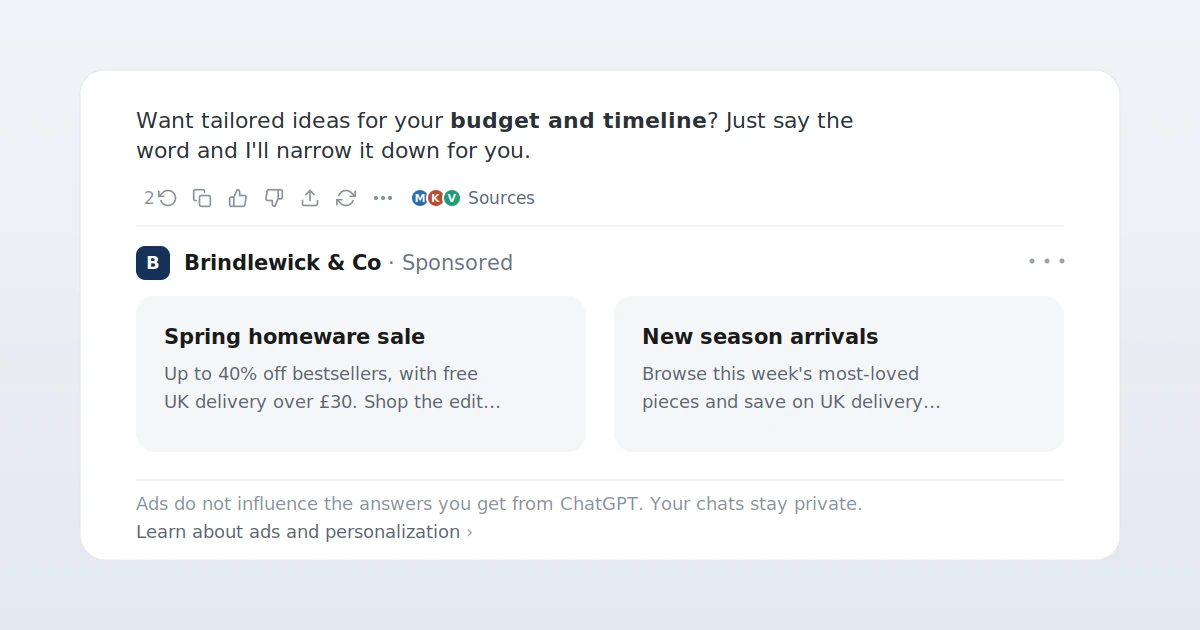
Access, buying options and integrations updated 9 October 2026.
UK businesses can buy ChatGPT Ads through Ads Manager. The channel has moved beyond its early launch phase: OpenAI announced wider self-service access across Europe on 31 August, followed by new creative tools and integrations in September. For a business already using Google Ads or Meta, the practical question is whether this additional channel can generate worthwhile enquiries at an acceptable cost. OpenAI’s August expansion update.
We have been following it since the US pilot opened in February 2026. Some of the detail is still moving. The core of it, though, is settled enough now to explain properly and to act on.
What Is a ChatGPT Ad?
It is a paid placement that shows up inside ChatGPT, just below the answer the AI has given. Each one sits in a tinted box with a clear sponsored label.
OpenAI has been firm on one point: the ads do not influence the answers. The response and the advertisement run on separate systems, and advertisers cannot shape, rank or alter what ChatGPT says.
Ads show to people on the free tier and the ChatGPT Go plan. Anyone paying for Plus, Pro, Business, Enterprise or Edu sees none. The reasoning is simple. OpenAI needs to fund free access for hundreds of millions of users, and advertising is how it is doing that.
OpenAI is also testing Sponsored Agents with selected US advertisers. These let a person start a separate conversation with a business-sponsored agent after clicking an ad. They should not be presented as a generally available UK format. For the broader work-agent product, see our ChatGPT Work guide.
What ChatGPT Ad Formats Are Available?
The core placement is a clearly labelled sponsored unit beneath a ChatGPT response, with advertising kept separate from the answer. It can contain one or more items. Plan the headline, image and landing page together: the ad needs to make sense to someone who is already working through a particular question. OpenAI’s ad-format guidance.
On 16 September, OpenAI announced new advertising tools and integrations. The Ads Manager plugin lets advertisers work on campaigns through ChatGPT, while Ads Manager is gaining creative assistance and optional text customisation. HubSpot users can connect an ads account to manage campaigns and follow up leads. The Shopify app launched for US merchants. OpenAI’s announcement scheduled international availability in supported markets for 23 September, but its Shopify setup guide (checked 7 October 2026) still lists the app as available to US Shopify customers, with other ChatGPT ads markets to follow shortly. It does not yet confirm UK availability.
Why This Is Different from Google and Meta
The honest answer is context, and context is everything in advertising.
When someone opens ChatGPT, they are not scrolling a feed. They are asking questions, comparing options, researching purchases and working through problems. That intent-led state is the most commercially valuable position a potential customer can be in, and social platforms have never quite matched it.
Conversation context is central to ad selection. OpenAI also considers the landing page, creative, advertiser-provided context hints and targeting choices. Where enabled, personalisation can use selected signals from the person’s wider ChatGPT experience. That is more specific than saying targeting uses only the current message, and it is a reason to make the offer and its intended audience clear.
That closeness to the point of purchase is genuinely new. On Google the path is search, result, click, decide. On ChatGPT the AI gives the answer, the ad sits beside it, and the person can act straight away.
Context can help an advertiser reach someone with a relevant offer without relying entirely on a history of visits across websites. Measuring the result is a separate job. Define your conversion events and check the data reaching your reporting tools before judging performance.
How the platform has grown
The original UK rollout has been followed by a much wider expansion. On 31 August, OpenAI reported availability through its sales team and partners in more than 40 countries, alongside broader self-service access. Country support and account approval still matter: use the official availability list when planning a campaign rather than an old launch-market count.
A few figures worth knowing:
- The US pilot opened on 9 February 2026 and crossed $100 million in annualised revenue within six weeks.
- OpenAI’s 31 August announcement reported more than one billion weekly active ChatGPT users. That is total product reach, not a measure of the audience available to a particular UK campaign.
- Set your budget using the objectives, bidding options and forecasts available in your own account. Early reported CPMs are not a current UK rate card.
- OpenAI reported a $1 billion annualised advertising revenue run rate on 31 August. A run rate is an extrapolation, not revenue already earned over a full year.
The major agency groups have already moved in, Dentsu, Omnicom, Publicis and WPP among them. Adobe, Criteo, Kargo, Pacvue and StackAdapt have working integrations too. This is not a niche experiment.
How Does the Targeting Actually Work?
Give OpenAI useful context about the situations in which your offer is relevant, then check which targeting controls your account supports. The current conversation is an important signal, but ad selection also considers creative, the landing page and other permitted signals. Advertisers do not receive a person’s private ChatGPT conversation.
A few implications worth spelling out.
Separate ad matching from measurement. Contextual matching does not mean your website needs no tracking setup. If you use the OpenAI Pixel, Conversions API or another measurement integration, review what it collects and how your consent arrangements apply.
The intent signal runs deep. What someone is asking, how they frame the problem, what they are weighing up: that is a richer commercial signal than a browsed web page.
Check personalisation settings by market. OpenAI’s current guidance explains the controls and regional differences. Those product settings do not remove your responsibilities for data collected on your own website.
Creative quality carries more weight. Because conversations can be personal and specific, a weak or irrelevant ad does more reputational damage here than on a traditional platform. Landing page quality, copy and brand consistency matter from the first pound you spend.
Accountability sits with you. OpenAI reviews ad creative and landing pages against its ad policies before campaigns run, but responsibility for accuracy and legal compliance rests with the advertiser. Sensitive and regulated categories are restricted, and some, such as financial services and healthcare, are approved case by case.
For UK buying, start with Ads Manager and complete the account and advertiser checks. Self-service Ads Manager is available in the UK, provided the legal entity that advertises and is billed is based in a listed country (OpenAI’s availability list, checked 7 October 2026). OpenAI’s buying guidance also covers supported agency and technology partners. Confirm which campaign objectives, measurement options and integrations your account offers before committing a budget; availability in one market does not establish availability in every other one.
What Should UK Businesses Do Right Now?
Start with a defined audience, one offer and a test budget. The account is only one part of the preparation: landing pages, measurement and a clear decision about what counts as a useful enquiry matter just as much.
Check access in Ads Manager. Use OpenAI’s advertising portal to set up the account and review its available features. Do not assume that a newly announced integration is already enabled for your business.
Check the landing page and measurement. Make the offer clear, test the enquiry or purchase journey and decide how you will assess lead quality. Our PPC team can help design a measurable pilot.
Review your paid media strategy. ChatGPT advertising is an additional channel, not a replacement for Google Ads or Meta. The businesses that gain most will be those with a joined-up approach across platforms. If you want a fresh pair of eyes on your PPC campaigns, we offer a free audit with no obligation.
Get your brand assets in order. Because conversations are personal, the bar for ad quality is higher than on traditional platforms. Weak creative does more damage. Sort your landing pages, your copy and your brand guidelines before you spend.
Talk to an agency that understands AI advertising. This is moving quickly, and the advantage goes to businesses with expert guidance rather than those working it out alone. Not sure where to start? We’ll walk you through it.
ChatGPT Ads and Your Organic AI Visibility
Advertising on ChatGPT and showing up organically in its answers are two different things, and both matter. Most businesses are only thinking about the first.
When someone asks ChatGPT to recommend a digital marketing agency in Manchester, or the best accountant for a small business, or a reliable web design company in Leeds, the AI draws on what it knows about your brand from across the internet. Your website, blog posts, reviews, mentions, case studies and backlinks all feed into whether you get recommended at all.
The trade name for this is Answer Engine Optimisation, or AEO. The idea behind it is straightforward. You want your brand described accurately and credibly in the places AI models read and quote from. It runs alongside traditional SEO rather than taking its place.
Build useful content around the questions your customers ask, and measure whether it brings relevant enquiries. Our guide to rankings and AI-search visibility explains why search rankings alone do not establish visibility in AI answers.
At AIWIZ we help businesses build both: the paid presence and the organic credibility that makes AI platforms recommend you.
The Bigger Picture
ChatGPT ads are not just a new format. They point to a change in where people make their decisions now, which is exactly where your brand has to be.
For years Google owned the moment of intent. Someone needed something, searched, clicked. That model is still very much alive. But it is being joined by another, in which people hold whole conversations with an AI before they ever reach a website. The brands that show up in those conversations, through paid placement and through earned credibility, will hold a real advantage over those that do not.
A small, measured pilot can help you decide whether the channel deserves a larger budget. Assess qualified leads, sales and the work required to manage the campaign before expanding it.
Ready to Get Ahead?
At AIWIZ we work with UK businesses on paid media, SEO and AI-driven visibility. You won’t get jargon from us, or lock-in contracts, or campaigns that look impressive in a report and do nothing for the numbers. If you would like a straight conversation about whether ChatGPT advertising is worth your while, or you simply want to know where your digital presence sits right now, get in touch with our team.
Frequently Asked Questions
Can a UK Business Actually Advertise on ChatGPT Yet?
Yes. OpenAI said on 7 May 2026 that it planned to expand the ads pilot to the UK in the coming weeks, and announced on 11 August 2026 that ChatGPT Ads had launched in the UK. Self-service Ads Manager is now available in the UK: OpenAI’s availability list (checked 7 October 2026) shows the United Kingdom as available, provided the legal entity that advertises and is billed is based in a listed country. Eligible businesses can sign up directly through Ads Manager, and larger advertisers can still work with OpenAI’s sales team or a partner.
Who Sees the Ads?
People on the free and ChatGPT Go tiers. Plus, Pro, Business, Enterprise and Education subscribers do not see ads, and ads are not shown to users identified or predicted to be under 18.
How Much Do ChatGPT Ads Cost?
In the US, OpenAI recommends a starting maximum bid of $3 to $5 per click (checked 9 October 2026). Buying runs on CPC and CPM through a relevance-weighted second-price auction, and conversion tracking and cost-per-action optimisation are available once you set up the OpenAI Pixel or Conversions API. UK pricing is still settling now that self-service is open here, and early rep-sold access ran well into five figures, by agency estimates.
Do the Ads Change What ChatGPT Says?
No. OpenAI keeps a clear wall between the AI’s answer and any sponsored content. Ads appear beneath the response in clearly labelled boxes, on systems separate from the model.
Is It Right for Every Business?
Not necessarily. In the early phase OpenAI is concentrating on consumer categories: household and everyday goods, local services, travel and entertainment, and digital products and education. Outside the US, OpenAI’s ad policies generally prohibit ads for financial and health services and currently prohibit legal services ads, so UK firms in those sectors cannot advertise yet (checked 9 October 2026). Dating, alcohol, tobacco, gambling and political ads are not allowed. Ads also will not appear next to sensitive conversations such as personal health, mental health or politics, even though OpenAI refined its rules in April so that general medical, legal and financial advice contexts are no longer blocked by default. Treat it like any new channel and test on a small budget before you scale.
What Is Answer Engine Optimisation?
AEO is the practice of making sure your brand appears clearly and credibly in the sources that AI platforms like ChatGPT learn from and cite. It works hand in hand with traditional SEO, and it counts for more every month as people lean on AI tools to work out what to buy and who to buy it from.
What Makes ChatGPT Ads Different from Google Ads?
Google Ads is built around search queries, keywords, audience signals and Google’s wider data. ChatGPT starts from the conversation itself. It reads what is being discussed and matches ads to that, only drawing on past chats when someone has turned on personalisation. And since people are often part way through researching or deciding when they ask, the intent behind the question runs stronger and the buying moment sits closer.