



Claude Cowork update (checked 9 October 2026)
From 6 October 2026, new Cowork tasks on Pro and Max plans run in the cloud and the “Only on your computer” setting has been removed; tasks already started on a computer stay there until they finish. Cowork is on the desktop app for every paid plan and runs in the cloud on Pro and Max; on web and mobile it is in beta for Team, and for Enterprise where an admin enables it. Anthropic is also rolling out a unified Claude experience to Pro and Max, in which chat and Cowork share one message box and Claude decides whether a request needs a quick answer or a task, so some screens may look different on your account. Sources: Anthropic’s Get started with Claude Cowork and Use Claude Cowork on web, desktop and mobile.
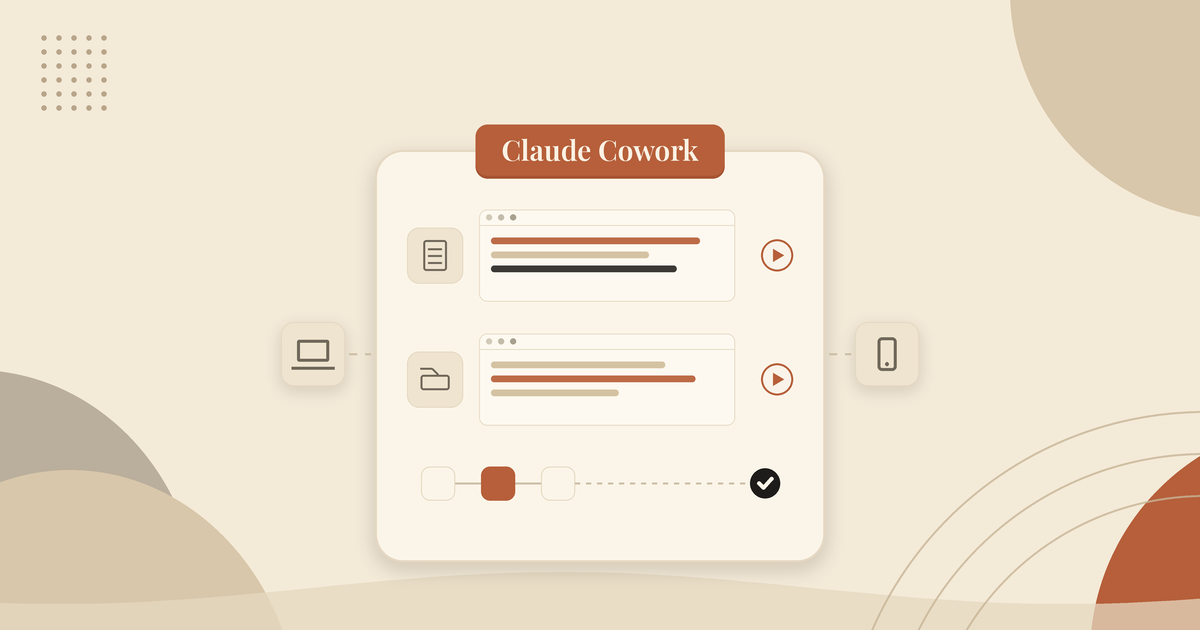
Claude Cowork is Anthropic’s AI agent for the work that fills most office days: research, reports, spreadsheets, organised files and finished documents rather than lines of code. Give it a goal, grant it access to the folders and tools it needs, and it plans the task, does the work and hands back something ready for review. It launched on desktop in January 2026, and on 7 July it reached web and mobile in beta, which means a task started at a desk now carries on in the cloud while the laptop sits shut in a bag. Two days later, OpenAI answered with ChatGPT Work. The agent race for ordinary office work has properly started, and for once the interesting product is the one that has already been in use for seven months.
Claude Cowork at a glance
| Question | Answer |
|---|---|
| What it is | An AI agent that completes multi-step tasks across your files and connected tools, built on the same architecture as Claude Code but with no terminal in sight |
| Launched | January 2026 on desktop, generally available from 9 April, web and mobile beta from 7 July 2026 |
| Who gets it | Paid Claude plans (Pro, Max, Team, Enterprise) on the desktop app; web and mobile for Pro and Max, in beta for Team, and for Enterprise where an admin enables it (checked 9 October 2026) |
| Is it free | No, there is no free-tier access |
| Models behind it | The Claude models your plan offers, chosen in the model selector; Anthropic’s help pages do not name a fixed default. See our guides to Opus 5.5 and Sonnet 5.5 |
| The July change | Sessions run on Anthropic’s servers, so work continues with your devices offline; from 6 October 2026, new Pro and Max tasks always run in the cloud |
| Main rival | ChatGPT Work, launched two days later |
If the table extends beyond the screen, scroll sideways to view all columns.
What exactly is Claude Cowork?
Anthropic describes Cowork as Claude Code for the rest of your work, and the lineage is the honest way to understand it. Claude Code earned its reputation by letting developers hand over whole programming tasks rather than asking questions one at a time. Cowork applies the same agentic approach to non-technical work. You describe an outcome in plain English, choose which folders and tools Claude can touch, and it gets on with it: reading files, running its own analysis in an isolated environment, working several strands in parallel where that helps, and delivering formatted documents, organised folders or synthesised research at the end.
The control model matters more than the party tricks. Claude shows its plan and each step as it works, waits for approval before anything significant, and cannot delete anything without your sign-off. When a task involves other software, it reaches for direct integrations first, falls back to your browser when it has to, and only takes over your screen as a last resort, because a proper connection is faster and more precise than an AI squinting at pixels.
Chat and Cowork now share one home, so switching between a conversation and a delegated task is a toggle in the message box rather than a separate product to learn.
Which plans include Claude Cowork?
Cowork is included with every paid Claude plan, from Pro upwards, through the desktop app on macOS and Windows. It started in January as a Max-only preview, demand pushed Anthropic to open it to Pro subscribers within days, and it left preview to become generally available on 9 April. There is no free-tier version, which remains one of the clearest dividing lines between Anthropic’s launch and OpenAI’s response. The web and mobile beta opened with the Max plan on 7 July. Anthropic’s help centre now describes Cowork as running in the cloud on Pro and Max, and in beta on web and mobile for Team, and for Enterprise where an admin enables it (checked 9 October 2026).
There is no separate price either. Usage draws on your plan’s allowance and scales with the size and complexity of each task, so a quick file tidy costs a fraction of a research synthesis that runs for an hour. The promotional doubling of limits that marked the July launch ended on 5 August, so the metering you see now is the normal arrangement. The models doing the work keep improving as well. Anthropic has since released Claude Opus 5.5 and Sonnet 5.5. Its help pages do not name a fixed default model for each plan, so check the model selector before you judge a result.
What changed on 7 July
The web and mobile expansion sounds like a small platform announcement and is actually a change in kind. Cowork sessions now run remotely on Anthropic’s servers, in an isolated temporary environment created for each session, rather than depending on your machine staying awake. Start a task from claude.ai or the mobile app, close the laptop, and the work carries on. Scheduled tasks run with no device online at all.
When Claude finishes or needs a decision, your phone gets a notification, and because sessions follow your account rather than your hardware, you can open the same task from any surface to check progress, answer a question or redirect the work. The desktop app remains the full experience for now. Local file access, browser control and computer use all reach your computer through it, even when the session itself runs in the cloud, and live artifacts made before 19 August 2026 and plugins that include local MCP servers still work only there.
What Anthropic’s usage data shows
The most useful thing Anthropic published alongside the expansion was not a feature list but a number. From an analysis of 1.2 million anonymised Cowork sessions across more than 600,000 organisations in May 2026, over ninety per cent of the work people delegate to the agent has nothing to do with software development. Business operations tasks lead at 33.4 per cent, content creation and copywriting come second at 16.4 per cent, and actual coding trails at 8.7 per cent.
Read that again with a marketer’s eyes. The technology was built for developers, and the moment it was packaged for everyone else, everyone else became the market. It also explains the calendar: OpenAI shipped ChatGPT Work two days after Cowork went multi-platform, built on its own coding agent in exactly the same way. The tools that spent 2025 fighting over programmers are now fighting over the rest of the office.
Claude Cowork vs ChatGPT Work
We have covered OpenAI’s launch in full, so the short version here. Both products take a brief and return finished work, both grew out of coding agents, and both meter usage by the size and complexity of what you ask. The practical differences today come down to access and maturity. ChatGPT Work arrived across web, mobile and desktop in one go, and its desktop app covers every plan including Free, which makes it the cheaper door to walk through. Cowork requires a paid plan and its web and mobile access is still in beta on Team and Enterprise plans, but the desktop product has seven months of production use behind it, along with the admin controls, usage analytics and OpenTelemetry monitoring that Team and Enterprise deployments actually need. Neither has a meaningful capability moat over the other yet. If your organisation already runs on Claude or on ChatGPT, the sensible pilot is the agent attached to the subscription you have.
Why this matters for marketing and business teams
Content creation being the second-largest use of Cowork tells you where the immediate value sits for agencies and marketing teams. The good early workloads share a shape: recurring reports assembled from the same sources every week, research synthesised from a pile of documents, files reorganised and renamed to a convention, first drafts built from briefs and source material. Work with a defined outcome and existing raw material, in other words, where the agent’s job is assembly and judgement rather than invention.
The gap between a demo and a dependable result is almost always on the customer’s side of the fence, though. An agent is only as useful as the context you can hand it, and that means documented processes, structured content, clean data and briefs that would survive contact with a new employee. We made the same argument when Fable 5 returned, and the advice has not changed with the interface: the businesses getting value from agents are the ones that prepared their information before the tools arrived.
Two cautions belong in any pilot plan. First, agents that read the open web can be fed malicious instructions hidden in pages and documents, so Anthropic’s own guidance is to scope folder access tightly, keep an eye on write actions and extend internet access only to sites you trust. Second, know where the data lives. Sessions in the cloud, and their files, are saved to each member’s Claude account; local sessions started before 6 October keep their history on the user’s computer. Anthropic says Cowork sessions are captured in the Compliance API that Enterprise admins use, and cloud sessions start from what Claude remembers from your chats unless memory is turned off for the task (checked 7 October 2026). None of that blocks a pilot. All of it belongs in the conversation with whoever signs off your data policies.
Frequently Asked Questions
What does Claude Cowork actually do?
It completes multi-step tasks on your behalf: reading and organising files, researching across the web and your connected tools, analysing data, and producing finished documents, spreadsheets and reports. You set the goal and approve significant actions; Cowork plans and does the work.
When did Claude Cowork launch?
On desktop in mid-January 2026, initially for Max subscribers and then for all paid plans, before becoming generally available on 9 April. The web and mobile beta began on 7 July 2026.
Which plans include Claude Cowork?
All paid Claude plans: Pro, Max, Team and Enterprise, through the desktop app on macOS and Windows. On web and mobile, Cowork runs on Pro and Max, and is in beta for Team, and for Enterprise where an admin enables it (checked 9 October 2026).
Is Claude Cowork free?
No. There is no free-tier access, which is a genuine difference from ChatGPT Work, whose desktop app includes a free tier. There is no separate charge either: Cowork is included in every paid Claude plan and usage draws on your plan's allowance.
Does Claude Cowork keep working when my laptop is closed?
Yes, since 7 July 2026. Sessions run in an isolated environment on Anthropic's servers, so tasks continue with your devices offline and scheduled tasks run with no device online at all. From 6 October 2026, new tasks on Pro and Max plans always run in the cloud. Anything that needs your local files or browser still requires the desktop app to be open and connected.
Can Claude Cowork run tasks on a schedule?
Yes. Since the web and mobile expansion, scheduled tasks run on Anthropic's servers with no device online, so a report can assemble itself every Monday morning while your laptop stays shut. Claude notifies you when a run finishes or needs a decision.
How is Claude Cowork different from Claude Code?
Claude Code is built for software engineering: writing, debugging and shipping code from the terminal, IDEs and the desktop app. Cowork uses the same agentic architecture for non-coding knowledge work such as research, analysis and document creation, with no terminal involved.
How is Claude Cowork different from ChatGPT Work?
They are direct rivals with the same core idea. The main differences today are access and maturity: ChatGPT Work launched everywhere at once with a free desktop tier, while Cowork is paid-only but has been in production on desktop since January, with deeper admin and monitoring controls for organisations. Our full ChatGPT Work coverage has the detail.
Is Claude Cowork safe to use with company data?
Anthropic runs sessions in isolated environments, requires approval for deletions and significant actions, and scans incoming content for hidden malicious instructions, but prompt injection remains a real risk for any agent that reads the open web. Scope folder access tightly, review write actions, and agree retention with your admin: Anthropic says Cowork sessions are captured in the Compliance API, and sessions in the cloud are saved to each member’s Claude account (checked 7 October 2026).
What are Claude Cowork's usage limits?
Usage counts against your plan's allowance and depends on the size and complexity of each task, so a long research job draws far more than a quick file tidy. A promotional doubling of limits marked the web and mobile launch and ended on 5 August 2026; standard allowances now apply, with the larger plans carrying the larger allowances.
Is Claude Cowork any good for marketing work?
Anthropic's own data says content creation and copywriting is the second-largest category of Cowork use, at 16.4 per cent of sessions. It suits assembly-and-judgement tasks with clear briefs and existing source material; it does not replace the strategy or the taste.
Is Claude Cowork worth trying?
Cowork is the most proven product in a category that barely existed a year ago, and the July expansion removed its biggest everyday annoyance, the tether to a desk. The way to find out what it is worth has not changed: pick one workflow you know the true cost of, hand it over, and measure the result against the hours it takes today. If the answer is promising, the harder and more valuable project is getting your processes and content into a state where an agent can actually use them, and that work pays off whichever tool wins.
It is exactly the kind of preparation we help businesses with, so if you want a second pair of eyes on where to start, get in touch.