



Update, 19 September 2026: Google now offers stable Gemini 3.8 Flash. This article preserves the July comparison between 3.6 and 3.5. If you are choosing a model now, start with our Gemini 3.8 Flash guide and test it against your existing workflow before switching.
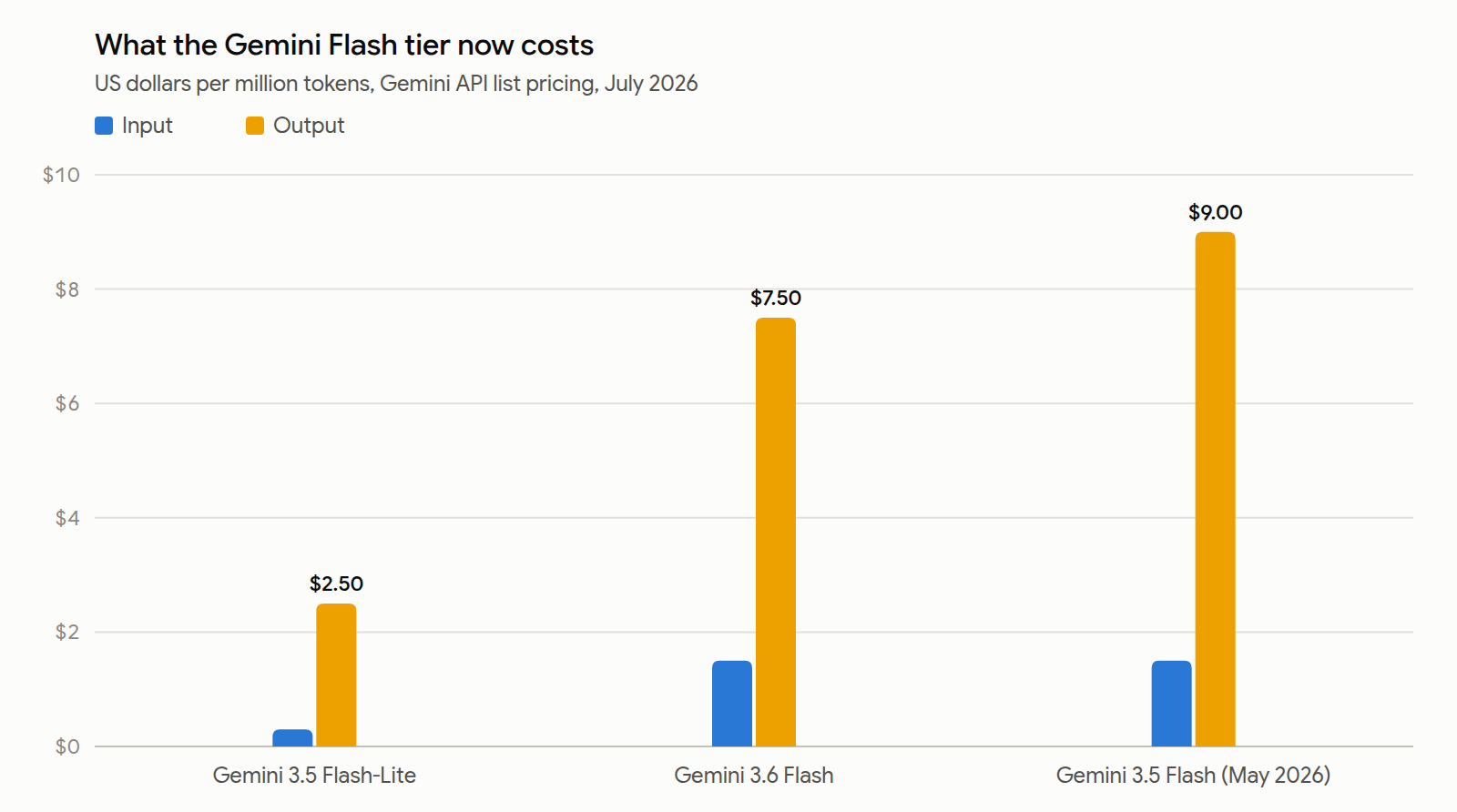
Price update, 7 October 2026: Google’s Gemini API pricing page (checked 9 October 2026) lists introductory rates for Gemini 3.6 Flash through 31 December 2026: $0.75 per million input tokens and $3.75 per million output tokens on Standard, returning to $1.50 and $7.50 from 1 January 2027. The pricing table below shows the current rates. Figure 1 and the worked monthly examples use the July 2026 list prices and are kept as a dated record of the change from 3.5 to 3.6.
Google launched Gemini 3.6 Flash on 21 July 2026, only nine weeks after 3.5 Flash and barely seven months after Gemini 3 Flash arrived in December. Three Flash generations in eight months is a pace worth noticing in itself. The headline specification has barely moved: both models in this comparison accept roughly one million input tokens, both can return up to 65,536 tokens, and both work with text, images, video, audio and PDFs.
The practical changes are easier to miss and more important to a business. Output tokens are cheaper. Google says the model completes agentic work with fewer reasoning steps and tool calls. Its selected coding, computer-use and knowledge-work benchmarks have improved. Independent testing, meanwhile, found the clearest gains in speed and efficiency rather than in the aggregate intelligence score. That makes this less a dramatic new generation than a careful attempt to remove waste from the previous one, and for a business that may be the more valuable kind of improvement.
The answer in brief: Gemini 3.6 Flash became generally available on 21 July 2026 and has since been followed by 3.7 Flash and 3.8 Flash. At launch, standard paid API pricing was $1.50 per million input tokens and $7.50 per million output tokens, against $1.50 and $9 for 3.5 Flash. Google’s pricing page (checked 7 October 2026) now lists 3.6 Flash at an introductory $0.75 and $3.75 through 31 December 2026, returning to $1.50 and $7.50 from 1 January 2027. In pre-release high-thinking tests published by Artificial Analysis on launch day, both models scored 50 on its composite Intelligence Index, while 3.6 completed the Index tasks in half the time and at lower measured cost. For a new build, include 3.8 Flash in your evaluation. Existing workflows should move only after regression testing, and Google’s current deprecation schedule should determine migration deadlines.
What is Gemini 3.6 Flash?
Gemini 3.6 Flash is a proprietary, natively multimodal model from Google. It sits between the cheapest high-volume models and the most expensive frontier models: capable enough for coding, document work and multi-step agents, but fast and economical enough to use repeatedly.
The stable API model ID is gemini-3.6-flash. It accepts text, images, video, audio and PDFs and returns text. The official model page lists Search and Maps grounding, URL context, file search, function calling, code execution, structured outputs and thinking as supported features, with Computer Use in preview. Native image generation, audio generation and the Live API are not supported by this model.
Google describes 3.6 Flash as a model for rapid agentic loops, complex coding cycles and spatial reasoning. It is generally available through the Gemini API and Google AI Studio, and Google’s launch announcement also lists the Gemini app, Android Studio, Antigravity and its enterprise products. Availability does not mean identical limits for every user: plan, region, product and usage caps still apply.
Gemini 3.6 Flash at a glance
If the table extends beyond the screen, scroll sideways to view all columns.
| Specification | Gemini 3.6 Flash | Why it matters |
|---|---|---|
| Release status | Generally available | Suitable for production evaluation, not merely a preview |
| Release date | 21 July 2026 | Very new at the time of this review |
| Stable model ID | gemini-3.6-flash | The identifier used in API requests |
| Inputs | Text, image, video, audio and PDF | One workflow can interpret several media types |
| Output | Text | Use another model for native image or audio generation |
| Maximum input | 1,048,576 tokens | Useful for substantial document sets and long working context |
| Maximum output | 65,536 tokens | Supports long reports and code output |
| Default thinking level | Medium | The same default as 3.5 Flash |
| Knowledge cut-off | March 2026 | Newer facts still need supplied sources or grounding |
| Standard paid API price | $0.75 input / $3.75 output per million tokens until 31 December 2026, then $1.50 / $7.50 (Google pricing page, checked 9 October 2026) | Output is about 58% cheaper than 3.5 Flash until the end of 2026, then 16.7% cheaper |
| Batch and Flex price | $0.375 input / $1.875 output per million tokens until 31 December 2026, then $0.75 / $3.75 | Lower-cost routes for suitable workloads |
| Built-in tools | Search, Maps, file search, URL context, code execution, function calling, Computer Use (preview) | The model can take part in workflows that act as well as answer |
Sources: Gemini 3.6 Flash model documentation, Google’s latest-model guide, Gemini Developer API pricing and the Google DeepMind model card. Prices are in US dollars and exclude tool charges, taxes and enterprise agreements.
Gemini 3.6 Flash vs Gemini 3.5 Flash
This is an iteration, not a clean-sheet model. The input formats and headline token limits are unchanged. The difference lies in the route to the answer.
Google says 3.6 reaches its results with fewer reasoning steps and tool calls, reports better instruction-following, and highlights stronger work on charts and multi-element visual layouts. These improvements matter if they survive contact with a real workflow: an unnecessary tool call costs money, and an unnecessary file edit costs review time.
If the table extends beyond the screen, scroll sideways to view all columns.
| Area | Gemini 3.5 Flash | Gemini 3.6 Flash | Practical reading |
|---|---|---|---|
| GA release | 19 May 2026 | 21 July 2026 | 3.6 is the newer stable model |
| Input context | 1,048,576 tokens | 1,048,576 tokens | No increase |
| Maximum output | 65,536 tokens | 65,536 tokens | No increase |
| Standard input price | $1.50 per million | $0.75 to 31 Dec 2026, then $1.50 | Half price until the end of 2026, then the same |
| Standard output price | $9 per million | $3.75 to 31 Dec 2026, then $7.50 | About 58% cheaper until the end of 2026, then 16.7% cheaper |
| Standard cache-read price | $0.15 per million | $0.075 to 31 Dec 2026, then $0.15 | Half price until the end of 2026 |
| Cache storage | $1.00 per million tokens per hour | $0.50 per million tokens per hour to 31 Dec 2026, then $1.00 | Retained context has a running cost |
| Default thinking | Medium | Medium | A familiar starting point, not identical behaviour |
| Knowledge cut-off | Not stated on Google’s model page | March 2026 | 3.6’s cut-off is from Google’s model card |
| Model lifecycle | No shutdown date announced | No shutdown date announced | There is no forced emergency migration |
The knowledge cut-off deserves restraint. Google’s model card gives March 2026 for 3.6 Flash, but neither model knows everything that happened after its training period. Search grounding can retrieve fresher material; it does not excuse the application from checking whether a source was read accurately or whether a newer source supersedes it.
What does Gemini 3.6 Flash cost?
At launch in July, the standard paid input price matched 3.5 Flash and output fell from $9 to $7.50 per million tokens. Google has since cut Gemini 3.6 Flash to introductory rates until 31 December 2026; the table shows each rate and the price that applies from 1 January 2027 (Google pricing page, checked 7 October 2026). Batch and Flex cost less than Standard, while Priority costs more in exchange for prioritised inference.
If the table extends beyond the screen, scroll sideways to view all columns.
| Gemini Developer API route | Input per million tokens | Output per million tokens | Typical fit |
|---|---|---|---|
| Standard | $0.75 to 31 Dec 2026, then $1.50 | $3.75 to 31 Dec 2026, then $7.50 | Interactive and ordinary production requests |
| Batch | $0.375 to 31 Dec 2026, then $0.75 | $1.875 to 31 Dec 2026, then $3.75 | Large asynchronous jobs |
| Flex | $0.375 to 31 Dec 2026, then $0.75 | $1.875 to 31 Dec 2026, then $3.75 | Flexible work where lower cost matters more than guaranteed immediacy |
| Priority | $1.35 to 31 Dec 2026, then $2.70 | $6.75 to 31 Dec 2026, then $13.50 | Workloads paying for prioritised inference |
Batch is asynchronous, with a target turnaround of 24 hours that is usually much quicker, and Flex and Priority carry their own service behaviour, so check the current documentation before committing production traffic to either. Until 31 December 2026, standard context-cache reads cost $0.075 per million tokens, Batch and Flex cache reads $0.0375 and Priority cache reads $0.135; from 1 January 2027 they return to $0.15, $0.075 and $0.27. In each case Google charges cache storage separately, at $0.50 per million tokens per hour until the end of 2026 and $1.00 from 1 January 2027, so a cache-hit figure by itself is not a complete cache budget. Search grounding has its own meter too: after a free allowance of 5,000 prompts per month shared across Gemini 3 models, Google charges $14 per 1,000 search queries, and a single model request can trigger more than one billable query.
Worth a line of history for budget owners: the Flash tier costs more than it once did. Gemini 3 Flash launched in December 2025 at $0.50 in and $3.00 out, and even Flash-Lite’s list price rose from $0.25 and $1.50 to $0.30 and $2.50 across the same period. Google’s cheap tier is cheap relative to its stablemates, not relative to its own past.
Worked monthly examples
If the table extends beyond the screen, scroll sideways to view all columns.
| Illustrative workload | 3.5 Flash | 3.6 Flash | Saving at identical token use |
|---|---|---|---|
| 10m input + 2m output tokens | $33 | $30 | $3 (9.1%) |
| 100m input + 20m output tokens | $330 | $300 | $30 (9.1%) |
| 20m input + 20m output tokens | $210 | $180 | $30 (14.3%) |
These examples use the July 2026 standard list prices, before Google’s introductory cut, assume no caching and exclude grounding, taxes and platform charges. They also assume identical token use. Google reports 17% lower output-token use on the Artificial Analysis Index and up to 65% lower use on its DeepSWE comparison. Those are measured results on particular evaluations, not a promise that every production job will use 17% fewer tokens.
The right unit is the accepted result. Add retries, tool calls, cache storage, grounding, latency, human correction and failed tasks to the model invoice. A cheaper output that takes longer to repair can still be the expensive option.
Artificial Analysis offers a useful outside view. In its launch-day high-thinking tests, the weighted cost per Intelligence Index task fell from $0.59 for 3.5 to $0.50 for 3.6, and running its full evaluation suite cost $1,040.88 on 3.5 against $726.70 on 3.6. Those figures show a genuine change in test economics. They do not tell a marketing team what a campaign report or content workflow will cost.
Google’s benchmarks and the independent evidence
Launch benchmarks answer a narrow question: how did the models perform in the publisher’s chosen test set-up, with its chosen settings? They can be useful without being the final word.
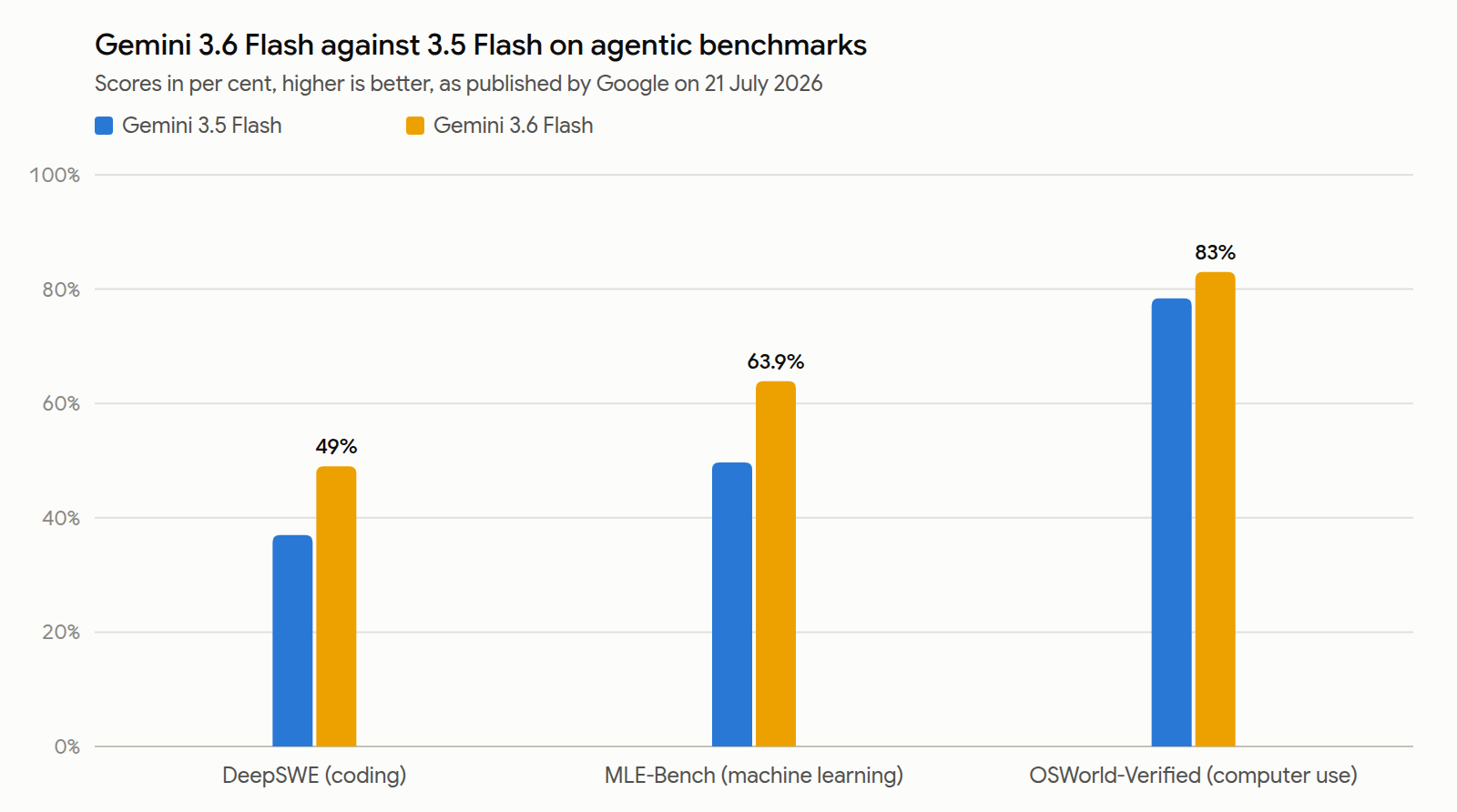
In the four comparisons highlighted in Google’s launch post, 3.6 scored higher:
If the table extends beyond the screen, scroll sideways to view all columns.
| Evaluation | Gemini 3.5 Flash | Gemini 3.6 Flash | What it covers |
|---|---|---|---|
| DeepSWE | 37% | 49% | Long-horizon software engineering |
| MLE-Bench | 49.7% | 63.9% | Machine-learning engineering and research |
| OSWorld-Verified | 78.4% | 83.0% | Computer-use tasks in desktop environments |
| GDPval-AA v2 | 1,349 Elo | 1,421 Elo | Real-world knowledge work |
These are Google-reported launch comparisons, not AIWIZ laboratory results. Scores depend on prompts, test rigs, tool access and reasoning settings. See the launch announcement and DeepMind’s model card and evaluation tables.
What Artificial Analysis found
Artificial Analysis tested the high-thinking variants ahead of release, publishing on launch day. Its aggregate Intelligence Index score was 50 for both models. That tie does not establish equal capability on every task; it says the gains and losses across that particular composite produced the same rounded total.
The efficiency differences were clearer:
If the table extends beyond the screen, scroll sideways to view all columns.
| Artificial Analysis launch snapshot | 3.5 Flash (high) | 3.6 Flash (high) |
|---|---|---|
| Intelligence Index | 50 | 50 |
| Average time per Index task | 2.7 minutes | 1.3 minutes |
| Output speed | 159 tokens/ |
304 tokens/ |
| Weighted cost per Index task | $0.59 | $0.50 |
| Output tokens across the Index | 75m | 59m |
| Humanity’s Last Exam | 41% | 38% |
This is a dated pre-release snapshot, not a service-level guarantee. The 304 figure comes from Artificial Analysis’s pre-launch testing; on both 23 and 24 July its live model page showed no current speed measurement for 3.6 Flash at all, while the 3.5 Flash page carried 159 tokens per second as its present first-party API figure. Treat throughput numbers as provisional until live medians settle. The HLE regression also matters: a composite score can stay level while one type of deep reasoning gets worse and coding or knowledge work improves.
Wider press comparisons deserve their own label. Gizmodo’s launch coverage argued that 3.6 Flash appears to sit behind Anthropic’s Claude Sonnet 5 and OpenAI’s GPT-5.6 on most major benchmarks; that is a press assessment of vendor-published figures rather than a like-for-like test, and Flash models are not priced to win leaderboards in any case. The honest reading is that 3.6 appears to deliver similar aggregate independent performance more economically, while Google’s selected tests show capability gains in the jobs it has prioritised. Your own evaluation must settle the rest.
What else shipped alongside it?
Three related announcements matter for planning. Gemini 3.5 Flash-Lite arrived the same day at $0.30 input and $2.50 output per million tokens, and Google says it is rolling into Google Search, which makes it one of the models reading and summarising web content inside AI-powered results. Gemini 3.5 Flash Cyber, a security-focused variant built on 3.5 Flash, remains in a limited pilot for governments and trusted partners. And Gemini 3.5 Pro, promised for June when the 3.5 family launched, was still in partner testing at the time of writing, while Google says pre-training for Gemini 4 has begun. The Flash tier is carrying the roadmap while the larger models finish.
Where the newer model makes business sense
The strongest use cases sit between a cheap classifier and a costly frontier model: complicated enough to need reasoning and tools, frequent enough for efficiency to matter.
Document and report analysis
A 1,048,576-token input limit can accommodate substantial document sets, depending on file size, extraction quality and tokenisation. File search, code execution and improved chart reasoning make 3.6 a plausible first-pass engine for evidence extraction, report comparison and management summaries. The model should not become the source of record. Keep the original files, require source references in the output and validate important figures before they enter a board paper, client report or public article.
Marketing analysis and content operations
There is a sensible role between the dashboard and the strategist. A controlled workflow can combine campaign exports, search-query reports, creative results and landing-page data, then draft a weekly narrative or flag patterns for review. Structured outputs make the result easier to validate before another system acts on it. Do not give the model an undefined mandate: spending changes, regulated claims, publication and customer-data decisions need explicit controls and named owners.
Coding and website maintenance
Google has concentrated much of the update on code and agentic execution. Fewer unwanted edits and shorter debugging loops would be valuable in a real repository, where a technically valid change can still damage an unrelated page. There is a useful caveat in Google’s latest-model guidance: human evaluators preferred earlier models for some visual layout and styling tasks. Functional code and good art direction are not the same skill. Give the model a design system, reference screens and acceptance criteria, then test the result.
Customer-service assistance
Long context, file search and grounding suit an assistant that finds the relevant policy and prepares a response for an adviser. Latency still needs testing in the actual channel: a fast output rate is little comfort if a customer waits through a long reasoning pause before the first useful sentence. Access control matters just as much. The assistant should retrieve only the records needed for the current case, with a clear route to a person when confidence is low or the consequence is high.
Multi-step agents
This is the job Google has designed around: a workflow that plans, calls tools, checks the result and continues. Competitor monitoring, catalogue quality checks, code maintenance and research packs are plausible examples. The unglamorous parts make the agent usable: permissions, logs, step and cost limits, schema validation, source checks and human approval for material actions.
If the table extends beyond the screen, scroll sideways to view all columns.
| Workload | Fit | Main reason | Main caveat |
|---|---|---|---|
| Multi-step research agent | Strong | Long context, grounding and improved tool use | Verify sources and recent facts |
| Document and chart analysis | Strong | Multimodal input and stronger spatial reasoning | Test complex layouts and extraction quality |
| Coding and migrations | Strong | Better instruction-following and fewer reported edit loops | Run tests and review every diff |
| High-volume extraction | Mixed | Capable, but possibly more model than the job needs | Compare with 3.5 Flash-Lite |
| Live customer chat | Mixed | Fast generation once output begins | Measure time to first useful answer |
| Brand-led visual design | Mixed | Can produce functional interfaces | Supply clear art direction |
| Native image or audio generation | Poor | These output modes are unsupported | Use a suitable image, audio or Live model |
| Unsupervised high-stakes decisions | Poor | Hallucinations remain possible | Require qualified human judgement |
When should a business keep Gemini 3.5 Flash?
Keep it temporarily when a production integration is stable and the cost of behavioural change is higher than the likely saving. Prompts, parsers, safety rules and tool contracts can depend on habits that never appear on a model card.
Deep-reasoning workloads deserve particular attention, because the independent Humanity’s Last Exam result moved backwards in the launch snapshot. That is not proof that your task will regress. It is a reason to include difficult, multi-step cases in the test set instead of relying on an average.
At the original July check, there was no announced deadline. Google’s deprecation schedule listed gemini-3.5-flash with no shutdown date announced when checked on 24 July 2026, and gemini-3.6-flash did not appear on the schedule. Google’s deprecations page now lists gemini-3.6-flash with no shutdown date announced (checked 9 October 2026). That is a dated observation, not a promise of continued support. Before starting or migrating a project, check current availability and compare 3.8 Flash with the model you already use. The July price comparison below remains useful for understanding the change from 3.5 to 3.6.
A practical migration checklist
Changing the model ID is the easy line. The surrounding behaviour is the work.
- Build a fixed evaluation set from real, permission-cleared production tasks.
- Run both models at equivalent thinking levels and through the same tools.
- Record task success, latency, token use, tool calls, retries and human correction time.
- Inspect failure types, not only averages.
- Validate every structured output and external tool result.
- Review permission boundaries, logs, safety behaviour and cost caps.
- Route a small share of live traffic to 3.6 while keeping a rollback path.
- Increase traffic only when the accepted-result rate and end-to-end cost are better.
Developers also need to check the API changes in Google’s migration guidance. temperature, top_p and top_k are deprecated and ignored for 3.6 Flash, and future model generations will return an error when they are supplied, so remove them from requests. Replace thinking_budget with the thinking_level setting, which takes medium or high on this model, and remove candidate_count, which is unsupported across Gemini 3.x. Prefilled model turns now return an error; an application that used prefilling to force a format should move to system instructions or structured outputs. Google recommends the generally available Interactions API for access to the latest features and models.
For marketing systems, add brand and compliance tests. Does the output preserve mandatory wording? Does it invent a performance claim? Does a table summary alter the source figure? Those are the small failures that become public.
Limits, privacy and controls
The DeepMind model card explicitly notes hallucinations, occasional slowness and timeouts. The March 2026 knowledge cut-off is another ordinary constraint. Search grounding can improve freshness, but a grounded answer can still omit context or overstate what a source supports.
Five controls cover most serious deployments. Source control: supply approved material or grounding routes, preserve citations and check each consequential claim. Action control: give an agent the minimum permissions needed for the job; reading a report and changing a campaign budget are different risk classes. Cost control: cap steps, tool calls, tokens and retries, and alert when a workflow loops. Quality control: validate schemas automatically and keep qualified people in the review chain. Data control: decide what may be sent to the service, under which terms, with what retention and regional requirements.
Google’s pricing page says free-tier content may be used to improve its products, while paid-tier content is not. That table row is not a complete privacy assessment. Organisations handling confidential, personal or regulated data should review the applicable API or enterprise terms and configure the workflow around their obligations.
What does this change for SEO and AEO?
The model matters to search marketing in two ways. It can be used as a production tool for research, clustering, reporting and content operations. It also illustrates the wider shift towards answer-led interfaces and agents that retrieve information from websites on a user’s behalf.
It does not create a secret ranking recipe. Google’s guide to optimising for generative AI features, published in May 2026, says ordinary SEO still underpins visibility. Pages need to be indexed and eligible for snippets, and a site must be included in Search generative AI features in Search Console. There is no special AI schema, no required llms.txt file and no reason to split useful prose into tiny AI-sized chunks; Google states plainly that Search does not use such files.
Structured data still earns its keep
Not required is not the same as not useful. Structured data remains one of the clearest ways to tell every machine, not only Google, who published a page, who wrote it, when it was last reviewed and what entity stands behind the site, and other search and answer systems read it too. The value now lies less in individual snippets than in the connected graph: Organization, WebSite, WebPage, BlogPosting, Person and image nodes linked together by ID references, so that a crawler can assemble one coherent picture of the site instead of a drawer of loose facts. This is what some SEO tools describe as schema aggregation, and the good news for WordPress publishers is that Yoast and Rank Math already build the graph automatically. The real work is feeding it properly: a correct organisation profile with logo and sameAs links to your public profiles, genuine author entities rather than “admin”, honest published and modified dates, and markup that always matches the visible page. Spend nothing on retired display types; FAQ rich results ended in May 2026, so FAQPage markup earns no Google feature, even though the questions and answers themselves remain exactly what answer engines like to quote.
Where llms.txt fits
llms.txt is a community proposal: a markdown index at the root of a site that points machines at your most important pages. Google’s AI optimisation guide says you don’t need AI text files or special markup to appear in Search, and that Search doesn’t use them. No major assistant had documented reading llms.txt for answers at the time of writing, so it has no place in an AEO plan. Spend the time on clear, current pages instead.
What verifiably does govern AI visibility today is crawler access, and the user agents are not interchangeable. For ChatGPT, OAI-SearchBot governs appearance in search answers while GPTBot concerns model training, and OpenAI notes that a site opted out of OAI-SearchBot can still surface as a bare navigational link. Anthropic separates ClaudeBot, its training crawler, from Claude-SearchBot and Claude-User, which handle search quality and user-requested visits. Perplexity draws the same line, with one wrinkle worth knowing: PerplexityBot respects robots.txt, but Perplexity-User generally ignores it because a human asked for the page. And Google-Extended controls certain Gemini training and grounding uses without affecting inclusion or ranking in Google Search, which follow ordinary indexing and snippet controls. Review robots.txt and firewall rules service by service rather than blocking by reflex; each door you close removes a place you can be cited.
The same principles on custom-built sites
Not every site has a plugin to lean on, and the principles port directly to custom builds. The first check on a React or otherwise JavaScript-heavy front end is rendering: Google executes JavaScript when it indexes, but assistant crawlers have been consistently observed reading only the raw HTML response, so content that exists solely after client-side rendering is invisible to the very systems this section is about. Server-side rendering or static generation through a framework such as Next.js closes that gap, and Google’s own guide points the same way when it asks for important facts to be visible in HTML rather than only in scripts or images. Structured data follows the same rule: emit the JSON-LD graph server-side, whether through Google’s schema-dts types in a TypeScript build, a package such as Spatie’s schema-org for Laravel, or hand-authored templates in plain PHP, and keep the organisation and author nodes identical on every page so the graph stays coherent. And treat heading discipline as a template concern, not an author’s memory test: one H1 per page, sections at H2, questions at H3, whatever the framework renders.
The work is familiar, but the standard is higher. Answer the main question early, then earn the detail. Publish evidence or a useful judgement rather than another launch summary. Keep prices, specifications and lifecycle information current, and make important facts visible in HTML rather than only in an image. Use descriptive links to primary sources, add tables where readers genuinely compare the same fields, name the editorial team, show review dates, connect the subject to the wider site with internal links, and keep structured data in agreement with the visible page.
Google’s guide also describes query fan-out, where the system may run related searches across subtopics before composing an answer. That supports one thorough page covering status, price, limits, uses and migration. It does not justify a thin page for every rearrangement of the keyword. Google now points site owners to the Generative AI performance report in Search Console rather than to third-party claims about secret AI metrics.
For the wider strategy, read AIWIZ’s analysis of how AI is changing Search, SEO and advertising.
Using generative AI in the writing process is not itself an SEO violation. Google’s concern is scaled, unoriginal content created to manipulate search. The safer test is plain: does the page contain accurate, useful work that a reader would choose over the launch post it summarises?
The verdict
Gemini 3.6 Flash looks like a worthwhile efficiency update. The output price is lower, Google reports fewer tokens and tool calls, and both the vendor benchmarks and the independent launch snapshot point towards a cheaper route through demanding work.
It is not a reason to change production traffic on trust. Gemini 3.6 Flash launched on 21 July 2026, its pre-release throughput figures are not yet reflected on live measurement pages, and a single aggregate score cannot describe every workload. Test the jobs that consume staff time now, include the awkward failures, and compare cost per accepted result.
For a new agentic, coding or multimodal build, 3.6 is the first Flash model to evaluate. For an existing 3.5 integration, run both in parallel and migrate when the evidence from your own tasks is better. There is no announced shutdown forcing the schedule.
The search lesson is similar. As agents become better at reading, comparing and acting on web content, brands benefit from being easy to retrieve and safe to cite. Clear answers, named editorial responsibility, current facts and sound technical SEO have not become old-fashioned. They have become the admission price.
AIWIZ helps organisations plan practical AI workflows and improve visibility across search and answer engines. To discuss an automation opportunity or an AI-search visibility review, contact the AIWIZ Digital Marketing team.