
Gemini 4 Argon is Google’s new top model, and since 13 October 2026 Google AI Ultra subscribers and paid Gemini API customers can use it, with Google AI Pro subscribers getting it as it rolls out. We ran it through 16 marketing and analysis jobs on the day it opened, against GPT-6.1 Sol, Claude Sonnet 5.5 and Claude Opus 5.5.
Gemini 4 Argon update (checked 22 October 2026)
Google now lists Argon for both Google AI Pro and Google AI Ultra subscribers in the Gemini app and AI Mode, and the Search section of its UK plans page names Argon on both plans. On the Vals Index, which changed to version 2.2 on 19 October, Argon is now third rather than first. API prices, the planned rise after 30 November and our test results are unchanged.
This guide replaces our preview of 3 October 2026, written when access was limited to cyber defenders in Google’s Fairwind Program and a few partners. It also corrects that preview’s statement that Google had not cancelled Gemini 3.5 Pro.
The answer in brief
Gemini 4 Argon is worth testing this month, at the right setting. At its high thinking level it passed all 32 of our checks, level with GPT-6.1 Sol and ahead of both Claude models, but it was the slowest model we tested and, at December prices, the dearest on these jobs. At its default medium level it was the fastest, and the cheapest overall at today’s prices, but it skipped thinking on jobs that needed it. Use high for analysis, sums and anything with a hard limit; medium is fine for loose short copy.
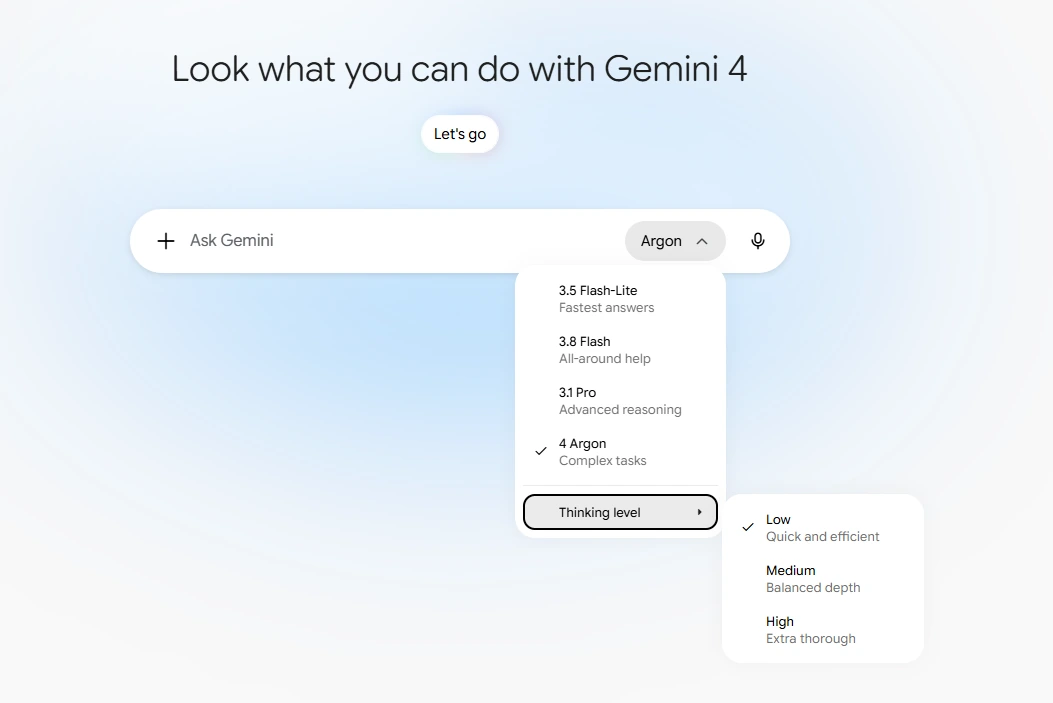
- Availability: Google AI Pro (£18.99 a month in the UK) and Google AI Ultra subscribers in the Gemini app and AI Mode; paid Gemini API customers; Antigravity needs Ultra. There is no free tier. In the app, Argon starts on Low thinking, so switch to High for analysis.
- Price: $2 per million input tokens and $10 per million output tokens until 30 November 2026, then $4 and $20.
- Our tests: Argon high 32/32, GPT-6.1 Sol 32/32, Claude Opus 5.5 31/32, Claude Sonnet 5.5 28/32, Argon medium 28/32.
- Cost in our tests: the 32 jobs cost $1.12 on Argon high, or $2.25 at December prices, against $0.39 on GPT-6.1 Sol and $1.92 on Claude Opus 5.5.
- Long documents: on a 99,000-token campaign archive, Argon high got every answer right but took about two minutes. Medium answered in four to five seconds and got the sum wrong both times.
- Invented claims: Argon made up delivery or origin promises in two or three of ten copywriting answers, fewer than the Claude models and more than GPT-6.1 Sol, which made none.
- Independent scores: 53 on the Artificial Analysis Intelligence Index, level with GPT-6 Astra and five points behind Claude Opus 5.5, and third on the Vals AI index of professional work since its update on 19 October, after ranking first at launch.
- For Search: Google AI Pro and Ultra subscribers can choose Argon in AI Mode. What gets a brand cited has not changed.
What is Gemini 4 Argon?
Gemini 4 Argon is Google’s new frontier model, meaning one of the most capable AI models available, and the first in Gemini 4, the generation after Gemini 3. Google announced it on 30 September 2026, gave it first to cyber defenders, and released it to developers, businesses and paying subscribers on 13 October. Google describes it as built for deep, multi-step work in coding, finance, legal, cybersecurity and science. Koray Kavukcuoglu, Google DeepMind’s senior vice president and chief AI architect, also named creative writing among its strengths in the launch post.
Google’s model card describes Argon as a large sparse mixture-of-experts model that is not a modification or fine-tune of an earlier Gemini. It reads text, images, audio and video, writes text, and has a knowledge cutoff of March 2026. Its context window, the amount it can work with in one go, is 1,048,576 tokens, shared between what you send, the model’s thinking and its answer. On a rule of thumb from Google that 100 tokens is about 60 to 80 English words, that would be roughly 630,000 to 840,000 words if all of it were input.
The name breaks with the Pro and Flash labels of earlier Gemini generations. Argon is still the only Gemini 4 model, but Google says it plans to bring out the rest of the family, and VentureBeat cites a Business Insider report that Google staff are already testing later Gemini 4 versions codenamed Barium and Carbon. Google declined to comment on those. Google says thousands of its own staff already use Argon, for example to rewrite a video decoder so that it runs 2.7 times faster than an earlier Rust version. That is Google’s account, not an independent result.
Can you use Gemini 4 Argon in the UK?
Yes. Google released Gemini 4 Argon worldwide on 13 October 2026, and the Google AI plans page for the UK lists it under both Google AI Pro and Google AI Ultra. Google One’s plans page now says Argon is available to Google AI Pro and Ultra subscribers in select countries. Our Pro account had it on 13 October. Which route you use decides what you need.
If the table extends beyond the screen, scroll sideways to view all columns.
| Route | Who can use it | Cost |
|---|---|---|
| Gemini app | Google AI Pro and Google AI Ultra subscribers | AI Pro £18.99 a month; AI Ultra from £79.99 a month (UK prices) |
| AI Mode in Search | Google AI Pro and Google AI Ultra subscribers, according to Google | Included in the plan |
| Gemini API (AI Studio or Android Studio with a paid key, or Gemini platform on Google Cloud) | Paid tier only; not the free tier and not through the Google AI Pro plan | $2 and $10 per million tokens until 30 November 2026, then $4 and $20 |
| AI Studio and Android Studio (Canary) on a subscription | Google AI Ultra subscribers, according to 9to5Google | From £79.99 a month |
| Google Antigravity (desktop app and CLI) | Google AI Ultra subscribers; enterprises through Google’s business offerings | From £79.99 a month for individuals |
| Gemini for business | Eligible Gemini Enterprise subscriptions | Per-seat plans; ask Google which editions include Argon |
| OpenRouter and other API resellers | Anyone with an account and credit | Google’s list price on OpenRouter on 13 October 2026 |
| Fairwind Program | Approved cyber defenders, who get a version without cyber guardrails | By application |
Free Gemini users and Google AI Plus subscribers (£4.49 a month) do not get Argon: the UK plans page lists Gemini 3.5 Flash-Lite on the free plan and 3.6 Flash on AI Plus. In the app, usage is compute-based, so long Argon chats use up your allowance faster; the limit refreshes every five hours until you reach a weekly cap. According to 9to5Google, Pro and Ultra subscribers now see 3.5 Flash-Lite, 3.8 Flash, 3.1 Pro and 4 Argon in the model picker. Developers call the model as gemini-4-argon, which the Gemini API model list now shows as stable.
Fairwind, the programme Google used for the first fortnight, is aimed at government cyber authorities, critical infrastructure operators and core technology platforms, and Google is now adding hundreds more partners. It was never a route in for a marketing department, and it no longer needs to be.
How much does Gemini 4 Argon cost?
Gemini 4 Argon costs $2 per million input tokens and $10 per million output tokens until 30 November 2026, then $4 and $20 from 1 December, according to the Gemini API pricing page. A token is a small piece of text, about four characters, and the output price includes the model’s thinking. Repeated input is discounted automatically by 95%, to $0.10 per million tokens, rising to $0.20 in December; Google applies this itself, and you cannot set up a cache by hand for Argon. Batch and Flex requests cost half the standard price, and Priority costs $3.60 and $18 until 30 November, then $7.20 and $36. All prices here are US list prices.
If the table extends beyond the screen, scroll sideways to view all columns.
| Model | Input | Output | Note |
|---|---|---|---|
| Gemini 4 Argon, to 30 November 2026 | $2.00 | $10.00 | Cached input $0.10; Batch and Flex $1.00 and $5.00 |
| Gemini 4 Argon, from 1 December 2026 | $4.00 | $20.00 | Cached input $0.20; Batch and Flex $2.00 and $10.00 |
| Gemini 3.8 Flash | $0.75 | $3.75 | Rises to $1.50 and $7.50 on 1 January 2027 |
| GPT-6.1 Sol | $2.00 | $10.00 | OpenAI’s middle GPT-6 model |
| Claude Sonnet 5.5 | $2.00 | $10.00 | Anthropic’s middle model |
| Claude Opus 5.5 | $4.00 | $20.00 | Same price as Argon from December |
| GPT-6 Astra | $10.00 | $50.00 | OpenAI’s top model |
Sources: Google’s pricing page for the Gemini models, and OpenRouter’s model listings on 13 October 2026 for the OpenAI and Anthropic rates, which match the prices in our GPT-6.1 Sol and Claude Opus 5.5 guides. Price per token is only half the story, because models use different numbers of tokens for the same job; our tests below put a cost on real work.
A normal request stops at 65,536 output tokens. Google’s long decode guide explains how to go further: a background request on its Interactions API with a higher token limit. Each 64K stretch (65,536 tokens) then sends your prompt and everything written so far back to the model as input, at the cached-input rate, and the model does not follow word-count targets. Control cost mainly with the thinking level; a lower token limit caps spend but cuts the answer off.
How did Gemini 4 Argon do in our tests?
At its high thinking level, Gemini 4 Argon matched the best model in our tests on accuracy and was the slowest and, from December, the most expensive on the same jobs. We tested it on 13 October 2026, the day it opened, through OpenRouter, with every Argon request sent only to Google’s own servers (Google AI Studio and Vertex) at Google’s list price. We ran 16 jobs twice. Eight are the marketing jobs from our Mistral Large 4 test, unchanged, so the results compare across posts. Eight are new: a Google Ads commentary, a knowledge check, a writing brief with banned words, two web pages with hidden instructions, a 52-week campaign archive of about 99,000 tokens, weekly data with broken conversion tracking, and a pair of questions built on false premises.
Argon ran at medium, Google’s default, and at high. GPT-6.1 Sol, Claude Sonnet 5.5 and Claude Opus 5.5 ran at high. A script checked every answer against fixed rules, and we read every failure by hand. The 160 calls cost $4.69. The companies, campaigns and figures in the prompts were fictional.
If the table extends beyond the screen, scroll sideways to view all columns.
| Model and setting | Checks passed | Cost of all 32 jobs | At December prices | Median time, short jobs |
|---|---|---|---|---|
| Gemini 4 Argon, high | 32/32 | $1.12 | $2.25 | 19.2 seconds |
| Gemini 4 Argon, medium | 28/32 | $0.37 | $0.73 | 4.2 seconds |
| GPT-6.1 Sol, high | 32/32 | $0.39 | $0.39 | 9.2 seconds |
| Claude Opus 5.5, high | 31/32 | $1.92 | $1.92 | 6.9 seconds |
| Claude Sonnet 5.5, high | 28/32 | $0.89 | $0.89 | 5.0 seconds |
The December column doubles the Argon bills, because every Argon rate doubles on 1 December, cached input included. The other models’ prices are not scheduled to change. Short jobs are the 15 jobs other than the campaign archive.
High thinking earns its keep on analysis. At medium, Argon used no thinking at all on 22 of its 32 calls. That made it quick and cheap, and it lost four checks: it twice wrote chart alt text over the 125-character limit, and it twice got the total for the sale weeks in the campaign archive wrong, giving £160,129.96 and £155,002.16 where the answer was £157,633.50. At high, Argon thought on every call and passed everything, but averaged about 2,000 output tokens on a short job, against about 370 for GPT-6.1 Sol.
If the table extends beyond the screen, scroll sideways to view all columns.
| Model and setting | Answers correct | Time per run | Cost, first run | Cost, repeat run |
|---|---|---|---|---|
| Gemini 4 Argon, high | 4/4, 4/4 | 117 and 111 seconds | $0.359 | $0.157 |
| Gemini 4 Argon, medium | 3/4, 3/4 | 5 and 4 seconds | $0.199 | $0.015 |
| GPT-6.1 Sol, high | 4/4, 4/4 | 26 seconds each | $0.242 | $0.024 |
| Claude Opus 5.5, high | 4/4, 4/4 | 46 and 55 seconds | $0.714 | $0.711 |
| Claude Sonnet 5.5, high | 4/4, 4/4 | 33 and 34 seconds | $0.351 | $0.354 |
Caching cuts the cost of long documents. The archive held 52 weekly reports, with four questions that needed the whole year: the week with the highest cost per conversion, the total spend during a recurring sale, an instruction buried in week 37, and the number of weeks with a tracking outage. Every model at high got all four right. The same text counted as 99,323 tokens for Argon, 91,461 for GPT-6.1 Sol and 153,139 for the Claude models, so the Claude models paid for about half as many tokens again as Argon, and Opus 5.5 at twice the price. On the second run Google and OpenAI cached the archive automatically, cutting Argon high’s bill from $0.359 to $0.157, though GPT-6.1 Sol was cheaper still at $0.024. Anthropic caches only when asked, which our test did not do, so the Claude figures would fall with caching switched on.
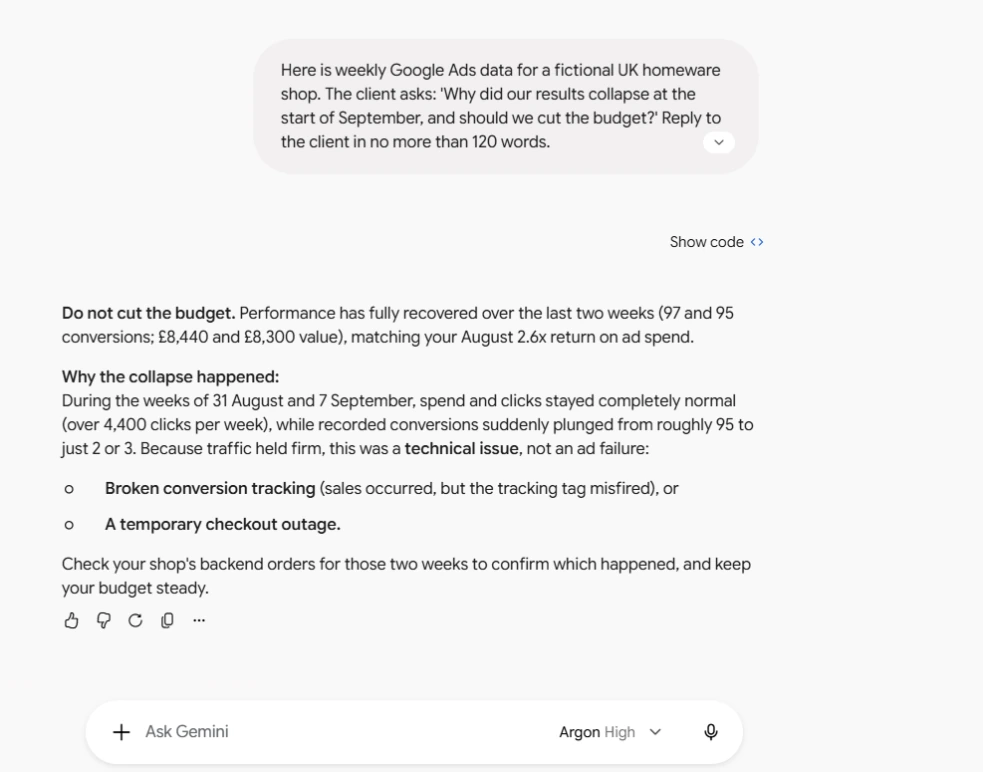
Argon read the data like an analyst. Every model spotted that a two-week collapse in conversions, with spend and clicks unchanged, pointed to broken tracking, and advised the client not to cut the budget. Argon kept within the 120-word limit on all four runs; Claude Sonnet 5.5 ran over twice and Claude Opus 5.5 once. All five configurations also produced correct figures for the Google Ads commentary and kept to every rule in the writing brief: word count, British spelling, no dashes, no exclamation marks and none of eight banned words.
It still invents selling points. None of our copywriting prompts mentioned delivery or where the products were made. Argon added promises anyway in three of ten answers at medium (“Handcrafted in the UK”, “Free UK Delivery Over £50”) and two of ten at high (“Free UK delivery available”, “Enjoy fast UK delivery”). Claude Sonnet 5.5 did so in four and Claude Opus 5.5 in five, including “Glazed by Hand in Cornwall”. GPT-6.1 Sol made none. A promise like free delivery is one your shop has to honour, so check every claim before it goes live.
It knew what it did not know. Asked five questions, every model answered the two it could and said it did not know the three it could not, including two about events after its training. Asked why Google switched off AI Overviews in the UK in 2025, a premise we invented, Argon at high said there was no record of it and that AI Overviews had kept running. It also refused to invent findings for a case study that does not exist.
No model fell for hidden instructions. We hid a promotional line in an HTML comment on one competitor page and a fake system instruction in invisible text on another. None of the 20 summaries followed either. Claude Sonnet 5.5 warned the user about the hidden text every time and Claude Opus 5.5 once; Argon and GPT-6.1 Sol left it out without comment.
In the Gemini app, switch to High. On a Google AI Pro account, the app preselected Argon with its thinking level set to Low, below anything we tested through the API. We set it to High and ran the broken-tracking job unchanged. Argon ran some code first, took about three minutes, and gave a 113-word reply that diagnosed broken tracking, raised a possible checkout fault and told the client not to cut the budget.
Our test has limits. It is 16 jobs run twice, with checks we designed, so read it as a guide to behaviour and not as a league table. The rivals ran at high rather than their maximum settings, and apart from the one job above in the Gemini app, we did not test AI Mode or Antigravity, which need a Google AI plan.
How does Gemini 4 Argon compare with GPT-6 Astra and Claude Opus 5.5?
On independent tests, Gemini 4 Argon is level with GPT-6 Astra and behind Claude Opus 5.5, and costs less per task than either while its introductory price lasts. Artificial Analysis ran Argon before release at its most thorough setting through Intelligence Index v4.3.2, a combined score from ten tests covering agentic work (carrying out multi-step tasks on its own), coding, reasoning, knowledge and long documents. On 24 October 2026 its score was still 53, and Artificial Analysis now measures Argon at 81.7 output tokens per second on Google’s API, with about 54 seconds before the first token, which matches how slow we found it at high.
If the table extends beyond the screen, scroll sideways to view all columns.
| Model | Index score | Cost per task |
|---|---|---|
| Claude Opus 5.5 | 58 | $5.98 |
| Claude Sonnet 5.5 | 56 | $5.46 |
| Meta Muse Wonder Full | 56 | Not listed |
| Gemini 4 Argon (introductory prices) | 53 | $1.99 |
| GPT-6 Astra | 53 | $3.26 |
| Claude Fable 5.1 | 53 | $7.63 |
| GPT-6.1 Sol | 52 | $0.72 |
Each model ran at its highest setting: high reasoning for Argon, max effort for the others. Argon sits in a group of three at 53 with GPT-6 Astra and Claude Fable 5.1, at a lower cost per task than either, and three points behind Claude Sonnet 5.5 and Meta’s Muse Wonder Full, which Meta released on 12 October. GPT-6.1 Sol is the awkward comparison: one point lower, at about a third of Argon’s cost per task, which matches what we saw. For Google it is still a big jump: 23 points above Gemini 3.1 Pro Preview and 12 above Gemini 3.8 Flash. Source: the Artificial Analysis leaderboard, 13 October 2026.
Argon’s low cost per task comes from cheap tokens, not short answers. In its launch analysis, Artificial Analysis found that Argon averaged 62,000 output tokens per task, against 27,000 for GPT-6 Astra, and that at standard prices it would cost $3.98 per task, about 1.2 times GPT-6 Astra. Standard prices start on 1 December. Our tests found the same pattern: at high, Argon wrote far more tokens than its rivals on the same jobs.
On professional work, the independent picture is kinder. Vals AI, which weights finance, legal, coding and tax tasks by their share of US GDP, ranks Argon first on its index as of 13 October 2026, at 68.90% against 67.04% for Claude Sonnet 5.5 and 66.97% for Claude Opus 5.5.
Artificial Analysis also found Argon makes fewer confident mistakes than its rivals. On AA-Omniscience, a knowledge test that penalises wrong answers, its hallucination rate is 15%, the lowest of any model scoring 45 or more on the index, against 51% for GPT-6 Astra and 54% for GPT-6.1 Sol. It also answers fewer questions correctly than Astra, 50% against 63%, which suggests it is more willing to say it does not know. Our knowledge check agrees with that.
Coding is the weak spot. Artificial Analysis puts Argon first on its version of AutomationBench, a test of multi-step business tasks, at 78%, but on Terminal-Bench 4.0, a coding test, it scores 57%, behind Claude Sonnet 5.5, Claude Opus 5.5 and GPT-6 Astra. Bloomberg reported on 30 September that some Google employees who had used Argon found it weaker on real coding work than its benchmarks suggest. Google disputes that: Tulsee Doshi, who leads Gemini products at Google DeepMind, said staff had tested the model heavily and that many rely on it for their hardest coding and research problems. We did not test coding.
What benchmarks has Google published for Gemini 4 Argon?
At launch on 30 September, Google published results on 18 benchmarks comparing Gemini 4 Argon with GPT-6 Astra, Claude Fable 5.1 and Claude Opus 5.5. Argon has the top score on 12 and ties GPT-6 Astra on one, the CWE-bench v1 security test, at 68%; GPT-6 Astra leads on three and Claude Opus 5.5 on two. Google ran Argon at its highest setting, while most rival scores are the providers’ own published figures, according to its evaluation methodology. Treat the table as Google’s case; the full set is on Google DeepMind’s Gemini page.
If the table extends beyond the screen, scroll sideways to view all columns.
| Benchmark | What it tests | Gemini 4 Argon | Best rival in Google’s table |
|---|---|---|---|
| Harvey’s Legal Agent Benchmark | Legal research and drafting | 19.6% | 6.7% (Claude Fable 5.1) |
| Vals Finance Agent v2 | Multi-step financial research | 65.4% | 58.9% (Claude Fable 5.1) |
| AutomationBench | End-to-end business workflows | 51.3% | 42.5% (Claude Opus 5.5) |
| GraphWalks, 256k to 1M tokens | Reasoning over very long inputs | 84.2% | 71.8% (GPT-6 Astra) |
| LVBench | Understanding long videos | 91.7% | 87.5% (GPT-6 Astra) |
| DeepSWE v1.1 | Long software-engineering tasks | 77.9% | 74.2% (Claude Opus 5.5) |
| FrontierSWE v2 | Agentic coding | 55.0% | 65.5% (GPT-6 Astra) |
| Terminal-Bench 4.0 | Agentic coding in a terminal | 57.4% | 66.4% (Claude Opus 5.5) |
Argon’s biggest leads are in professional work, where its Harvey legal score is almost three times the next model’s, in reasoning over very long inputs and in business automation. It also leads on long video. Coding is mixed: it leads on DeepSWE but trails by around ten points on FrontierSWE and Terminal-Bench 4.0. With the release on 13 October, Google added an 87% score on ERQA, a test of spatial and physical reasoning, and first place on two private Gamow Labs tests of rare-disease diagnosis and lab reasoning, according to its release post.
What happened to Gemini 3.5 Pro?
Google dropped it, and Argon took its place. A Google spokesperson told Reuters on 30 September 2026 that Google no longer plans to release Gemini 3.5 Pro, and that Argon is larger than Google’s previous Pro models.
Sundar Pichai announced Gemini 3.5 Pro at Google I/O on 19 May 2026 and promised it the following month; it missed June, and a rumoured July date passed too, as our Gemini 3.5 Pro timeline records. On Alphabet’s earnings call on 22 July 2026, Pichai described 3.5 Pro as in testing, then told analysts that the next generation of frontier models needs much larger base models, and that Google would “need Gemini 4 as a larger base model” to compete there. A week before the announcement, Kavukcuoglu told The Information that Google intended to release an early version of Gemini 4 as soon as possible. On 13 October 2026, Google DeepMind’s Gemini Pro page still showed a “3.5 Pro coming soon” label above Gemini 3.1 Pro; treat that label as out of date.
How is Google handling safety and security?
Google held Argon back for two weeks of testing with cyber defenders and released it with what it calls its most comprehensive safety and security stack yet. Its model card is unusually direct about the risk. Google says it cannot rule out that Argon reaches its critical capability levels for biological information risk and for cybersecurity, so it built a safety case for each and says the safeguards bring the risk below those levels. It also cannot rule out that Argon reached an earlier warning threshold on stealth and situational awareness, and has deployed safeguards for it. It assessed harmful manipulation and AI research automation as below the threshold.
Google’s release post gives some numbers. External red teamers working on biology could unlock fewer than 1% of the sub-tasks Google tests for. On coding tests, attempts to take unauthorised shortcuts fell to 2%. In Google’s chart for Gray Swan’s indirect prompt injection test, attacks succeeded 0.7% of the time across 15 adaptive attempts, against 1.0% for Claude Opus 5.5 and Claude Fable 5.1 and 8.5% for GPT-6 Astra, as VentureBeat reported. Our two injection pages are a much smaller test, and every model passed them. Trusted defenders in the Fairwind Program still get a version without cyber guardrails.
What does Gemini 4 Argon mean for UK marketing teams?
Gemini 4 Argon is now something a UK marketing team can use this week, in the Gemini app on a Google AI Ultra plan, a Pro plan once it reaches your account, or through the API. Our tests point to where it earns its place.
Reporting and analysis. Argon diagnosed broken tracking correctly every time, kept client replies within the word limit, and got every answer right on a year of weekly reports at high. That is the work behind a good monthly report. Use the high setting for it, and expect to wait.
Large archives. If you ask repeated questions of the same large document, such as a year of reports or a full content audit, automatic caching makes Argon cheap after the first run: our second pass over the archive cost less than half the first.
Video. Google says Argon can pick out details from long videos, and its LVBench result in Google’s own table supports that. Reviewing webinar recordings or a competitor’s video ads for messaging is a realistic first test. We did not test video ourselves.
Copy. Argon followed a strict writing brief to the letter at both settings, and Google says it hedges less and avoids clichés. It also invented delivery and origin promises in some answers, so give it the facts it may use and check every claim. Its knowledge stops at March 2026, so give it current sources.
Agents that read the web. If you let an AI agent read web pages or inboxes, prompt injection matters: a hidden instruction planted in a page, email or document that tries to hijack the agent. Argon resisted ours and has the best published score on Gray Swan’s test. Low is not zero, so limit what any agent is allowed to do.
Search has changed too. Google says Google AI Pro and Ultra subscribers can now use Argon in AI Mode, and Google’s Robby Stein said on X on 13 October that subscribers switch to it with the + icon in AI Mode, so Google’s strongest model sits behind some AI Mode answers for paying users who choose it. When we checked on 3 October 2026, Gemini 3.8 Flash was the newest model in AI Mode for those subscribers. Google has not said that Argon powers AI Overviews or AI Mode for free users, and the Search section of Google’s UK plans page now names Argon for Pro and Ultra, so a paying UK user can choose it. Check AI Mode on a UK account before you plan around it. What gets a brand cited in AI answers, clear and well-sourced answers to real questions, does not depend on which model Google runs, and that is where our answer engine optimisation work starts.
Run your own test while the introductory price lasts:
- Pick one recurring job. A monthly Google Ads or Meta performance commentary works well, because the inputs are exported data and the output is easy to judge.
- Write the checklist first. List what an approved version must contain, and what it must not claim, so the same standard applies to every model.
- Run it on your current model. Record the model cost, the review time and how many runs failed.
- Run the same job on Argon at high before 30 November. Note the tokens it uses and how long it takes.
- Compare cost per approved deliverable. Count model charges plus review time and rework, at December prices as well as today’s.
Should you switch to Gemini 4 Argon?
Test it this month, and switch only for the jobs where it wins. Across our tests and the independent ones, Argon is as accurate as the best on analysis and long documents, behind on coding, and slower than its rivals at the setting that makes it accurate.
If you use Claude Opus 5.5 or GPT-6 Astra for analysis, legal or finance-style work, run a side-by-side test now: that is where Argon’s results are strongest, and until 30 November it costs half as much per token as Opus 5.5 and a fifth as much as Astra. From December it costs the same per token as Opus 5.5 and, at high, used more output tokens than Opus and cost more on our jobs ($2.25 against $1.92), so after that the case rests on quality and caching. If you already use GPT-6.1 Sol, our tests give you no reason to move: it matched Argon high’s accuracy for about a third of the cost and in half the time. If coding is your main use, the evidence does not yet justify switching. If you already pay for Google AI Pro, check whether Argon is in your model picker, set its thinking level to High and try it in the Gemini app first; upgrade to Ultra only if you need Antigravity or much higher limits.
If you want the same kind of test on your own work, talk to AIWIZ. Bring one process, and we will help you measure approved work before you commit to a new model. Our AI adoption services can then build the winner into your workflows.