


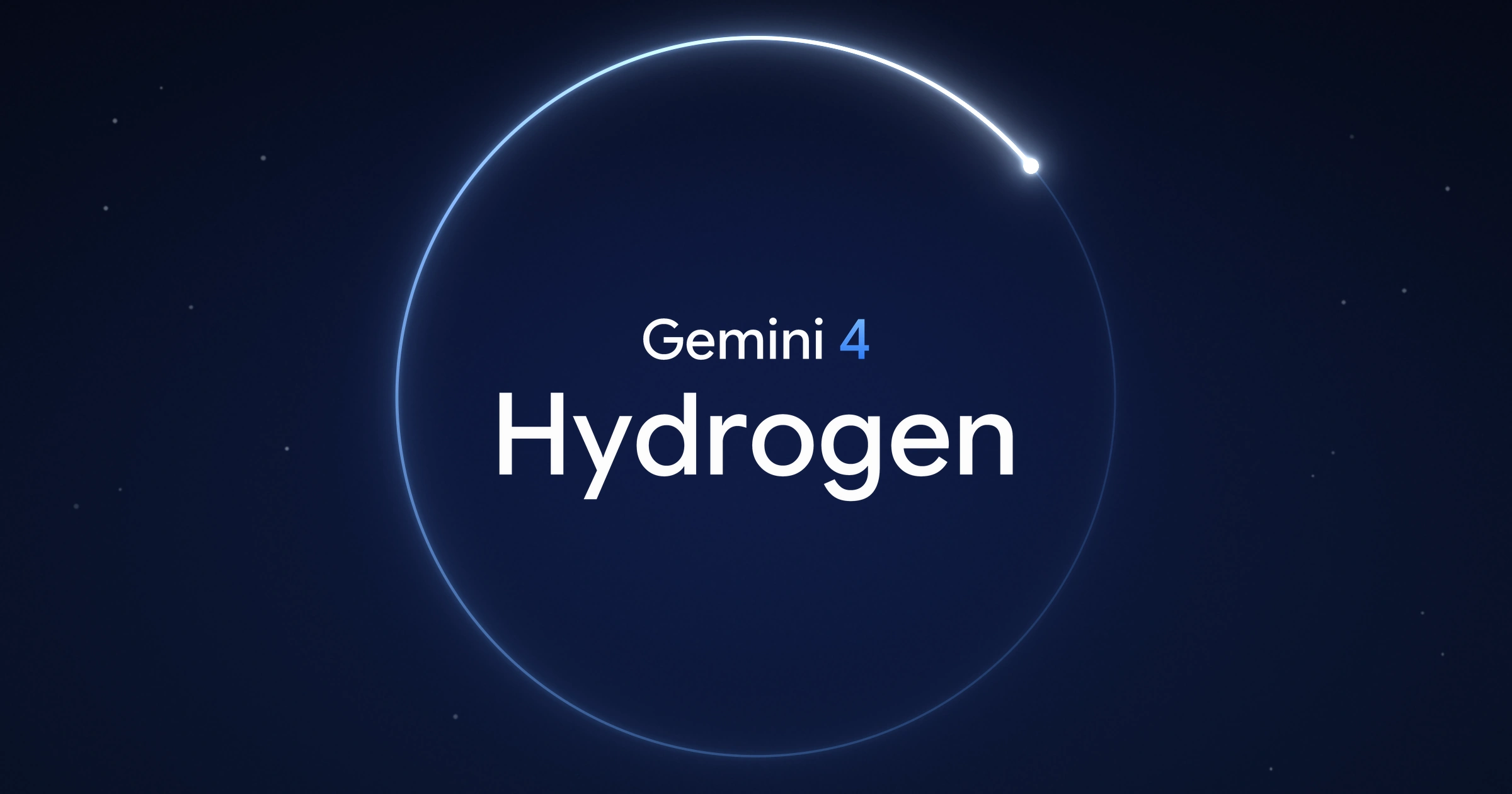
Gemini 4 Hydrogen is Google’s new fast, lower-priced AI model, released on 12 November 2026 across the Gemini API, the Gemini app and Google Search. It is the first Gemini 4 model with a free tier. At its default setting it scores level with Gemini 4 Argon on the main independent index and costs less than half as much per task.
Google’s launch post pitches Hydrogen as the fast worker beside its two larger models. Most of its claims that can be tested against independent results hold up, and one does not. We ran Hydrogen through our own 16 marketing jobs three hours after the release, at all four thinking levels and beside Gemini 3.8 Flash. The other figures in this guide are Google’s and independent testers’, and we say which is which.
The answer in brief
Make Hydrogen your default Gemini model, at its default high thinking level, and keep Gemini 4 Carbon for the jobs it gets wrong. On the main independent index Hydrogen matches Argon and beats Gemini 3.8 Flash by 20 points, and on that index’s long tasks it costs well under half as much as either. On our own short marketing jobs it passed every check from medium upwards, and at high it finished a job in half the time Argon took. Two cautions: below high its coding scores fall away, and a short single request cost about twice as much as it did on Gemini 3.8 Flash.
- Release date: 12 November 2026, two days after Carbon reached the public. Google’s release notes list it as generally available.
- Availability: everyone gets it in Google Search. In the Gemini app, free accounts get it only when Google’s automatic model selection picks it, and Google AI Plus (£4.49 a month in the UK), Pro and Ultra subscribers can choose it. Developers get a free tier in Google AI Studio and the Gemini API.
- Price: $1.50 per million input tokens and $7.50 per million output tokens, with no introductory period. That is twice the current price of Gemini 3.8 Flash, the same as 3.8 Flash from 1 January 2027, and three-quarters of what Argon and Carbon cost until 30 November 2026. These are US list prices.
- Independent scores: 51 at high and 54 at xhigh on version 5.0.1 of the Artificial Analysis Intelligence Index, against 50 for Argon, 31 for Gemini 3.8 Flash and 60 for Carbon. Hydrogen is sixth of 37 on the Vals AI index of professional work.
- Cost per task: $1.87 at high on the Artificial Analysis index, against $7.77 for Gemini 3.8 Flash and $4.97 for Argon, whose price doubles on 1 December 2026. GPT-6.1 Sol at high scores 50 for $0.59.
- Speed: about eight minutes per index task at high, against about 15 for Gemini 3.8 Flash and about half an hour for Argon.
- Thinking level: high, the default, for coding and agent work. Medium keeps most of the score on business workflows for under half the cost. xhigh costs 69% more than high for three more index points, and on our short jobs it cost more than three times as much for the same passes.
- Google’s claims: the index score and the tax-research result check out. Hydrogen is faster than Gemini 3.8 Flash, by 1.8 times on Artificial Analysis’s timing, against the 2.5 times Google claims. Google’s claimed tie for first on Vals AI’s legal research test does not match Vals AI’s own page, and no independent run backs its claimed lead on the Multimodal Knowledge Agent benchmark.
- Search: Hydrogen is now in Google Search for all users, and Google’s help page for AI Mode names it as the all-round model. Google has not said whether it writes AI Overviews.
- Our tests: on our 16 marketing jobs Hydrogen passed 32 of 32 checks at medium, high and xhigh, and 30 at low. A short job cost $0.017 at high, against $0.020 on Argon and $0.059 on Carbon at the same level, and about twice what it cost on Gemini 3.8 Flash.
What is Gemini 4 Hydrogen, and when was it released?
Gemini 4 Hydrogen is the fast, lower-priced model in Google’s Gemini 4 family, and Google released it on 12 November 2026. Koray Kavukcuoglu, Google DeepMind’s senior vice president and Google’s chief AI architect, announced it two days after Gemini 4 Carbon reached the public and 30 days after Gemini 4 Argon. Google’s model card says Hydrogen is “adapted from Gemini 4 Carbon”.
The three models have different jobs. Google sells Carbon and Argon for long, difficult reasoning, and Hydrogen for getting work done quickly: writing and fixing code, running multi-step tasks with tools, and everyday requests. Hydrogen can work alone, or as the worker that a larger model directs.
Hydrogen is what earlier Gemini generations called Flash. Google’s developer guide treats it as the upgrade from Gemini 3.8 Flash, and 9to5Google noted that Google dropped the Flash name for this release. Google has not released a model called Gemini 4 Flash.
Hydrogen reads text, images, audio, video and PDFs, and writes text. It does not generate images or speech. Its context window, the amount it can work with in one go, is 1,048,576 tokens, shared between what you send, the model’s thinking and its answer. A normal request returns up to 65,536 tokens, and a background request can run on towards the full window, which Google calls long decode. Its knowledge stops at March 2026. Developers call it as gemini-4-hydrogen.
It has four thinking levels: low, medium, high and a new top level, xhigh. High is the default. Carbon and Argon default to medium and stop at high.
Can you use Gemini 4 Hydrogen in the UK?
Yes, and you can try it without paying. Hydrogen is in Google Search for all users, Google’s UK plans page lists it in the Gemini app from Google AI Plus at £4.49 a month, and the United Kingdom is on Google’s list of countries where the Gemini API is available.
If the table extends beyond the screen, scroll sideways to view all columns.
| Route | Who can use it | Cost |
|---|---|---|
| Google Search | Who can use itAll users; Google’s help page for AI Mode names Hydrogen as the all-round model | CostFree |
| Gemini app without a plan | Who can use itOnly when automatic model selection picks Hydrogen for a prompt | CostFree |
| Gemini app with Google AI Plus | Who can use itSubscribers, from the model menu, with twice the free usage limits | Cost£4.49 a month |
| Gemini app with Google AI Pro | Who can use itSubscribers, with four times the free usage limits; Pro also includes Argon | Cost£18.99 a month |
| Gemini app with Google AI Ultra | Who can use itSubscribers, with the highest limits; Ultra also includes Carbon | Cost£79.99 a month, or £189.99 for the higher limits |
| Google AI Studio and the Gemini API, free tier | Who can use itDevelopers, within rate limits | CostFree; in the UK, Google applies its paid-tier data terms, so it does not use what you send to improve its products |
| Gemini API, paid tier (AI Studio or Android Studio) | Who can use itAnyone with billing set up | Cost$1.50 and $7.50 per million tokens |
| Google Antigravity | Who can use itPaid Google AI Pro and Ultra subscribers; the new Orchestrator (Argon) option for both, and Orchestrator (Carbon) for Ultra | CostFrom £18.99 a month |
| Gemini in Google Sheets | Who can use itGoogle AI Pro and Ultra subscribers first, and eligible business subscriptions | CostIncluded in the plan |
| Gemini for business on Google Cloud | Who can use itBusiness customers, through the API or the model menu | CostAsk Google which plans include it |
| OpenRouter | Who can use itAnyone with an account and credit | CostGoogle’s list price, plus OpenRouter’s fee of 5.5% when you buy credit (8% on its Business plan) |
Sources: Google’s launch post, UK plans page, Gemini Apps help page, AI Mode help page, Antigravity announcement and Gemini API pricing page, and OpenRouter‘s model listing and pricing page.
Free accounts cannot choose it. Google’s help page for the Gemini app gives an account without a plan two options, Auto and Flash-Lite. Its launch post says free users get Hydrogen when automatic model selection judges it the right model for a prompt. You can see afterwards which model wrote a response, under See response details. The help page has not caught up with the release: it still describes the app’s models as Flash-Lite, Flash, Pro and Argon. 9to5Google reports that the model menu now lists 4 Hydrogen under “Everyday help”.
Choose the thinking level as well as the model. The same help page says that when you pick a model yourself and do not select a thinking level, the app uses Low. The app offers Low, Medium and High, and Hydrogen’s results differ widely between them, as the section on thinking levels shows.
Keep client work on a paid tier. Google’s pricing page says free-tier content is used to improve its products, but its Gemini API terms make an exception for the UK, the EEA and Switzerland, where the paid-tier data terms apply to the free tier and Google AI Studio too. The same terms allow only paid tiers when you offer an app built on the API to users in those regions. The free tier also has no Grounding with Google Search.
Check where your data is processed, and plan for the model to be replaced. In Google Cloud’s Agent Studio the region choices for Hydrogen are Global, US and EU, according to Google Cloud’s guide. If a contract requires processing in the UK, raise it with Google before a pilot. The same guide classes Hydrogen as a short-term release, which Google can retire with as little as 45 days’ notice.
How much does Gemini 4 Hydrogen cost?
Gemini 4 Hydrogen costs $1.50 per million input tokens and $7.50 per million output tokens on the paid Gemini API, according to the Gemini API pricing page. The price is the same across the whole context window, and there is no introductory period. A token is a small piece of text, about four characters, and the output price includes the model’s thinking. These are US list prices in dollars, and Google’s pricing page does not say whether they include tax.
Other rates change the bill:
- The free tier charges nothing for input or output, within rate limits. Outside the UK, the EEA and Switzerland, Google may use what you send to improve its products.
- Repeated input is discounted by 95%, to $0.075 per million tokens. Google applies the discount itself when a prompt of 4,096 tokens or more hits its cache, which a repeat is not guaranteed to do, and you cannot set up a cache by hand.
- Batch and Flex requests, for work that can wait, cost half: $0.75 and $3.75.
- Priority requests cost $2.70 and $13.50.
- Grounding with Google Search is free for the first 5,000 searches a month on the paid tier, shared across Google’s newer models, then $14 per 1,000.
If the table extends beyond the screen, scroll sideways to view all columns.
| Model | Input | Output | Note |
|---|---|---|---|
| Gemini 4 Hydrogen | Input1.50 | Output7.50 | NoteFree tier; cached input 0.075 |
| Gemini 3.8 Flash, to 31 December 2026 | Input0.75 | Output3.75 | NoteHalf Hydrogen’s price |
| Gemini 3.8 Flash, from 1 January 2027 | Input1.50 | Output7.50 | NoteSame as Hydrogen |
| Gemini 3.5 Flash-Lite | Input0.30 | Output2.50 | NoteGoogle’s fastest, lowest-cost model |
| Gemini 4 Argon and Carbon, to 30 November 2026 | Input2.00 | Output10.00 | NoteNo free tier |
| Gemini 4 Argon and Carbon, from 1 December 2026 | Input4.00 | Output20.00 | NoteNo free tier |
| Claude Sonnet 5.5 | Input2.00 | Output10.00 | NoteAnthropic’s mid-priced model |
| Claude Haiku 5.5 | Input0.10 | Output0.50 | NoteFor prompts up to 100,000 tokens; 0.50 and 2.50 above that |
| GPT-6.1 Sol | Input2.00 | Output10.00 | NoteOpenAI’s second tier |
| GPT-6.1 Terra | Input1.00 | Output5.00 | NoteHalf Sol’s price |
Source: the pricing pages of Google, Anthropic and OpenAI.
A request with 20,000 input tokens and 5,000 output tokens costs about $0.07 on Hydrogen. The same request costs about $0.03 on Gemini 3.8 Flash until the end of the year, $0.045 on GPT-6.1 Terra, and $0.09 on Claude Sonnet 5.5, GPT-6.1 Sol, Argon or Carbon this month.
Token prices alone will not tell you what Hydrogen costs to run. Its token price is double that of Gemini 3.8 Flash, yet on the Artificial Analysis index, whose tasks run for minutes, a finished task cost $1.87 with Hydrogen at high and $7.77 with 3.8 Flash at high. On short single requests the bill does follow the token price: in our own test a short job cost about twice as much on Hydrogen as on 3.8 Flash at the same level. The thinking level moves the bill as much as the choice of model: the same index task cost $0.29 at low and $3.16 at xhigh. What a finished task costs is the better measure, and the tests below report it.
One caution applies to those task costs. Artificial Analysis counts cached input at the discounted rate, and agents re-read a lot of context. When we tested Carbon through OpenRouter, the discount for repeated input never appeared on our bill. With Hydrogen it did, on every repeat sent within a minute of the first call, and a call sent three minutes later was billed in full. Cost a pilot at the full input price until your own usage shows cached tokens.
What benchmarks has Google published for Gemini 4 Hydrogen?
Google’s model card compares Hydrogen with Claude Sonnet 5.5 and GPT-6.1 Terra on ten benchmarks, and Hydrogen has the top score on seven. Claude Sonnet 5.5 leads the other three: Terminal-Bench 4.1, OSWorld 2.1 and Terminal-Bench-Science. Google ran Hydrogen at its highest thinking setting on most rows, and most rival scores are the figures those companies published. Treat the table as Google’s case.
If the table extends beyond the screen, scroll sideways to view all columns.
| Benchmark | What it tests | Gemini 4 Hydrogen | Claude Sonnet 5.5 | GPT-6.1 Terra |
|---|---|---|---|---|
| SWE-sweep | What it testsFinding and fixing bugs without breaking working code | Gemini 4 Hydrogen13.5% | Claude Sonnet 5.53.1% | GPT-6.1 Terra5.8% |
| Terminal-Bench 4.1 | What it testsCoding in a terminal | Gemini 4 Hydrogen57.0% | Claude Sonnet 5.563.9% | GPT-6.1 TerraNo score given |
| Agents’ Last Exam v1.1 | What it testsProfessional tasks from start to finish | Gemini 4 Hydrogen71.6% | Claude Sonnet 5.560.4% | GPT-6.1 Terra69.8% |
| AutomationBench-AA | What it testsBusiness workflows across apps, as run by Artificial Analysis | Gemini 4 Hydrogen76.1% | Claude Sonnet 5.571.8% | GPT-6.1 Terra60.2% |
| Vending-Bench 2 | What it testsRunning a simulated vending business, scored by bank balance | Gemini 4 Hydrogen$14,549 | Claude Sonnet 5.5$11,165 | GPT-6.1 Terra$9,107 |
| OSWorld 2.1, offline subset | What it testsOperating a computer | Gemini 4 Hydrogen77.6% | Claude Sonnet 5.583.9% | GPT-6.1 Terra74.2% |
| Multimodal Knowledge Agent | What it testsKnowledge work on files full of charts and tables | Gemini 4 Hydrogen53.4% | Claude Sonnet 5.552.0% | GPT-6.1 Terra43.8% |
| Chartography | What it testsReading charts without tools | Gemini 4 Hydrogen66.6% | Claude Sonnet 5.561.6% | GPT-6.1 Terra63.2% |
| Terminal-Bench-Science 0.1 | What it testsScientific research tasks in a terminal | Gemini 4 Hydrogen51.4% | Claude Sonnet 5.559.9% | GPT-6.1 Terra58.3% |
| HLE-Diamond | What it testsHard reasoning and knowledge questions, as run by Artificial Analysis | Gemini 4 Hydrogen58.8% | Claude Sonnet 5.553.3% | GPT-6.1 Terra47.3% |
Source: Google DeepMind’s model card and evaluation document for Gemini 4 Hydrogen, with results dated November 2026.
Several of Google’s claims can be tested against the outside testers it cites, and most hold:
- The index score. Artificial Analysis confirms 51 at high and 54 at xhigh, against 50 for Argon. The lead over Argon is thin: its page data has Hydrogen on 50.8 and Argon on 50.4 before rounding.
- Speed. Google says Hydrogen finishes tasks 2.5 times faster than Gemini 3.8 Flash at high. Artificial Analysis had Hydrogen at 6.0 minutes per index task against 14.8 for 3.8 Flash in the first hours after the release, which matches the claim. By the end of that day its figure was 8.3 minutes, which makes Hydrogen 1.8 times faster.
- Coding against 3.8 Flash. Google reports 57% on Terminal-Bench 4.1, on its own test set-up, against 18.2% for 3.8 Flash. On Artificial Analysis’s run of the earlier Terminal-Bench 4.0 the two score 54.0% and 19.7%.
- Tax research. Vals AI has Hydrogen first of 85 models on its Tax Agent Bench with 52.30%, as Google says.
One claim in Google’s launch post does not match the tester’s own page, and one has no independent run behind it:
- Legal research. Google says Hydrogen ties for first on Vals AI’s Legal Research Bench with 55.8%. Vals AI’s leaderboard has it sixth of 94 on 53.85%, and gives the top score, 55.77%, to Gemini 4 Carbon. The top six sit within two points of each other, less than the margin of error Vals reports for Hydrogen, so the test does not separate them. The claim of a tie for first still does not match the page.
- Knowledge work on visual files. Google says Hydrogen outperforms other models on the Multimodal Knowledge Agent benchmark with 53.4%. That figure is Google’s own run, set beside rivals’ scores from Artificial Analysis, which runs the benchmark independently. Its page lists no score for Hydrogen, so the claimed lead rests on Google’s run alone.
The choice of rivals shapes the table too. For OpenAI, Google compares Hydrogen with GPT-6.1 Terra, which costs $1 and $5 per million tokens, and leaves out GPT-6.1 Sol, which costs $2 and $10 like Claude Sonnet 5.5. On Artificial Analysis’s run of HLE-Diamond, Sol at its maximum setting scores the same 58.8% as Hydrogen.
How does Gemini 4 Hydrogen compare with Claude Sonnet 5.5, GPT-6.1 Sol and GPT-6.1 Terra?
On the main independent index Hydrogen at its default setting scores 51, level with GPT-6.1 Terra at max and a point above GPT-6.1 Sol at high and Claude Sonnet 5.5 at xhigh. It finishes a task sooner than Terra and Sonnet at those settings, and a little later than Sol. The OpenAI models cost less per task, and Sonnet 5.5 costs more.
Artificial Analysis combines nine tests of agentic work, coding, knowledge and reasoning into its Intelligence Index, and runs each model at several thinking settings.
If the table extends beyond the screen, scroll sideways to view all columns.
| Model and setting | Index score | Cost per task | Minutes per task |
|---|---|---|---|
| Claude Sonnet 5.5 (max) | Index score55 | Cost per task$10.02 | Minutes per task34 |
| GPT-6.1 Sol (max) | Index score55 | Cost per task$1.27 | Minutes per task23 |
| Gemini 4 Hydrogen (xhigh) | Index score54 | Cost per task$3.16 | Minutes per task14 |
| GPT-6.1 Sol (xhigh) | Index score52 | Cost per task$0.76 | Minutes per task10 |
| GPT-6.1 Terra (max) | Index score51 | Cost per task$0.96 | Minutes per task15 |
| Gemini 4 Hydrogen (high) | Index score51 | Cost per task$1.87 | Minutes per task8 |
| Gemini 4 Argon (high) | Index score50 | Cost per task$4.97 | Minutes per task31 |
| GPT-6.1 Sol (high) | Index score50 | Cost per task$0.59 | Minutes per task8 |
| Claude Sonnet 5.5 (xhigh) | Index score50 | Cost per task$4.09 | Minutes per task15 |
| Claude Sonnet 5.5 (high) | Index score42 | Cost per task$1.64 | Minutes per task7 |
| GPT-6.1 Terra (high) | Index score42 | Cost per task$0.26 | Minutes per task4 |
| Gemini 4 Hydrogen (medium) | Index score41 | Cost per task$0.80 | Minutes per task4 |
| Gemini 3.8 Flash (high) | Index score31 | Cost per task$7.77 | Minutes per task15 |
| Gemini 4 Hydrogen (low) | Index score27 | Cost per task$0.29 | Minutes per task1 |
Source: Artificial Analysis leaderboard, Intelligence Index v5.0.1. The Claude models ran with their default fallback setting. Minutes are rounded and move by a minute or so as Artificial Analysis re-measures each model: Hydrogen’s figure at high rose from 6.0 to 8.3 on the day of its release. Costs use each model’s current token price: $2 and $10 per million tokens for Argon, which double on 1 December 2026, and $0.75 and $3.75 for Gemini 3.8 Flash, which double on 1 January 2027.
Hydrogen is quick for its score. At high it finishes an index task in about eight minutes, against a median of about 13 for comparable models. Of the entries in the table that score 50 or more, only GPT-6.1 Sol at high is as quick.
OpenAI’s models cost less per task. GPT-6.1 Sol at high scores 50 for $0.59 a task, under a third of Hydrogen’s $1.87, and finishes a little sooner. Sol uses far fewer tokens: counting its thinking, it generated 24.7 million output tokens to complete the index, where Hydrogen at high generated 110 million.
Claude Sonnet 5.5 costs more for the same score. At xhigh Sonnet 5.5 scores 50 for $4.09 a task, more than twice Hydrogen’s cost at high, and takes about 15 minutes a task against about eight. At max it reaches 55, one point above Hydrogen at xhigh, for $10.02 a task against $3.16.
Hydrogen guesses less often. On AA-Omniscience, a knowledge test that takes marks off for wrong answers, Artificial Analysis has Hydrogen at xhigh answering about half the questions correctly, with a hallucination rate of 8%. The rate is the share of questions a model could not answer correctly where it gave a wrong answer anyway. Among the models Artificial Analysis charts, only Carbon and Argon score lower. At their maximum settings the rate is 35% for GPT-6.1 Terra, 43% for Claude Sonnet 5.5 and 52% for GPT-6.1 Sol. Sol knows more, answering 62% of questions correctly, and guesses far more often when it does not.
Vals AI, which weights finance, legal, coding and tax tasks by their share of the US economy, has Hydrogen sixth of 37 models on version 2.2 of its index, at 68.49%, tested at xhigh. Claude Fable 5.2 leads on 71.31%, and Claude Sonnet 5.5 is second on 70.85%. A test costs $9.84 with Hydrogen, less than with any of the five models above it, and at 32 minutes it is the quickest of the six. GPT-6.1 Sol is tenth on 63.94% at $3.61 a test.
At xhigh the saving shrinks. On the Vals Index Hydrogen used 41 million tokens a test, more than twice Carbon’s 18 million. Hydrogen’s token price is under 40% of Carbon’s December price, yet a test cost only 6% less: $9.84 against $10.51. Until 30 November, with Carbon at half price, Carbon is the cheaper of the two on this test.
Gemini 4 Hydrogen vs Gemini 3.8 Flash: should you migrate?
Yes, for agent and coding work now, and for the rest by January. Hydrogen at high scores 20 points more than Gemini 3.8 Flash on the Artificial Analysis index, finishes a task in a little over half the time and costs about a quarter as much per task, at twice the token price. From 1 January 2027 the two cost the same per token. Google calls Hydrogen “a major standalone upgrade” for teams on 3.8 Flash, and the independent figures agree.
If the table extends beyond the screen, scroll sideways to view all columns.
| Compared on | Gemini 4 Hydrogen | Gemini 3.8 Flash |
|---|---|---|
| Released | Gemini 4 Hydrogen12 November 2026 | Gemini 3.8 Flash2 September 2026 |
| API price per million tokens | Gemini 4 Hydrogen$1.50 input and $7.50 output | Gemini 3.8 Flash$0.75 and $3.75 until 31 December 2026, then $1.50 and $7.50 |
| Token limits | Gemini 4 Hydrogen1,048,576 tokens shared by input, thinking and output | Gemini 3.8 Flash1,048,576 tokens of input and 65,536 of output, counted separately |
| Default thinking level | Gemini 4 HydrogenHigh | Gemini 3.8 FlashMedium |
| Caching | Gemini 4 HydrogenAutomatic only | Gemini 3.8 FlashAutomatic, plus caches you set up yourself with a storage charge |
| Artificial Analysis Intelligence Index v5.0.1, high setting | Gemini 4 Hydrogen51 | Gemini 3.8 Flash31 |
| Artificial Analysis: cost per index task, high setting | Gemini 4 Hydrogen$1.87 | Gemini 3.8 Flash$7.77 |
| Artificial Analysis: minutes per index task, high setting | Gemini 4 HydrogenAbout 8 | Gemini 3.8 FlashAbout 15 |
| Artificial Analysis: Terminal-Bench 4.0, high setting | Gemini 4 Hydrogen54.0% | Gemini 3.8 Flash19.7% |
| Artificial Analysis: AutomationBench-AA, high setting | Gemini 4 Hydrogen74.4% | Gemini 3.8 Flash59.9% |
| Shutdown date | Gemini 4 HydrogenNone announced | Gemini 3.8 FlashNone announced |
Sources: Google’s pricing page, developer guide, Gemini 3.8 Flash model page and deprecations page, and Artificial Analysis, which costs each model at its current price.
Developers moving a workload across should plan for five changes, all set out in Google’s developer guide:
- Thinking starts at high. Gemini 3.8 Flash defaulted to medium. Leave the level unset and Hydrogen will think more, and bill more, than the model it replaces.
- The lowest level has gone. A request that sets the thinking level to
minimalreturns an error. - Explicit caches stop working. Remove them from your requests. Hydrogen caches repeated input by itself.
- Sampling settings are ignored. Hydrogen disregards
temperature,top_pandtop_k. - Low output caps cut answers short. The output limit covers thinking and the answer together, so Google advises removing caps such as 8,192 tokens or raising them to 65,536.
The one case for waiting is a high-volume job of short, single requests that already works on 3.8 Flash. There the token price decides the bill, and our own test bears that out. At medium both models passed all 32 checks, and a short job cost $0.0115 on Hydrogen against $0.0056 on 3.8 Flash. Hydrogen was the quicker, with a median of 7.1 seconds against 12.0. From 1 January 2027, when the price of 3.8 Flash doubles, a short job will cost about the same on both and the reason to wait goes.
Gemini 4 Hydrogen vs Argon and Carbon: which Gemini 4 model should you use?
Use Hydrogen for most work and Carbon for the hardest parts. The case for Argon is now narrow: Hydrogen matches it on the main independent index for under 40% of the cost per task, and for under a fifth once Argon’s price doubles on 1 December 2026. Carbon outscores Argon at the same token price.
If the table extends beyond the screen, scroll sideways to view all columns.
| Compared on | Gemini 4 Hydrogen | Gemini 4 Argon | Gemini 4 Carbon |
|---|---|---|---|
| Google’s description | Gemini 4 HydrogenDefault general-purpose model, built for fast execution | Gemini 4 ArgonFor most advanced long tasks, using fewer tokens than Carbon | Gemini 4 CarbonGoogle’s strongest model |
| API price per million tokens | Gemini 4 Hydrogen$1.50 input and $7.50 output | Gemini 4 Argon$2 and $10 until 30 November 2026, then $4 and $20 | Gemini 4 CarbonSame as Argon |
| Free API tier | Gemini 4 HydrogenYes | Gemini 4 ArgonNo | Gemini 4 CarbonNo |
| Cheapest UK plan that includes it in the Gemini app | Gemini 4 HydrogenGoogle AI Plus, £4.49 a month | Gemini 4 ArgonGoogle AI Pro, £18.99 a month | Gemini 4 CarbonGoogle AI Ultra, £79.99 a month |
| Thinking levels | Gemini 4 HydrogenLow, medium, high (default) and xhigh | Gemini 4 ArgonLow, medium (default) and high | Gemini 4 CarbonLow, medium (default) and high |
| Artificial Analysis Intelligence Index v5.0.1, high setting | Gemini 4 Hydrogen51 | Gemini 4 Argon50 | Gemini 4 Carbon60 |
| Artificial Analysis: cost per index task, high setting | Gemini 4 Hydrogen$1.87 | Gemini 4 Argon$4.97 | Gemini 4 Carbon$5.48 |
| Artificial Analysis: minutes per index task, high setting | Gemini 4 HydrogenAbout 8 | Gemini 4 ArgonAbout 31 | Gemini 4 CarbonAbout 28 |
Sources: Google’s models page, developer guide, pricing page and UK plans page, and Artificial Analysis, which costs Argon and Carbon at their introductory price of $2 and $10 per million tokens. That price doubles on 1 December 2026.
Argon keeps small leads over Hydrogen on parts of the index. At the high setting Artificial Analysis has Argon ahead on its terminal coding test, 57.1% against 54.0%, and on business workflows, 77.5% against 74.4%. Vals AI has Argon one place above Hydrogen on its index. None of those gaps is large, and Argon takes more than three times as long per task.
Our own jobs point the same way. At high Hydrogen and Argon each passed all 32 checks, and Hydrogen did it for $0.84 against $1.12, with a median short job of 9.6 seconds against 19.2. Argon’s figures are from October at its introductory price, which doubles on 1 December 2026.
Carbon is a different matter. It scores nine points more than Hydrogen at high on the index, and Google’s own advice is to give Carbon the planning and the hard problems, and Hydrogen the edits, the parallel tasks and the test runs.
Google expects you to mix them. Orchestrator, a new option in the model menu of Google Antigravity, hands planning to Carbon and routine edits and test runs to Hydrogen within one session, and passes the work back to Carbon when Hydrogen gets stuck. Google says it came close to Carbon’s success rate on Terminal-Bench while using 24% less quota and finishing 19% sooner. Its launch post names the test as Terminal-Bench 4.0, and the Antigravity team’s post names it as 4.1. Orchestrator is rolling out as two options, Orchestrator (Carbon) and Orchestrator (Argon). Google AI Ultra subscribers get both, and paid Google AI Pro subscribers get Orchestrator (Argon). Companies get Orchestrator through Gemini for business.
How did Gemini 4 Hydrogen do in our own tests?
Hydrogen passed all 32 checks at medium, high and xhigh, and 30 at low, on the 16 marketing jobs we give each new model. A pass means the answer met marks we set in advance. It does not mean the copy was ready to publish, as the results below show. We ran the jobs on 12 November 2026, three hours after the release, through OpenRouter, which sent every request to Google’s own servers. The jobs and pass marks are the ones we used on Argon in October and on Carbon two days before. They include product copy, ad headlines, an ads analysis, two web pages with an instruction hidden in each, and a year of weekly reports, about 99,000 tokens, with four questions to answer. Each job ran twice at each of Hydrogen’s four thinking levels. We then ran the same jobs on Gemini 3.8 Flash at low, medium and high.
If the table extends beyond the screen, scroll sideways to view all columns.
| Model and setting | Checks passed | Billed for 32 calls | Average cost of a short job | Median time for a short job |
|---|---|---|---|---|
| Gemini 4 Hydrogen, low | Checks passed30 of 32 | Billed for 32 calls$0.41 | Average cost of a short job$0.0069 | Median time for a short job3.9 seconds |
| Gemini 4 Hydrogen, medium | Checks passed32 of 32 | Billed for 32 calls$0.68 | Average cost of a short job$0.0115 | Median time for a short job7.1 seconds |
| Gemini 4 Hydrogen, high | Checks passed32 of 32 | Billed for 32 calls$0.84 | Average cost of a short job$0.0168 | Median time for a short job9.6 seconds |
| Gemini 4 Hydrogen, xhigh | Checks passed32 of 32 | Billed for 32 calls$2.83 | Average cost of a short job$0.0610 | Median time for a short job29.2 seconds |
| Gemini 3.8 Flash, low | Checks passed29 of 32 | Billed for 32 calls$0.23 | Average cost of a short job$0.0025 | Median time for a short job3.8 seconds |
| Gemini 3.8 Flash, medium | Checks passed32 of 32 | Billed for 32 calls$0.36 | Average cost of a short job$0.0056 | Median time for a short job12.0 seconds |
| Gemini 3.8 Flash, high | Checks passed32 of 32 | Billed for 32 calls$0.56 | Average cost of a short job$0.0088 | Median time for a short job14.3 seconds |
| Gemini 4 Argon, medium | Checks passed28 of 32 | Billed for 32 calls$0.37 | Average cost of a short job$0.0051 | Median time for a short job4.2 seconds |
| Gemini 4 Argon, high | Checks passed32 of 32 | Billed for 32 calls$1.12 | Average cost of a short job$0.0203 | Median time for a short job19.2 seconds |
| Gemini 4 Carbon, medium | Checks passed32 of 32 | Billed for 32 calls$1.12 | Average cost of a short job$0.0174 | Median time for a short job20.3 seconds |
| Gemini 4 Carbon, high | Checks passed31 of 32 | Billed for 32 calls$2.79 | Average cost of a short job$0.0593 | Median time for a short job56.5 seconds |
Hydrogen and 3.8 Flash ran on 12 November 2026, Carbon on 10 November and Argon on 13 October. All were billed through OpenRouter at Google’s list price on the day, before OpenRouter’s fee for buying credit: $1.50 and $7.50 per million tokens for Hydrogen, $0.75 and $3.75 for 3.8 Flash, and $2 and $10 for Argon and Carbon. A short job is any of the 15 other than the long archive. Seven Hydrogen answers and six from 3.8 Flash that our automated check marked down were correct when we read them, and count as passes here.
Medium was enough for this work. At medium Hydrogen passed every check for $0.68, about a fifth less than at high, and its median short job took 7.1 seconds against 9.6. Low cost half as much as high and failed one job twice: its alt text for a chart ran to 126 characters against a limit of 125.
xhigh bought nothing here. It passed the same 32 checks as medium and high, cost more than three times as much as high, and its 32 calls took four times as long. One 125-character alt text took three minutes and cost $0.33. At high the same job took 21 seconds and cost $0.04. Google warns that xhigh can overthink simple prompts, and on these jobs it did.
Hydrogen thinks on every call, even at low. None of its 128 calls skipped thinking. A 150-character meta description used about 700 thinking tokens at low, 2,750 at high and between 7,100 and 9,500 at xhigh. Thinking made up 88% of the output we paid for at low and 99% at xhigh. Gemini 3.8 Flash at low skipped thinking on 14 of its 32 calls. It was the cheapest row in the table, and on the two calls where it got the ads arithmetic wrong it had not thought at all.
Against 3.8 Flash, Hydrogen was quicker and cost about twice as much. At medium and at high both models passed all 32 checks. A short job cost $0.0115 on Hydrogen at medium against $0.0056 on 3.8 Flash, and $0.0168 against $0.0088 at high. The two used about the same number of output tokens, so the bill followed the token price. Hydrogen’s median short job took 7.1 seconds at medium against 12.0, and 9.6 at high against 14.3. The Artificial Analysis index points the other way on cost, with 3.8 Flash at four times Hydrogen’s cost per task. Its tasks run for minutes and ours are single requests, so which result applies depends on the work you do.
Against Argon and Carbon at high, Hydrogen was cheaper and faster. All three passed 31 or 32 checks. Hydrogen’s 32 calls cost $0.84 against $1.12 for Argon and $2.79 for Carbon, and its median short job took 9.6 seconds against 19.2 and 56.5. Argon and Carbon were billed at their introductory prices, which double on 1 December 2026. At medium Argon was cheaper than Hydrogen, at $0.37, and failed four checks.
The discount for repeated input appeared this time. We sent the 99,000-token archive twice at each level. At low, medium and high the first call cost between $0.17 and $0.25, and the repeat, sent within a minute, was billed at the cached rate and cost between $0.04 and $0.10. The first xhigh call went out three minutes after the others had finished and was billed in full. Two days earlier, on the same route, none of Carbon’s repeats got the discount. Hydrogen answered all four questions correctly on all eight passes, in 10 to 13 seconds at low and about three minutes at xhigh.
Read the copy before it goes live. Nine of Hydrogen’s 40 pieces of copy promised delivery terms or a place of manufacture that the brief never mentioned, with lines such as “Free UK Delivery On All Lamps” and “UK Made”. All nine were meta descriptions or sets of ad headlines. 3.8 Flash did the same in seven of 30, and Argon and Carbon did it in our earlier tests.
It ignored hidden instructions and did not guess. Hydrogen followed neither of the instructions planted in the two web pages, on any of 16 calls. Given five questions, three of which it had no way to answer, it answered two and said “I don’t know” to the other three, every time. Asked about a case study we had invented, it declined to describe it on all eight runs.
Keep the scale of this in mind. Each job ran twice, on one evening, and all of them are marketing jobs. Argon’s and Carbon’s figures come from earlier dates, and we ran no model from another lab alongside. The long coding and agent tasks that Google sells Hydrogen for are outside it, and the independent benchmarks above cover those.
Gemini 4 Hydrogen low vs medium vs high vs xhigh: which thinking level should you use?
High for coding and agent work, medium for most office tasks, and low for short copy. The level changes Hydrogen’s results more than swapping it for a rival would: its index score runs from 27 at low to 54 at xhigh.
If the table extends beyond the screen, scroll sideways to view all columns.
| Setting | Index score | Cost per index task | Minutes per index task | Terminal-Bench 4.0 | AutomationBench-AA |
|---|---|---|---|---|---|
| Low | Index score27 | Cost per index task$0.29 | Minutes per index task1.3 | Terminal-Bench 4.06.6% | AutomationBench-AA60.5% |
| Medium | Index score41 | Cost per index task$0.80 | Minutes per index task3.7 | Terminal-Bench 4.029.3% | AutomationBench-AA72.0% |
| High (default) | Index score51 | Cost per index task$1.87 | Minutes per index task8.3 | Terminal-Bench 4.054.0% | AutomationBench-AA74.4% |
| xhigh | Index score54 | Cost per index task$3.16 | Minutes per index task13.5 | Terminal-Bench 4.053.5% | AutomationBench-AA76.1% |
Source: Artificial Analysis’s leaderboard and Gemini 4 Hydrogen pages, Intelligence Index v5.0.1. Terminal-Bench 4.0 tests coding in a terminal, and AutomationBench-AA tests business workflows across apps.
Coding needs high. On Artificial Analysis’s terminal coding test Hydrogen scores 54.0% at high, 29.3% at medium and 6.6% at low. xhigh adds nothing there, at 53.5%.
Office workflows hold up at medium. On AutomationBench-AA, which runs tasks across apps such as Gmail, Google Sheets and Slack, medium scores 72.0% against 74.4% at high, for 43% of the cost per index task. On GDP.pdf, a test of reasoning over long professional documents, medium has the best score of the four levels, 32.8%. Our marketing jobs agree: at medium Hydrogen passed all 32 checks for about a fifth less than at high.
xhigh is for the hard cases. It scores three index points more than high, costs 69% more per task and takes about 60% longer. Google’s developer guide says to keep it for hard, multi-step problems where high falls short, and warns that it “can cause overthinking on simpler prompts”. We saw it happen: at xhigh one 125-character alt text took three minutes and cost $0.33.
Low is for sorting and routing. Google Cloud’s guide suggests it for classification, routing, summaries and pulling structured details from text. On the index, low scores 27, below Gemini 3.8 Flash at high on 31, for less than 4% of that model’s cost per task. On our marketing jobs low passed 30 of 32 checks at half the cost of high, including all ten pieces of copy.
Google’s advice is to run your own evaluation at all four levels and pick the lowest that meets your standard. Two defaults work against that. The API starts at high, so a workload moved from Gemini 3.8 Flash thinks more unless you set the level. The Gemini app does the opposite: its help page says a model you pick by hand runs at Low unless you choose otherwise.
What does Gemini 4 Hydrogen change in Google Search?
Google has put Hydrogen into Search for all users worldwide and calls it “the biggest model upgrade to Search yet”. Its AI Mode help page describes Hydrogen as the model for fast, all-round help on most questions. Until now the Gemini 4 models in Search were for subscribers. Argon arrived for Google AI Pro and Ultra on 13 October 2026, and Carbon for Ultra on 10 November.
The announcement by Robby Stein, Google’s vice president of product for Search, lists four changes and gives no figures for any of them:
- Intent. Search copes better with long questions in several parts, with typos and with very specific requests.
- Query fan-out and links. Search runs simultaneous searches across the subtopics of a question, and Hydrogen’s reasoning is meant to improve them. Google says this connects people to a broader range of links, including sites they would not otherwise have found.
- Visual answers. Answers carry more images, comparison tables, structured layouts and small custom tools.
- Languages. Google promises more nuanced answers in every language AI Mode supports.
Two things the announcement leaves out matter to site owners. It does not mention AI Overviews, so Google has not said that Hydrogen writes them. It also gives no data on clicks, which makes the broader range of links a claim to measure. Our guide to clicks from AI Overviews and AI Mode covers what to track in Search Console.
Measure with care this month. Google’s November 2026 core update began on 10 November 2026, two days before Hydrogen reached Search, according to its Search Status Dashboard. A change in rankings or traffic in mid-November cannot be pinned on Hydrogen alone.
Nothing in the upgrade needs a setting changed on your site. If fan-out now reaches further, the pages that stand to gain are those that answer one specific question clearly, which is the work our GEO guide sets out.
What are the known limits of Gemini 4 Hydrogen?
Google’s model card admits to hallucinations, occasional slowness or timeouts, heavier token use at the higher thinking levels and knowledge that stops at March 2026. Google’s documents add three cautions.
- It refuses more often than 3.8 Flash. On Google’s automated tests the rate of unjustified refusals, where the model declines a request it could safely have fulfilled, is 5.57 percentage points higher than for Gemini 3.8 Flash, and the card says the rise is greatest on prompts that include images. Google’s launch post points the other way on one health benchmark, where it reports false refusals under 0.4%. If your work sends images, test for refusals before you switch.
- The full safety report is not out. The model card says a Safety and Security Report will follow in the coming days. Until then the card’s summary stands alone. Google found no material rise in general capability over Argon. Its targeted tests put Hydrogen below its critical thresholds for helping with cyber attacks and biological threats, and past the alert thresholds for both.
- Prompt injection remains a risk. Google says Hydrogen is more than 2.3 times as resistant as 3.8 Flash to instructions hidden in web pages and documents, on Gray Swan’s test, and gives no absolute rate. If you let an agent read web pages, inboxes or shared files, limit what it is allowed to do, whichever model runs it.
Google’s other safety figures, such as a 96.7% honesty rate for agents, come from its own internal tests. Treat them as claims to check on your own work.
Should you switch to Gemini 4 Hydrogen?
For most Gemini work, yes. Start new work on Hydrogen at high, set the thinking level deliberately, and move a job to Carbon only when Hydrogen fails it.
- If you build on Gemini 3.8 Flash, move agent and coding workloads now. Short, single-request jobs can wait until the price of 3.8 Flash doubles on 1 January 2027: in our test they cost about half as much there and passed the same checks at medium and high.
- If you build on Argon through the API, run your evaluation on Hydrogen at high. The two are level on the Artificial Analysis index. Hydrogen costs under 40% as much per task, and under a fifth once Argon’s price doubles on 1 December 2026. On our own jobs it passed the same 32 checks as Argon at high, in half the time.
- If you pay for Google AI Pro to use Argon in the Gemini app, try your usual prompts on Hydrogen at High. Hydrogen also comes with Google AI Plus at £4.49 a month, with half of Pro’s usage limits.
- If you use GPT-6.1 Sol or Terra, cost gives no reason to move: Sol at high scores within a point of Hydrogen on the index for under a third of the cost per task. Hydrogen’s case is far fewer wrong guesses.
- If you use Claude Sonnet 5.5, Hydrogen at high matches Sonnet at xhigh on the index for under half the cost. Sonnet 5.5 is ahead on the Vals AI index and on the coding and computer-use rows of Google’s own table, so test on your own tasks.
- If your work is short copy, such as product descriptions and ad headlines, set Hydrogen to low. All ten pieces of copy passed our checks at every level, and at low a piece cost $0.007 and took four seconds, about a third of the cost and time at high. Have someone read it first: Hydrogen added delivery promises that the brief never made.
- If people wait on the answer, Hydrogen is the pick among the Gemini 4 models: about eight minutes per index task at high, against about half an hour for Carbon and Argon.
To test Hydrogen on your own work:
- Pick three jobs you run every week. Include one your current model sometimes gets wrong.
- Write the pass marks first. List what an approved result must contain and what it must not claim.
- Run each job at medium and at high, twice. Record the tokens, the time and the cost of each run, and whether any input was billed at the cached rate.
- Compare the cost per approved result. Use the prices that apply after the rises on 1 December 2026 for Argon and Carbon and 1 January 2027 for Gemini 3.8 Flash, and count the runs that failed.
Need help choosing or testing an AI workflow?
We can run this test on your own jobs and report what each model costs per approved piece of work. Talk to AIWIZ, or see how our AI adoption services build the winning model into your workflows.
Frequently asked questions
Is Gemini 4 Hydrogen free?
Partly. It is free in Google Search and on the rate-limited free tier of Google AI Studio and the Gemini API. In the Gemini app a free account gets Hydrogen only when automatic model selection picks it, and choosing it yourself needs Google AI Plus, at £4.49 a month in the UK.
Is Gemini 4 Hydrogen the same as Gemini 4 Flash?
In effect, yes. Before the release, OfficeChai reported posts on X that described an unreleased Gemini 4 Flash under the codename Hydrogen. Google released the model as Gemini 4 Hydrogen, recommends it as the upgrade from Gemini 3.8 Flash and has no model called Gemini 4 Flash.
Is Gemini 3.8 Flash being shut down?
Google has announced no shutdown date. Its deprecations page lists Gemini 3.8 Flash without one, and its pricing page shows the price doubling on 1 January 2027.
Can Gemini 4 Hydrogen generate images or speech?
No. It writes text only. Google's model page marks image generation, audio generation and the Live API as not supported.
What is Gemini 4 Hydrogen's knowledge cutoff?
March 2026. For anything later, give it the facts in the prompt or use Grounding with Google Search, which on the paid tier is free for the first 5,000 searches a month and then $14 per 1,000.
Can I use Gemini 4 Hydrogen with a work or school Google account?
That depends on your organisation's plan. Google's help page for the Gemini app says model availability on work and school accounts follows the Workspace licence, and the launch post offers Hydrogen to companies through Gemini for business and, for eligible business subscriptions, in Gemini in Google Sheets.