


Update, 24 September 2026: GPT-6 Astra launched on 3 September, and GPT-6 Sol and Luna followed on 22 September. Astra is now OpenAI’s GPT-6 flagship; GPT-6 Sol is the middle tier. See our GPT-6 Sol guide and GPT-6 Astra guide. OpenAI has since begun rolling out GPT-6.1 Sol, an upgrade to GPT-6 Sol, from 29 September 2026 (checked 9 October 2026). The July–August GPT-5.6 launch record and the promotional rates below remain useful history.
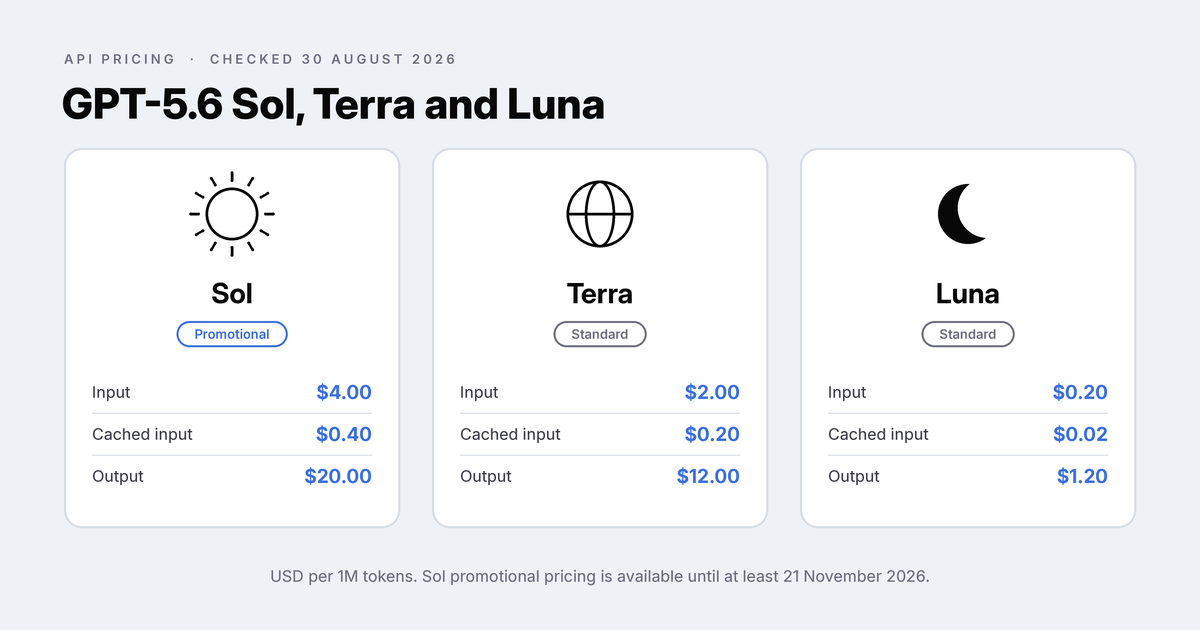
On 9 July 2026, after almost a fortnight of political choreography, OpenAI put the GPT-5.6 family on general release. The family’s flagship, GPT-5.6 Sol, still powers Instant and the deeper thinking settings in ChatGPT Chat for eligible paid subscribers, as of 24 September 2026. The newer GPT-6 Sol and Luna are in ChatGPT Work and Codex but not yet in Chat. Its current promotional API price is $4 per million input tokens, $0.40 per million cached input tokens and $20 per million output tokens. That makes standard input and output 60% cheaper than Claude Fable 5 at Anthropic’s current rates, according to Anthropic’s own pricing page.
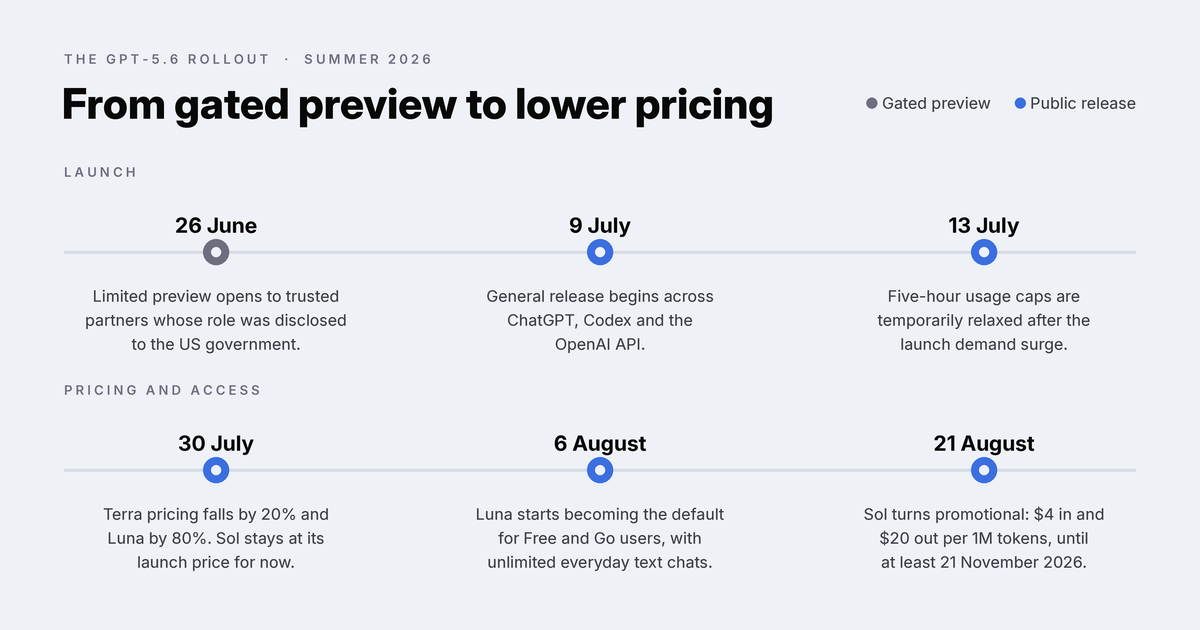
Three weeks after launch, OpenAI cut the prices of the two smaller models in the family, by 80% in one case. A week after that, the family reached ChatGPT’s free tier, with Luna taking over as the default model and everyday text chats becoming unlimited, subject to safeguards. On 21 August, OpenAI also reduced Sol’s API price for a promotion that it says will run until at least 21 November 2026.
The launch came in two stages, and the first one was unusual. For two weeks the only people allowed near the models were a small group of trusted partners whose participation OpenAI had disclosed to the US government. The same political pressure that took Claude Fable 5 offline in June shaped how GPT-5.6 reached the public.
Plenty of the early coverage is recycled press release. Here is what checks out against primary sources as of 24 September 2026, with the GPT-5.6 launch record kept for history, and what still matters for anyone signing off a marketing budget while the Sol promotion runs.
Open the GPT-5.6 rollout and pricing timeline at full size
What is GPT-5.6 Sol?
GPT-5.6 Sol was the most capable model in OpenAI’s GPT-5.6 series, sitting above two smaller siblings: Terra, a mid-priced model for everyday work, and Luna, the fastest and cheapest of the three. For current OpenAI flagship and mid-tier choices, start with GPT-6 Astra and GPT-6 Sol. The release also introduces a new naming system. The number tells you the generation, while Sol, Terra and Luna are durable capability tiers that can be updated on their own schedules. Expect those three names to stick around.
The spec sheet reads like a machine built to be left alone with a job. OpenAI’s model comparison lists a 1,050,000-token context window and a maximum output of 128,000 tokens. Call the plain gpt-5.6 alias in the API and Sol is what answers. Two new settings define how far you can push it. A max reasoning effort gives the model more thinking time than any previous setting, and ultra can coordinate multiple subagents, splitting a hard task into concurrent workstreams and merging the results. Developers can build a related pattern through the Responses API multi-agent beta, which runs concurrent subagents and synthesises their work, and Programmatic Tool Calling lets the model write small programs to manage tool use and intermediate results.
Little of that sounds like marketing, granted. But the tools your team already pays for sit on these APIs, and OpenAI has plainly decided the metric that matters is finished work per pound spent. When that number moves, your software bills tend to move a few months later.
Why was GPT-5.6 held back for two weeks?
The preview opened on 26 June 2026 to a handpicked set of partners. OpenAI says their participation was shared with the US government, though it has not published who they were. TechCrunch reported that the restriction came at the administration’s request, following a June executive order that created a voluntary framework for AI companies to give the government early access to their most powerful models before public release. The order is explicit that it imposes no licensing or preclearance requirement; OpenAI chose to take part. During the preview, the models were only reachable through the API and Codex, and only for those partners.
OpenAI did not pretend to be happy about it. The company said publicly that government-gated access should not become the default for model releases, arguing it keeps useful tools away from the developers and defenders who need them. The caution was understandable. Weeks earlier, Anthropic had been forced to suspend Claude Fable 5 and Mythos 5 entirely under government export controls, a saga we covered in detail in our Claude Fable 5 analysis. That episode has since ended: the controls were lifted on 30 June and access came back from 1 July, days before GPT-5.6 went public. OpenAI clearly wanted a staged release rather than a shutdown.
The gate lifted quickly. On 8 July, CNBC reported that OpenAI would release the models publicly that Thursday, and on 9 July general availability began rolling out worldwide across ChatGPT, Codex and the API over roughly 24 hours. Demand made itself felt almost immediately. Within days, OpenAI temporarily removed the five-hour usage cap on Sol for Plus, Pro and Business subscribers in Codex and ChatGPT Work, after a surge in the 48 hours following launch.
How good is GPT-5.6 Sol?
The honest answer is very good, with caveats. Every benchmark figure below comes from OpenAI’s launch post, published on 9 July 2026, so treat it as a vendor’s best case rather than a permanently current leaderboard.
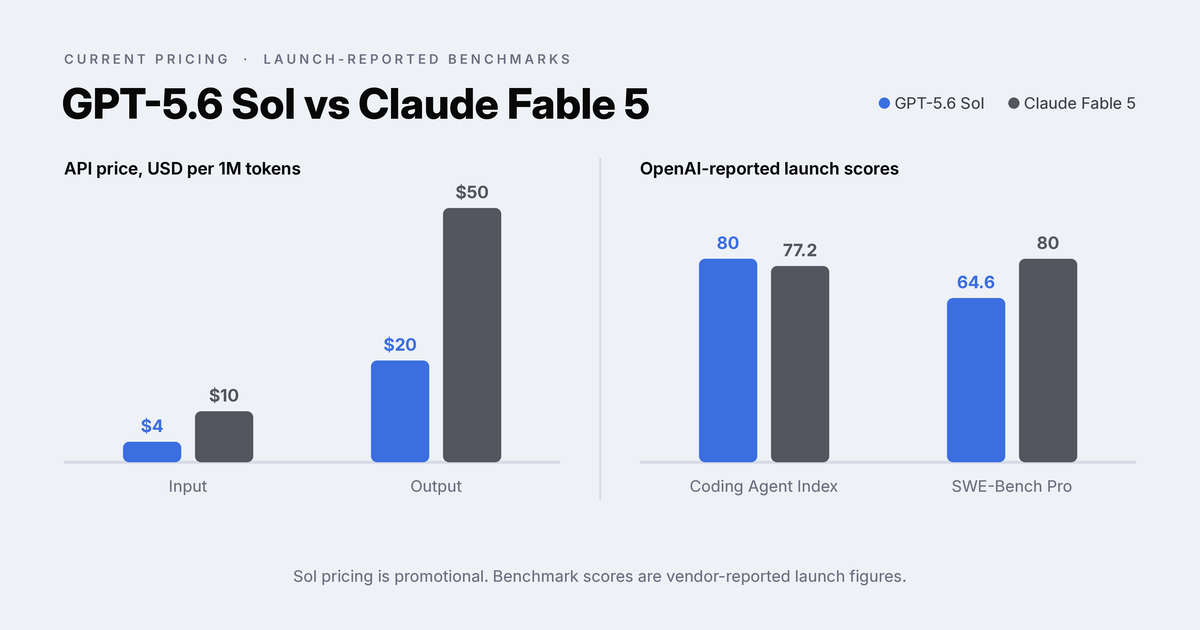
Coding is the headline. On the Artificial Analysis Coding Agent Index, Sol with max reasoning scored 80 in OpenAI’s launch table, 2.8 points above Claude Fable 5, achieved with fewer than half the output tokens. On Terminal-Bench 2.1, which tests command-line work, Sol scored 88.8% and rose to 91.9% in ultra mode. For knowledge work, OpenAI’s announcement claimed a new high of 53.6 on Agents’ Last Exam, an evaluation of long professional workflows across 55 fields, beating Claude Fable 5 in its adaptive reasoning mode by 13.1 points. One wrinkle: the results table on the same page gives Sol 52.7% on that benchmark, so even the vendor’s own numbers vary depending on where you look. On the broader Artificial Analysis Intelligence Index, Sol landed within a single point of Fable 5, 58.9 against 59.9, while OpenAI estimated it finished tasks in 61% less time at roughly half the cost.
The agentic browsing numbers deserve attention from anyone who cares about search. OpenAI reported Sol at 90.4% on BrowseComp, a benchmark of tasks that require researching the live web, and 92.2% in ultra mode. On OSWorld 2.0, which measures how well a model operates a real computer, its launch score was 62.6%, passing Claude Opus 4.8 while using 85% fewer output tokens.
Anthropic was not swept off the board, though, and OpenAI’s own comparison tables showed it. On SWE-Bench Pro, a hard software-engineering benchmark, Claude Fable 5 scored 80% against Sol’s 64.6%. Fable 5 also edged Sol on HealthBench Professional, 60.9% to 60.5%. The fair summary of those launch figures is that Sol competed at the frontier on most measures and won decisively on sticker price, while Fable 5 kept the lead on some demanding engineering work.
There is one more area worth flagging. OpenAI describes GPT-5.6 as a step change in design judgement, able to inspect its own rendered output through computer use and fix visual problems before handing work back. In a report published on 14 July 2026, Tekedia said Sol had taken the top spot on Design Arena’s web-design leaderboard. That is a dated report, not a claim about today’s ranking. Early partners pointed the same way: Canva said the model was stronger than rivals for slide creation in its design evaluations and about 1.6 times more token-efficient, and Model ML found it produced more polished, presentable decks than Fable while using 39% fewer tokens per deck.
Open the Sol versus Claude Fable 5 comparison at full size
What does GPT-5.6 cost?
OpenAI changed Sol’s price on 21 August after cutting the smaller tiers on 30 July. Sol’s current rate is promotional and, according to OpenAI’s model documentation, will remain available until at least 21 November 2026. The current standard rates below are in US dollars per million tokens:
If the table extends beyond the screen, scroll sideways to view all columns.
| Model | Input | Cached input | Output |
|---|---|---|---|
| GPT-5.6 Sol | $4 | $0.40 | $20 |
| GPT-5.6 Terra | $2 | $0.20 | $12 |
| GPT-5.6 Luna | $0.20 | $0.02 | $1.20 |
For context, Claude Fable 5 sits at $10 input, $1 for cache hits and refreshes, and $50 output on Anthropic’s price list. At the promotional Sol rate, standard input and output are each 60% cheaper than Fable 5. That is a sticker-price comparison, not proof that every completed task will cost 60% less.
Two billing details matter for anyone running the model at scale. For GPT-5.6 and later models, cache writes cost 1.25 times the uncached input rate, while cache reads receive a 90% discount. Very long prompts also carry a surcharge: OpenAI’s model documentation says a request with more than 272,000 input tokens is billed at 2× the input rate and 1.5 times the output rate for the whole request, not only the tokens above the threshold. Tool calls and premium processing tiers are billed separately.
One caution on the headline numbers. Cheap tokens are not the same as cheap tasks. The max setting exists to spend more tokens on harder problems, and ultra can coordinate multiple subagents, so it can multiply consumption by design. Price the job, not the token, and run a week of your own workloads through it before anyone signs anything.
Which ChatGPT plans include GPT-5.6 Sol?
According to OpenAI’s help centre, GPT-5.6 Sol powers Instant, Medium, High and Extra High on eligible paid plans. Plus includes Medium and High. Pro, Business and Enterprise add Extra High and GPT-5.6 Sol Pro, the highest-capability option for difficult, longer-running work. The exact controls can depend on plan and managed-workspace settings. Terra and Luna are not selectable in standard ChatGPT conversations.
Free and Go users receive GPT-5.6 Luna rather than Sol. Luna powers their default ChatGPT experience and the Think option for harder questions. OpenAI describes everyday text chats as unlimited, subject to abuse-prevention safeguards, while file uploads, image generation, voice, data analysis and other tools retain separate limits.
The picture is different in other products. Work in ChatGPT offers Sol, Terra and Luna to Plus, Pro, Business and Enterprise users. Codex offers Terra to Free and Go users and all three models to Plus and above. Developers can access all three through the API.
For UK readers, the practical news is good. OpenAI says GPT-5.6 has no separate country list, and confirms that eligible users in the United Kingdom can use it when it is available for their plan and product. Rollout timing and managed-workspace settings can still affect when an option appears. Microsoft also made GPT-5.6 the preferred model in Microsoft 365 Copilot at launch.
What should marketing teams actually do about GPT-5.6?
Start with the money, but keep the deadline in view. At OpenAI’s current promotional rate, Sol’s standard input and output are 60% cheaper than Claude Fable 5’s. That can change the economics of AI-assisted workflows, from reporting pipelines and chatbots to internal research tools, but the rate is only guaranteed until at least 21 November 2026. Suppliers should be challenged on cost per verified outcome, not asked to pass through a temporary token discount as though it were permanent.
The design and document gains matter more than they first appear. Think about what actually eats a marketing week: deck production, template wrangling, the third round of visual tidy-up. A model that drafts an editable deck from a brief and then looks at its own rendered output to catch the ugly bits is pointed straight at that pile. It will not replace a designer with taste. It can compress the distance between a rough idea and a reviewable first draft.
The browsing benchmarks carry a quieter warning. OpenAI’s launch results suggest a model that can complete a high share of live-web research tasks. As these capabilities reach more users, the systems will increasingly read websites on customers’ behalf. That raises the stakes for answer engine optimisation. In our experience, pages that state facts plainly, answer real questions under clear headings and keep their information current tend to get cited; pages that bury the answer rarely do. This is the same discipline we apply in our own AEO work.
Two cautions belong in any honest assessment. The benchmark figures above are OpenAI’s own launch results from 9 July 2026, and coding, browsing or design benchmarks do not prove better marketing quality, rankings, conversions or return on ad spend. OpenAI’s system card also notes a somewhat greater tendency than GPT-5.5 to go beyond instructions in agentic coding tasks, at low absolute rates. Keep a human in the review chain. That rule outlives every model cycle.