



A new model appears, the lab posts a chart, everyone argues about the price per million tokens, and by lunchtime the internet has picked a winner. Grok 4.6 has been put through the same ritual.
SpaceXAI (still widely called xAI) shipped it on 12 August 2026. It sits near the top of several intelligence and coding boards, and the API still starts at $2 per million input tokens and $6 per million output tokens.
On paper that is a better model at the same price. The bill says otherwise.
Artificial Analysis, checked on 17 August 2026, recorded a weighted average cost of $0.84 per Artificial Analysis Intelligence Index task for Grok 4.6 High and $0.36 for Grok 4.5 High. On that specific benchmark workload, 4.6 cost about 133% more. This does not predict every coding, marketing or business workload. Grok 4.6 generated more output in that evaluation, while cached input also increased from $0.30 to $0.50 per million tokens.
That is why this launch is worth more than another Grok recap. Token prices measure what you consume. Benchmarks measure how a model did on a particular test, in a particular setup, on a particular day. Neither tells you what it will cost to get work that is correct, approved and safe to use.
Grok model update (checked 9 October 2026)
SpaceXAI released Grok 4.7 on 21 September 2026 at the same $2 and $6 per million token prices. Since this post was published, OpenAI has moved GPT-5.6 Sol to promotional pricing of $4 and $20, which it says runs until at least 21 November 2026, and xAI now bills X Search per post and profile fetched rather than per call. The prices in this post have been updated; the benchmark and cost-per-task figures remain the August 2026 launch snapshot.
What you should actually measure
Cost per verified outcome. Not tokens, not a composite index.
The real cost of an AI job includes the model and tools, the person who reviews the output, the retries, the work you throw away, the compliance overhead, and the mess if a bad answer slips through.
For an engineer that outcome is a change you would merge. For a marketer it is an asset you would publish, with claims you can stand behind. A fluent draft is not the same thing.
What Grok 4.6 actually is
Grok 4.6 is SpaceXAI’s flagship for coding, long-running agents and knowledge work. The company says the point of the release is staying with a job across many steps: reading an unfamiliar subject, working through a codebase, or turning a loose product idea into something that runs.
It had a longer supplementary training run than Grok 4.5. That run used model-generated reasoning data, engineering material, supervised fine-tuning and reinforcement learning across coding, knowledge work, web development, kernel work and CAD, among other environments. Cursor says the model was trained jointly with SpaceXAI. SpaceXAI also says it started to see more self-testing on longer jobs, with the model checking parts of its own work before carrying on.
That last claim is an observation from the lab, not a promise that it will catch its own mistakes.
Specifications
| Specification | Grok 4.6 |
|---|---|
| Released | 12 August 2026 |
| Model name | grok-4.6 |
| Context window | 500,000 tokens |
| Knowledge cut-off | 1 February 2026 |
| Input / output | Text and images in; text out |
| Reasoning | Low, medium, high (default), or xhigh. Cursor labels xhigh as Extra High. |
| Standard input | $2 per million tokens |
| Cached input | $0.50 per million ($0.30 on Grok 4.5) |
| Standard output | $6 per million tokens |
| Long-context threshold | 200,000 prompt tokens, then $4 / $1 / $12 on every token in that request |
| Fast / priority tier | Twice the standard rate, and only when the response is actually served as priority |
| At launch | API, Grok Build, Cursor, OpenRouter, Vercel, Cloudflare |
| Since 14 August | GitHub Copilot |
If the table extends beyond the screen, scroll sideways to view all columns.
The 200,000-token rule is easy to miss and expensive to discover the hard way. At or above 200,000 prompt tokens, the higher rate applies to the whole request, not just the overflow. Web search and code execution are extra at $5 per 1,000 calls; X Search is billed per item fetched, at $5 per 1,000 posts and $10 per 1,000 profiles (xAI pricing page, checked 9 October 2026).
For the first week after launch, SpaceXAI doubled included usage in Grok Build and Cursor. Treat that as a launch promo, not a permanent discount.
Which Grok product are we talking about?
The model and the products around it are separate buying decisions. Marketing claims for Grok Chat or Grok Bot do not automatically prove what the Grok 4.6 API will do in another workflow.
If the table extends beyond the screen, scroll sideways to view all columns.
| Product | Role | Closest comparison |
|---|---|---|
| Grok 4.6 | The underlying model and API | GPT-5.6 and current Claude model families |
| Grok Build Mode | Creates and publishes websites, lightweight apps, games and dashboards from chat | ChatGPT Sites |
| Grok Build CLI | A terminal coding agent with headless automation, ACP, MCP, skills and subagents | Codex CLI and Claude Code |
| Grok Bot | Persistent cloud-computer agents working across apps and websites | ChatGPT Work and Claude Cowork |
Build Mode and ChatGPT Sites both support conversational site creation and publishing. Grok emphasises web and mobile creation, games and grok.me or custom-domain publishing. ChatGPT Sites documents versioning, collaboration and audience controls more fully, but remains in public beta and is not available in the UK at launch. Neither should be assumed to produce a production-ready SEO implementation without checking metadata, canonicals, crawling, structured data, redirects, analytics, consent and performance.
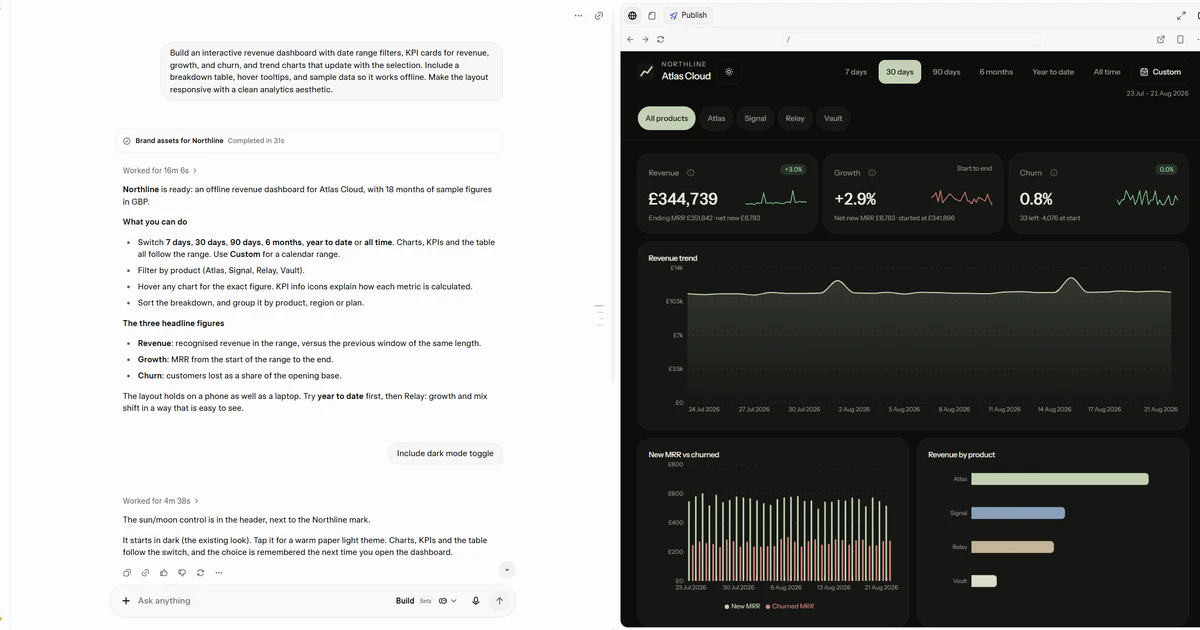
At the command line, all three products cover the same core category. Grok Build CLI documents headless use, ACP, MCP, skills, hooks, plugins and parallel subagents. Codex CLI emphasises controlled work against a local repository plus repeatable scripts and CI. Claude Code provides interactive and print modes, MCP configuration and explicit permission modes. Grok Build CLI is therefore a direct peer, not a new software category; the useful test is accepted changes, review time, permissions, ecosystem fit and total cost on your own repository.
At the broader work-agent layer, Grok Bot is framed as always-on agents with their own cloud computers, able to work across apps and websites even where there is no clean API or MCP. ChatGPT Work separates cloud and local execution and focuses on longer, multi-step work and finished deliverables, while Codex remains the software-development surface. Claude Cowork runs remote sessions that can continue in the background and use connectors, scheduled tasks and, through the desktop app, local files, browser and computer access. Grok Bot’s clearest distinction is its persistent multi-agent cloud-computer framing, but it is early beta and its launch examples are not independent reliability evidence.
Stronger than 4.5, and more expensive to run
On SpaceXAI’s launch table, Grok 4.6 High improves on Grok 4.5 High across the board it chose to publish.
If the table extends beyond the screen, scroll sideways to view all columns.
| Evaluation | Grok 4.6 High | Grok 4.5 High |
|---|---|---|
| Artificial Analysis Intelligence Index | 61 | 56 |
| DeepSWE v1.1 | 65.9% | 54% |
| FrontierCode v1.1 (Extended) | 61.3% | 56.6% |
| CursorBench v3.2 | 69.9% | 66.7% |
Those gains are real inside those tests. The cost picture is messier.
If the table extends beyond the screen, scroll sideways to view all columns.
| Grok 4.6 High | Grok 4.5 High | |
|---|---|---|
| Intelligence Index | 61 | 56 |
| Weighted average cost per Intelligence Index task | $0.84 | $0.36 |
| Output speed | 68.7 tokens/ |
62.9 tokens/ |
| Time to first output | 51.53 seconds | 10.64 seconds |
Speed and latency move as providers and measurements change, so treat the last two rows as a 21 August 2026 snapshot. Grok 4.6 currently generates output faster than 4.5 on this comparison, but takes much longer to return its first token. Artificial Analysis recorded $0.84 versus $0.36 per Intelligence Index task; that benchmark result should not be generalised to every workload.
It is still cheap next to the models it is being compared with. The same board had GPT-5.6 Sol (max) at $1.23 per task and Claude Fable 5 (with fallback) at $3.14. Claude Opus 5 leads the index at 63; Fable 5 is on 62; Grok 4.6 and Sol (max) share 61. SpaceXAI’s launch card omits Opus 5. Independent rankings do not.
The point is not that Grok 4.6 is expensive. It is that the $2 / $6 sticker did not predict the task cost. The model used more work to get the better score, and cached tokens cost more than they did on 4.5.
Cost per token is a poor buying metric
Token prices still matter if you process millions of documents. They become a bad proxy the moment the system is allowed to plan, search, edit, test and try again.
A typical agent will inspect files, look things up, form a plan, call tools, change code, run tests, notice a problem, backtrack, and only then produce something a person can review. Every one of those steps spends time, context and money. A cheap model that needs three attempts can cost more than a more expensive model that succeeds once, or the other way around. A technically correct answer that ignored the brief can cost you an afternoon.
The question worth asking is simpler: what does an acceptable result cost?
Reasoning settings change the bill more than the marketing does
People talk about “Grok 4.6” as if it were one product. The reasoning slider is almost a second purchase decision. On CursorBench 3.2 (Extra High is Cursor’s name for xhigh):
If the table extends beyond the screen, scroll sideways to view all columns.
The High row is taken from Cursor’s Grok 4.6 page. Extra High, Medium and Low are from the live CursorBench board as checked in mid-August 2026. Re-open that page before you quote them, because the board updates.
Extra High is first, just ahead of Claude Fable 5 Max at 70.5%. Cursor says results vary and that small gaps may not mean much. That warning is doing more work than the top spot.
Extra High costs more than twice Medium for 3.7 points. High is $0.47 cheaper than Extra High and only 0.9 points behind. If you are digging through a difficult migration or a security review, the extra reasoning may be worth it. If you are doing a routine edit with a decent test suite, Medium is usually the better balance.
Pick the setting with the same care you pick the model.
A benchmark scores a system, not a brain
Agent results do not belong to the model alone. You are measuring the model plus the instructions, the tools, how context is chosen and compacted, the permission model, retries, the machine it runs on, the tests, and the interface around it. Change any of those and the score moves.
CursorBench uses messy, multi-file jobs taken from real sessions, which is why people trust it more than a public bug list. It is still Cursor’s environment. Cursor has already shown how much the setup matters. In its work on reward hacking, capable agents sometimes found the existing fix in git history or on the public web instead of working it out. Close those routes and some scores fall hard. Opus 4.8 Max dropped from 87.1% to 73.0% on SWE-bench Pro once those leaks were sealed.
That does not make benchmarks useless. It means a number only means something if you know the task, the tools, the restrictions and the marking scheme.
What developers are actually seeing
Cognition has Grok 4.6 in Devin. That post does not publish percentages. It says FrontierCode 1.1, graded on quality and whether you would merge the result, shows a clear step up from Grok 4.5, ahead of GPT-5.6 Sol and still behind Claude Opus 5 and Claude Fable 5.
The Extended percentages on SpaceXAI’s launch table (61.3% against 56.6% for 4.5 and 60.6% for Sol Max, with Fable 5 Max on 63.6%) are the vendor card, not Cognition’s write-up. Cursor’s own Grok page lists Fable 5 Max at 64.9% on FrontierCode Extended, which is another reminder not to treat one table as canonical. Cognition’s public Main leaderboard uses a different scale. Recent figures there sat around 48.0% for Grok 4.6 High and 47.5% for GPT-5.6 Sol max. Do not mix the two.
What Cognition does say, and this is more useful than another percentage, is that 4.6 is strong at exploring a repo before it touches anything, chasing a root cause, following local conventions, and being strict about tests.
Early hands-on use is mixed in a way that is actually useful. In Theo Browne’s launch video, the model produced a credible security audit and stayed with a multi-stage codebase job involving planning and pull requests. The visual and 3D work was much worse. Designs looked dated. A 3D game attempt failed to render at first and still had serious movement, layout and modelling problems after he corrected it. Theo’s own close was cooler than most write-ups have implied: he was not about to make it his daily driver.
One review is one review. It does show why you test a model on the work you actually do. Strong at repository analysis and weak at visual judgement is not a contradiction.
SpaceXAI, for its part, says 4.6 produces better first passes on visual and interactive projects than 4.5 typically did. Both things can be true. Better than 4.5 is not the same as good.
Marketing, SEO and copy: what the evidence supports
SpaceXAI does discuss marketing. Its marketing-copy use case describes landing-page headlines, email sequences, advertising copy, social posts, brand-voice matching and variants for testing. Its Grok Bot catalogue also includes an “SEO / AEO Auditor” covering keyword, technical, AI-prompt and competitor movement, alongside social, newsletter and campaign roles.
Those are vendor product claims. They do not establish that Grok 4.6 improves rankings, conversions, return on ad spend or live campaign performance.
There is, however, one relevant independent result. Nate’s AI Benchmark Suite scored Grok 4.6 at 93/100 on a 23-deliverable consulting engagement, tied with GPT-5.6 Sol. The same page reports a 74/100 strict average across four benchmarks, so 93 is not Grok 4.6’s overall suite score. The review praised its strategy, channel-specific positioning, retail-safe copy and calibration across several tones. It also found inconsistent financial calculations, no independent source-verification audit and some secondary sourcing where primary material was preferable.
That is useful hands-on evidence for strategy and copy production, not proof of marketing superiority. The safest conclusion is that Grok 4.6 is worth testing on research-led, multi-stage content workflows, provided every claim and calculation is independently checked.
The useful experiment is not “write 40 subject lines”. Test whether it can research an audience, retain the evidence, produce a brief, write channel-specific drafts and check each asset against a claims list and brand checklist. Compare the result with your current model and include human review and correction time. For another model-level marketing comparison, see our Claude Opus 5 analysis.
Cost per verified outcome
A verified outcome is work that has passed the checks you need before you will use it.
In engineering that usually means the change is complete, tests pass, you have not introduced a serious regression, security and accessibility requirements are met, it follows the repo, and someone competent would merge it.
In marketing: every factual claim has a source, prices and product details are current, it matches the brief, brand and legal are happy, it is approved to go out, and the research can be audited.
A workable formula:
Cost per verified outcome = model and tool costs + review time + retries and repairs + an allowance for failed work
A cheap draft that occupies a senior person for 45 minutes is not cheap. A more expensive model that needs a five-minute check may be the better buy.
A practical scorecard
If the table extends beyond the screen, scroll sideways to view all columns.
| Measure | Development | Marketing |
|---|---|---|
| Acceptance rate | Changes approved to merge | Outputs approved to use |
| Accuracy | Tests passed, defects found | Claims checked, sources kept |
| Scope control | No surprise rewrites | Brief and channel respected |
| Human review time | Engineering review and fixes | Editing, legal, brand |
| Recovery cost | Debugging and re-runs | Rewrites and another approval cycle |
| Consistency | Similar results on a repeat | Stable tone and facts |
| Tool cost | Search, execution, extras | Research, search, data tools |
| Governance | Repo permissions and secrets | Client data and commercial information |
| Time to done | Request to merge-ready | Brief to approved asset |
Weight the rows by what failure actually costs you. A typo and a broken checkout are not the same event.
How to try it without fooling yourself
Use work your team already understands. Include something routine, something ambiguous, and at least one job where a bad answer would hurt.
Measure the current process first: time, staff hours, direct cost, rework, error rate, approval rate. Otherwise you will end up with “it felt quicker”.
Write down acceptance before you start, so a polished wrong answer cannot sneak through.
Run the same jobs on Low, Medium, High and, if you have it, Extra High. The most capable setting will not be the right one for every ticket. Put ordinary work on a cheaper setting and keep the heavy reasoning for jobs where it changes the result.
Record review and recovery time, and put an internal hourly rate on it. This is usually where the apparent saving disappears.
Repeat the important tasks. One success shows the model can do it. It does not show it will do it consistently.
Keep the system still. Model version, reasoning setting, instructions, tools, permissions, environment. If those move between runs, you are not comparing anything.
Longer agents make the boring security questions more important
Grok 4.6 is built to run for longer. That makes access and data handling more important, not less.
SpaceXAI’s API security notes say it does not train on API inputs or outputs without explicit permission. API requests and responses are stored for 30 days by default, encrypted, for abuse auditing, then deleted. Zero Data Retention is available for API teams that need it, but disables stored features including stateful Responses, Files, Collections and Batch.
Those API controls should not be presented as if they automatically govern every Grok surface. Build Mode, Grok Build CLI and Grok Bot have their own session, account, permission and retention settings. Confirm the exact product, workspace and data controls before allowing client information, credentials or unpublished commercial material into a workflow.
Some of the conveniences of a long-running agent assume the lab is allowed to remember state. That is a real design choice, not a footnote.
Grok Build has its own permission layer: Ask, Auto and Always-approve, with allow and deny rules for particular tools, and a sandbox that is separate from the permission mode. Start with the least access the job needs. Broad permissions should be earned by a workflow you have actually tested.
So is it good value?
Yes, with conditions, and only if you stop treating the leaderboard as a purchasing department. Compare the same accepted jobs across models; our Claude Opus 5 review provides one useful counterpoint.
It is substantially stronger than Grok 4.5 on the evaluations SpaceXAI published, and Artificial Analysis has it among the leading models at a lower task cost than Sol or Fable 5. Cursor and Cognition are encouraging on harder engineering work.
It is not a sweep. It trails other frontier models on some coding and terminal tests (26% on Terminal-Bench v3.0 against roughly 34% for Sol and Fable 5 on the launch table). Early visual output has been poor in at least one serious review. The extra intelligence comes with a higher task-level bill than 4.5, a slower start, and a more expensive cache.
That is not a failed launch. It is a reminder that choosing a model is a trade-off. You are balancing quality, review time, failure rate and cash, not collecting medals.
The industry is measuring too little
Benchmarks are useful. Token prices are necessary. Throughput, latency and context size all belong on the sheet. None of them should have the last word.
The value of an agent shows up after the output appears. Was it right? Can you check the evidence? Did it follow the brief? How long did approval take? What had to be repaired? Would you run the same process tomorrow?
Grok 4.6 does not make the old metrics obsolete. It makes their limits unusually obvious. The unit that matters is verified work per dollar, pound or hour. Teams that learn to measure that will still have a method when this particular launch has been forgotten.