



SpaceXAI launched Grok 4.7 on 21 September 2026 as its latest model for coding and knowledge work. It is available through the xAI API, Cursor and Grok Build, with a gradual rollout across GitHub Copilot. Standard direct API pricing starts at $2 per million input tokens and $6 per million output tokens, unchanged from Grok 4.6.
For UK web and marketing teams, the useful question is whether it can improve work you already do: reviewing content, preparing reports, working through research packs or fixing websites.
Our recommendation is to run a small comparison against your existing models. Independent professional-work evaluations give it a credible case for a trial. They do not establish that it writes better advertising copy or improves campaign results.
Where can you use Grok 4.7?
There are several documented access routes, but they have different subscriptions, settings and billing rules. Start with the product you intend to use rather than assuming a Grok subscription covers everything.
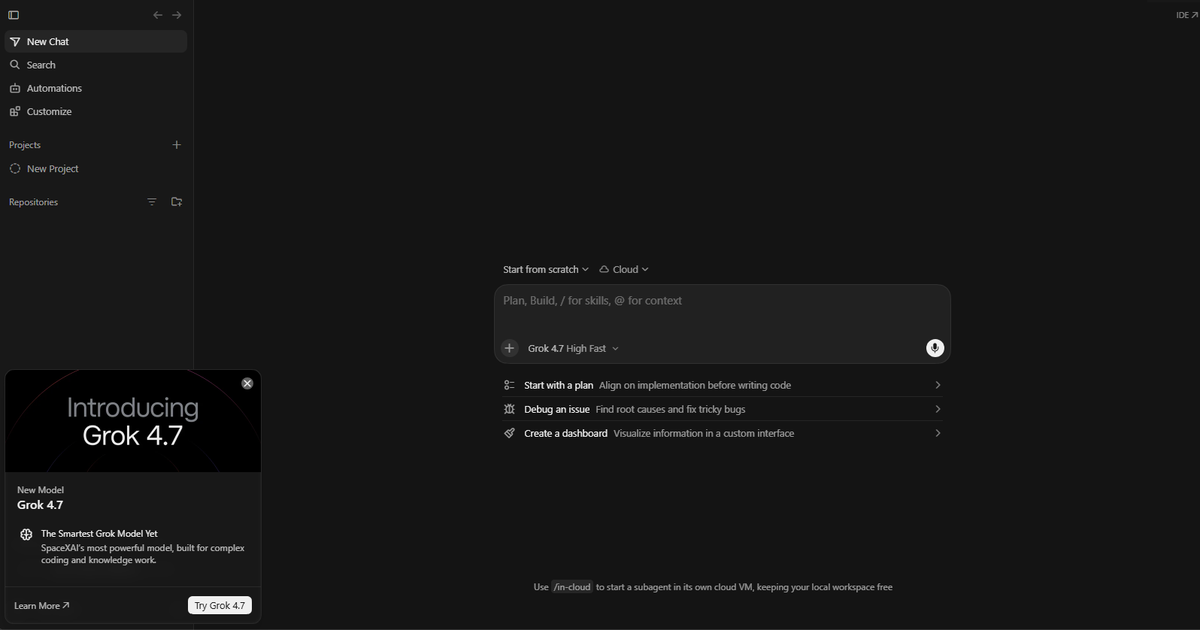
Documented access routes
The following availability review reflects documentation and platforms checked on 21 September 2026.
| Route | Status | What to know |
|---|---|---|
| xAI API | Available | The model documentation lists grok-4.7 for the Responses and Chat Completions APIs. |
| Cursor | Paid access documented | Cursor’s model page places usage in the Cursor Models pool, with Fast enabled by default on Pro and above. SpaceXAI says “all plans”, but the checked Cursor documentation did not establish free Hobby entitlement. |
| Grok Build | Available as the documented default | The developer guide refers to a Grok Build free tier that excludes Fast. The pages checked did not specify which accounts qualify or a numerical free allowance. |
| GitHub Copilot | Rolling out gradually | GitHub lists access for Pro, Pro+, Max, Business and Enterprise across VS Code, Visual Studio, Copilot CLI, the cloud agent, the Copilot app, JetBrains, Xcode and Eclipse. Organisation policies can affect access. |
| OpenRouter | Listed | The OpenRouter listing uses x-ai/grok-4.7. Check the selected provider and pricing tier. |
| Vercel AI Gateway | Listed | The Vercel listing uses spacexai/grok-4.7. Its launch pricing ended on 27 September 2026 (updated 7 October 2026). |
Routes where model-specific access was not confirmed
| Route | What the checked sources established |
|---|---|
| Cloudflare AI Gateway | SpaceXAI names Cloudflare as a gateway, and Cloudflare documents xAI routing. Its checked model catalogue did not list Grok 4.7. We did not test a request. |
| grok.com, iOS and Android apps; Grok on X | The consumer overview, rechecked on 22 September, links to the Grok 4.7 launch. It does not specify a dated rollout across the apps and X, or which subscriptions include the model. |
| Grok Bot in Cursor | Cursor manages model selection, and Grok Bot has no customer-facing model picker. Linking SuperGrok or X Premium+ grants Bot usage without upgrading the Cursor plan. |
| Google Cloud partner models | Grok 4.7 was absent from the checked partner-model catalogue. |
| Amazon Bedrock | The checked AWS model cards listed Grok 4.3 and 4.6, but not 4.7. |
| Microsoft Foundry | The checked Foundry Grok guide listed 4.6 preview and older models, but not 4.7. |
An absent catalogue entry does not rule out an account-specific preview. These findings are dated because launch availability can move quickly.
GitHub Copilot, Microsoft Copilot, Copilot Studio and Microsoft Foundry are also separate products. Availability in one does not establish availability in the others.
If you can see Grok 4.7 but cannot start a task, check the feature as well as the model. Cursor’s Cloud Agent access depends on your plan, while GitHub organisation policies and its staged rollout can affect access.
What can the model handle?
The direct API specification lists a 500,000-token context window, text and image inputs, and text output. Its documented knowledge cut-off is May 2026. For newer information, supply current sources or enable an appropriate search tool. Batch API requests are not supported, and host products can impose their own limits.
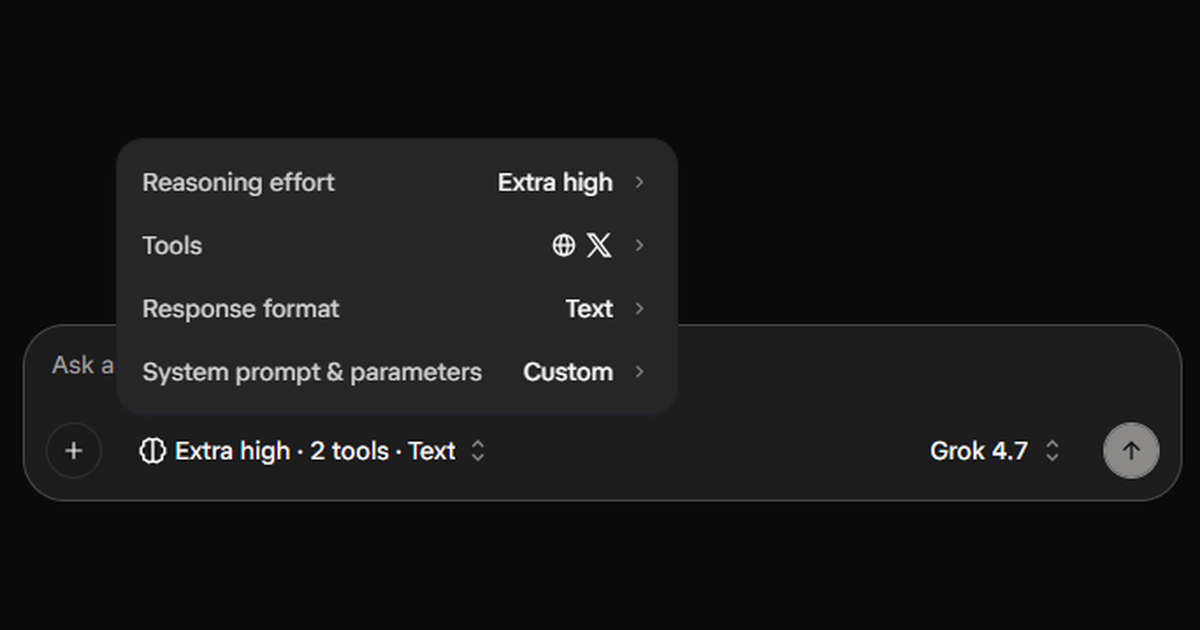
The reasoning setting can be low, medium, high or xhigh. High is the default; reasoning cannot be switched off. Test the setting against the job. Extra thinking takes time and uses tokens, so judge whether it produces work that needs less correction. Selecting xhigh is no guarantee of better copy.
A large context window makes room for substantial source material. It does not guarantee that every deadline, figure or qualification will survive a summary. For business documents, ask for references and check important details against the originals.
What UK teams should check about data handling
The regional API documentation describes a global endpoint without a guaranteed processing location and a US endpoint with a 10% token-price premium. It does not list a UK or EU endpoint. The US commitment excludes Files, Collections, server-side tools and network transit.
Check the route your team will actually use. The direct API’s terms do not automatically describe how Cursor, GitHub or a gateway handles data.
GitHub’s model-hosting documentation describes xAI’s zero-data-retention API policy for its xAI-hosted models, including Grok 4.7. That is a retention commitment, not a guarantee of UK processing.
How much does Grok 4.7 cost?
The headline rate is only a starting point. Your bill depends on the provider, context length, speed setting, tools and number of attempts needed to finish the job.
Token rates describe metered usage. A subscription may include an allowance that usage draws down. Cached input gets the lower rate only when the request produces a cache hit. Repeating a prompt does not guarantee one.
For a direct API integration, follow the caching guidance: use prompt_cache_key with the Responses API or the x-grok-conv-id header with Chat Completions to improve cache reuse. Check the returned cached-token count before budgeting for the saving.
The following rates are USD per million tokens. They describe published usage-based tiers. Legacy plans and separately agreed terms may differ.
| Route and condition | Input | Cached input | Output |
|---|---|---|---|
| xAI global API, prompt below 200,000 tokens | $2.00 | $0.50 | $6.00 |
| xAI global API, prompt of 200,000 tokens or more | $4.00 | $1.00 | $12.00 |
| xAI US endpoint, prompt below 200,000 tokens | $2.20 | $0.55 | $6.60 |
| xAI US endpoint, prompt of 200,000 tokens or more | $4.40 | $1.10 | $13.20 |
| GitHub Copilot, up to 200,000 input tokens | $2.00 | $0.50 | $6.00 |
| GitHub Copilot, above 200,000 input tokens | $4.00 | $1.00 | $12.00 |
| Cursor standard, up to 256,000 input tokens | $2.00 | $0.50 | $6.00 |
| Cursor Fast, up to 256,000 input tokens | $4.00 | $1.00 | $12.00 |
| Cursor standard, above 256,000 input tokens | $4.00 | $1.00 | $12.00 |
| Cursor Fast, above 256,000 input tokens | $6.00 | $1.50 | $18.00 |
| OpenRouter catalogue, prompt below 200,000 tokens | $1.60 | $0.40 | $4.80 |
| OpenRouter catalogue, prompt of 200,000 tokens or more | $3.20 | $0.80 | $9.60 |
xAI pricing boundary: the table follows the public pricing page, which puts 200,000 prompt tokens in the higher tier. The Grok 4.7 console screen supplied to AIWIZ instead shows standard rates up to and including 200,000, with higher rates above that. The official sources disagree at exactly 200,000 tokens; confirm that boundary with xAI if your budget depends on it.
GitHub’s higher tier starts above 200,000 input tokens and Cursor’s above 256,000. xAI and Cursor apply the applicable tier to the whole request. GitHub’s pricing table does not explain that allocation in the same detail.
For example, 190,000 uncached input tokens on the standard xAI global API cost $0.38; 210,000 cost $0.84. That calculation excludes output, tools and other premiums.
OpenRouter also lists separate Priority endpoints starting at $3.20 input, $0.80 cached input and $9.60 output. Those figures match its standard long-context row, but describe a different service condition.
Vercel advertised launch rates of $1.20 input, $0.30 cached input and $3.60 output until 27 September 2026. That offer has ended. When we checked the listing on 7 October 2026, it showed $2 input, $0.50 cached input and $6 output per million tokens. Its listing includes further pricing tiers, so check which applies to your request.
Fast mode and additional charges
Fast uses the same model on faster infrastructure. SpaceXAI’s developer guide advertises twice the output speed and makes it available in Cursor and Grok Build, excluding Build’s free tier. It explicitly says Fast is not available through the public API.
Under Cursor’s published rates, Fast costs twice the matching standard rate up to 256,000 input tokens and 1.5 times the corresponding long-context standard rate above the threshold. Check the switch before starting a long session.
Grok Build Fast has a different threshold. Its published rate card lists $4 input, $1 cached input and $12 output per million tokens below 200,000 prompt tokens. Above 200,000, those rates rise to $6, $1.50 and $18 respectively. Do not apply Cursor’s 256,000-token threshold to Build. The Fast card says the higher rate applies when a prompt exceeds 200,000 tokens; confirm the charge at exactly that boundary if it affects your budget.
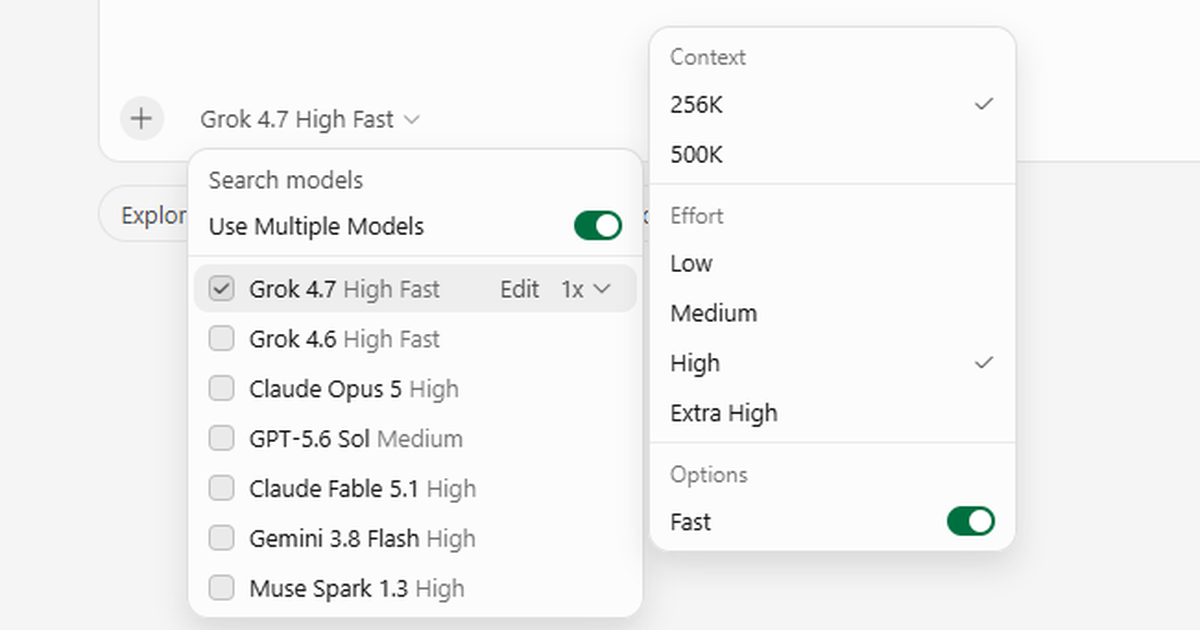
Direct API priority processing is separate: the 2× token charge applies when the response confirms priority service.
The API pricing page also lists additional tool charges. Web search, code execution and attachment search each cost $5 per 1,000 calls (checked 9 October 2026). From 20:00 BST on 21 September, X Search changed to $5 per 1,000 posts fetched and $10 per 1,000 profiles. Use the dated notice rather than the older per-call row.
Tool use also consumes tokens. The tool-pricing schedule lists Collections Search at $2.50 per 1,000 calls. Remote MCP tools have no xAI invocation fee, but their token usage is charged; the connected service may have its own fees. Files and Collections stored on xAI can add storage charges. Include those costs when comparing a recurring reporting workflow.
Subscriptions and included usage
Cursor’s individual plans cost $20 a month for Pro, $60 for Pro Plus and $200 for Ultra, before tax. They include a Cursor Models usage pool, but the checked plan page does not translate that into a fixed Grok 4.7 allowance. Optional on-demand usage is charged separately. India’s Start plan fixes Grok 4.7 at medium effort and standard speed.
GitHub’s published usage-based allowances are:
Under GitHub’s model-billing rules, one AI credit represents $0.01. Flex allowances can change, and legacy annual subscriptions using request-based billing have separate rules. Copilot Free uses automatic model selection; it is not listed for selectable Grok 4.7 access.
Is Grok 4.7 better than Grok 4.6?
Published evaluations show improvements, but the settings and tasks matter.
SpaceXAI’s launch table reports CursorBench 4.0 rising from 40.4% to 46.3%, DeepSWE v1.1 from 65.2% to 71.0%, and Terminal-Bench 4.0 from 20.3% to 38.0%.
These are vendor-published results. Most compare Grok 4.7 at xhigh with Grok 4.6 at high; the 4.7 DeepSWE result uses high. The table does not isolate how much of each difference comes from the model change rather than its configuration.
Cursor’s own comparison uses the same named effort level. Grok 4.7 High scores 43.9% on CursorBench 4.0 at an estimated $4.69 per task, against 40.4% and $5.20 for Grok 4.6 High. Cursor is commercially involved with the model and cautions that small score differences may not be statistically meaningful. These costs describe benchmark tasks, not a forecast for your work.
What independent testing tells us
Artificial Analysis scores Grok 4.7 xhigh at 46 on Intelligence Index v4.3.2. It also reports approximately 81,000 output tokens per task, versus 38,000 for Grok 4.6 xhigh. Those are evaluation averages, and output-token consumption should not be confused with the length of the visible answer. They are a reason to measure total task cost rather than relying on an unchanged unit price.
For reporting and document work, the professional evaluations are particularly relevant. At xhigh, Grok 4.7 scores:
- 1,657 on AA-Briefcase v1.1, against 1,555 for Grok 4.6.
- 1,695 on GDPval-AA v2.1, against 1,632 for Grok 4.6.
These are relative Elo ratings, not success percentages.
The AA-Briefcase methodology assesses business deliverables created from supplied files using tools, including the quality of the analysis and presentation. It does not test live web research. In a separate comparison of 4.7 xhigh with 4.6 high, Artificial Analysis reports stronger analysis but a slightly lower presentation score. That is neither a same-effort comparison nor a verdict on brand writing.
Taken together, the evidence supports trying Grok 4.7 on reports and document workflows. Whether it improves your copy, saves review time or helps a campaign remains something to test.
Using tools with Grok 4.7
A recurring report needs reliable figures, consistent fields and sources you can check. Grok 4.7 supports tools that can help with each part, provided the connections and permissions are in place.
| Capability | What it does | What a team could test |
|---|---|---|
| Custom function calling | Grok requests a tool call with structured arguments. Your application runs it and returns the result. A response can request several calls. | Retrieve campaign figures, product details or CRM records through an authorised integration. Grok does not gain access to those systems simply because you ask. |
| Structured outputs | Return fields in a supported JSON schema, including after using tools. | Produce consistent content briefs, product records or report sections for another system. Check the facts inside the fields: the right format does not make them correct. |
| Code execution | Run Python through the API’s code-execution tool. | Calculate period-on-period changes and reconcile supplied figures before drafting the commentary. Check the data, calculation and assumptions. |
| Collections search | Search uploaded document collections and return references to source files. | Find approved product facts, brand guidance or previous reports for a draft, then check the cited passages. |
| Remote MCP tools | Connect configured tool servers and choose which tools Grok can access. | Bring an existing business system into the workflow. We would start a reporting trial with only the read-only tools it needs. |
For example, a reporting trial could retrieve approved campaign figures, calculate the changes and return a summary with sources and unanswered questions. Review the numbers and the explanation before sending it to a client. Count that review time when deciding whether the workflow saves work.
What web and marketing teams should test
Start with work you can judge. A bounded task, reliable source material and a clear acceptance criterion will tell you more than asking for an impressive answer.
The following are proposed trials, not results from an AIWIZ comparison. SpaceXAI promotes research synthesis, writing and marketing copy as uses for Grok broadly. Those examples do not establish Grok 4.7-specific gains in writing quality or conversion rates. Access to Search Console, GA4, advertising accounts or client systems depends on tools, connectors or integrations you have configured and authorised.
Research-led writing and editorial review
Give Grok an article, an approved source pack and your brand guidelines. Ask it to identify unsupported claims, contradictions and missing information before requesting a rewrite.
Then check what changed. Did it preserve the meaning? Are the citations still accurate? Does it sound like your business? Count useful corrections, errors introduced and editing time.
SpaceXAI lists long-form writing and iterative editing among Grok’s intended uses. That establishes a suggested workflow, not proof that Grok 4.7 is a better writer for your brand.
Client reporting and campaign briefs
Supply approved exports, metric definitions, date ranges and relevant account notes. Ask for calculations, an executive summary and recommendations tied to the evidence.
Reconcile the totals. Keep observed changes separate from proposed explanations: a rise in enquiries is a result; the reason for that rise may still need investigation.
For competitor or positioning briefs, require sources for factual claims and separate them from proposed messaging. Grok supports search and code execution when configured, but retrieved social posts should not be treated as a representative customer survey.
Copy variants and content repurposing
Start from approved product facts and existing copy. Ask for landing-page alternatives, an email sequence or social posts adapted from a finished article.
Judge accuracy, voice, format and whether the variants offer meaningfully different angles. Ten versions of the same sentence are not ten useful ideas.
SpaceXAI describes marketing copy and repurposing as intended workflows. Campaign performance still gets tested after editorial sign-off, not in the chat window.
WordPress and JavaScript development
Provide the relevant PHP, JavaScript or TypeScript, error logs and a clear specification. Ask for a diagnosis, a proposed fix and appropriate tests.
A developer should review the change, run it on staging and check for regressions. Generated tests can pass while missing the actual requirement.
Measure time to an accepted fix, including retries and review. State the WordPress and PHP versions: version-specific behaviour, such as the changes covered in our WordPress 7.0 guide, can affect the right answer.
Technical SEO and analytics investigation
Use a crawl export and affected HTML to investigate canonical tags, or a GTM export and tracking specification to review event names and consent settings. Require evidence for each finding.
Then verify the behaviour. SEO findings need checks against the live site and relevant Search Console data. Tracking findings need Preview, consent-state and network checks. A configuration export shows what is configured; it does not prove what fired during a visit.
Track confirmed findings and false alarms. Measure any ranking or commercial effects separately after implementation.
Long specifications and research packs
Ask for obligations, deadlines and open questions with page references. Check critical figures and inspect the originals for omissions.
Leave room for instructions and output, and check the host’s context limit and pricing threshold before uploading a large pack. More room for documents is useful only if the resulting work is dependable.
How to run a useful comparison
Choose five to ten representative tasks and write down what an acceptable result looks like. This is a practical pilot, not a statistically representative benchmark.
Use the same source files, prompts and permitted tools across Grok 4.7 and your existing models. Repeat important tasks so one unusually good or bad response does not decide the outcome.
Record the model version, host product, supplied context and reasoning effort. Record Fast separately. Matching labels such as “high” do not establish equal compute budgets across providers; compare settings you would realistically use.
Set a spending limit and measure:
- Correctness and completeness.
- Time to an accepted result.
- Human review and correction time.
- Retries, token consumption and tool charges.
- Total cost across all attempts.
Keep response speed separate from completion time. A quick draft that needs three rounds of correction may save nothing.
Distinguish included subscription usage from extra charges so you do not count the same usage twice. Include human review and rework in your comparison.
Use synthetic material until the selected access route and tools meet the client’s data-handling requirements. For writing tasks, hide the model names from reviewers and score accuracy, voice and usefulness separately.
Should your team switch to Grok 4.7?
We would test it before changing a default, particularly if it is already available inside a tool the team uses.
Reporting, document review and development are sensible starting points because the published evidence gives you specific capabilities to investigate. Writing and repurposing are also worth trying, provided you judge them against your own briefs and brand standards.
Keep the model that produces the best accepted work at a sensible total cost. That includes time spent checking sources, correcting mistakes and bringing the output into your voice.
If you want help evaluating AI across your content, reporting or web workflows, get in touch with AIWIZ. We will tell you what we would do, including when the answer is to stay where you are.