




AI is no longer confined to helping marketing teams write copy, analyse data or produce campaign variations. It has started to influence the customer’s side of the journey too: researching products, comparing providers and deciding which brands deserve consideration.
That shift ran through Adobe Summit London 2026, held at the InterContinental London – The O2 on 7 July. The event brought Adobe’s latest thinking on customer experience, content and agentic AI to a UK audience of marketing leaders, practitioners and technology specialists.
The message that mattered most was bigger than any product announcement. The relationship between brands, customers and marketing technology is being redrawn, and marketers who treat this as a tooling upgrade will miss the point.
The next website visitor may not be human
For more than two decades, digital visibility has largely meant being found through search engines, social platforms, marketplaces and paid media. Those routes still matter, but they are no longer the whole picture.
A customer can now ask an AI assistant to find a suitable product, compare several suppliers, explain the differences and recommend a shortlist. Much of the research that once happened across multiple websites may instead take place inside ChatGPT, Gemini, Claude, Copilot or another conversational service.
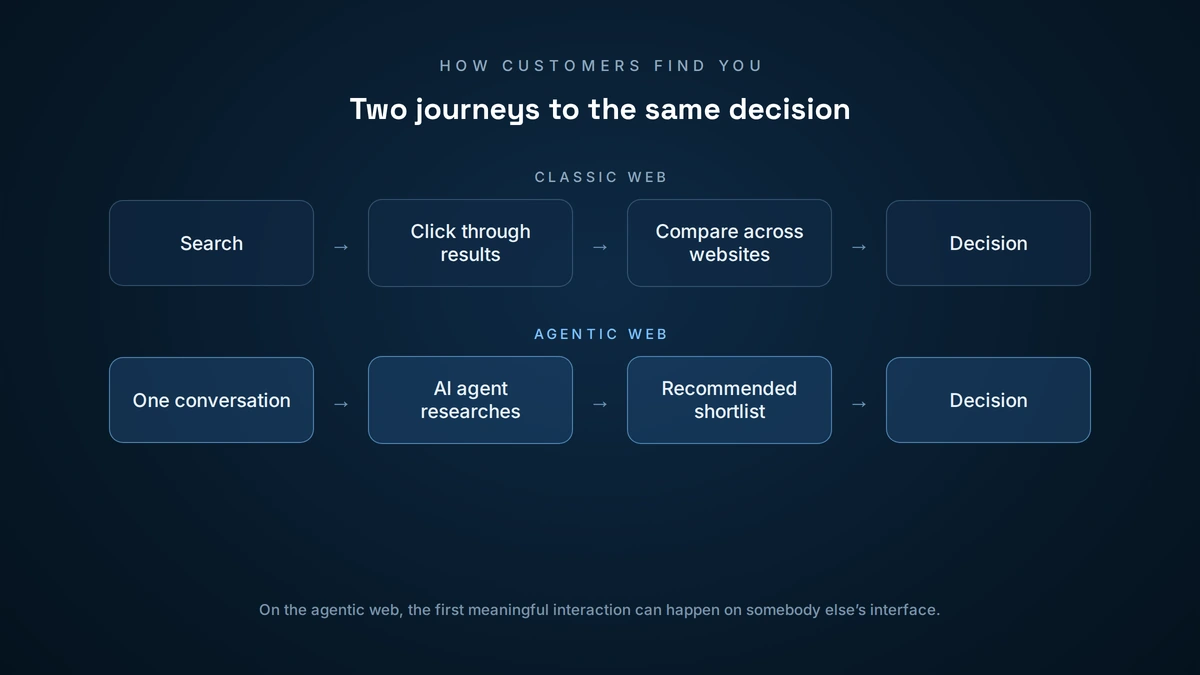
Adobe’s official Summit London programme described this as the “agentic web”: an environment in which AI systems increasingly mediate how people discover, evaluate and buy.
That raises an uncomfortable question. If an AI agent investigates your market, will it understand what your company offers, who it serves and why it is credible? And will it find enough reliable evidence to include your brand in its answer?
An independent account of the event by Bernard Marr reported that more than 3,000 marketers, technologists and creatives attended. His strongest takeaway was that the first meaningful interaction with a customer may increasingly happen on somebody else’s interface.
One demonstration he described involved Heathrow, whose Head of Digital spoke in the event’s agentic web session. A traveller used ChatGPT to plan a journey, identify relevant airport services and find a suitable lounge. Rather than forcing the traveller to abandon the conversation and start again on a conventional website, the experience allowed Heathrow to stay involved as the enquiry developed.
This goes further than the arrival of another search channel. It changes what it means for a brand to be visible at all.
SEO remains important, but visibility is getting broader
The rise of AI-assisted discovery does not make search engine optimisation obsolete. AI systems still depend on accessible pages, clear language, structured information, credible sources and consistent signals about a business.
What changes is the range of questions marketers need to ask.
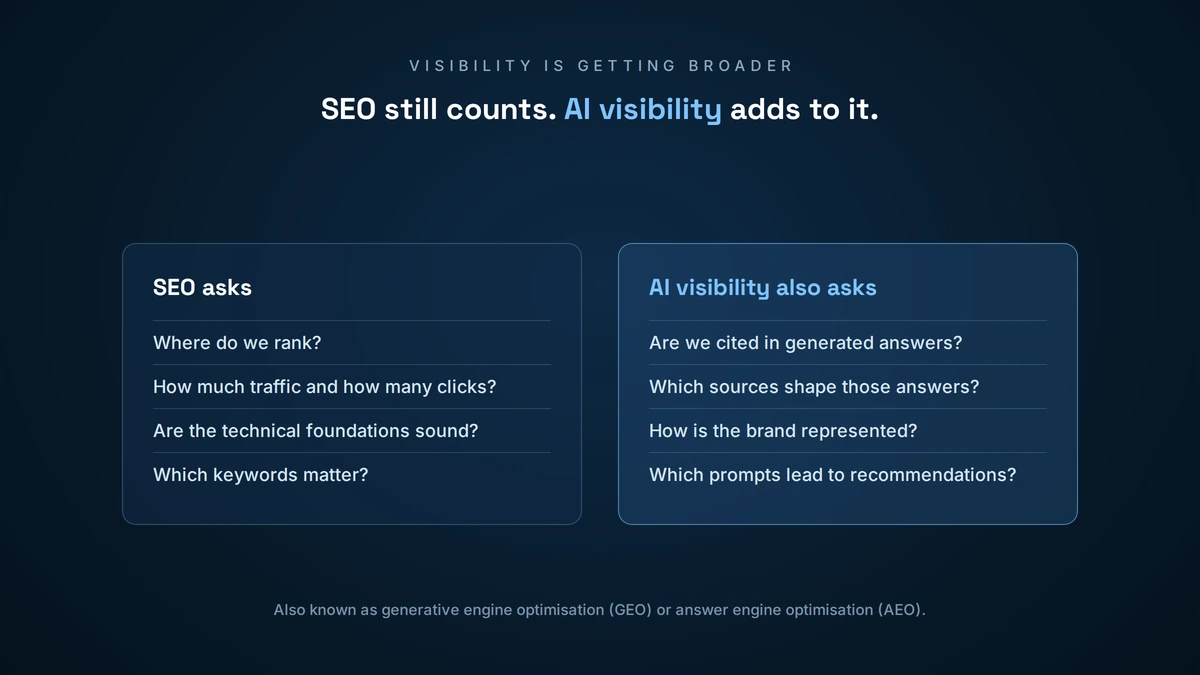
Traditional SEO often begins with rankings, traffic and clicks. AI visibility also requires businesses to understand how their brand is represented in generated answers, which sources influence those answers and which customer prompts lead to recommendations.
This discipline is collecting names almost as quickly as it is collecting tools. Generative engine optimisation (GEO), answer engine optimisation (AEO) and AI search optimisation all describe broadly the same work: making sure AI systems can find, interpret and cite a brand accurately.
Adobe’s answer in London was its LLM Optimizer, which featured in several sessions on brand visibility for the agentic web. A few weeks before the event, Adobe had announced Adobe Brand Visibility, a broader solution that brings LLM Optimizer together with the AI-search intelligence Adobe gained through its acquisition of Semrush. At the time of writing, Brand Visibility is listed as coming soon.
Adobe says the platform will examine how brands appear across services including ChatGPT, Claude, Perplexity, Google AI Mode and Microsoft Copilot. It combines this with prompt research, competitor analysis, technical checks and links to Adobe’s analytics products.
The broader lesson applies whether or not a business uses Adobe. Marketing teams need to understand the questions customers are asking AI systems, not merely the shortened phrases they enter into a search box.
This is where prompt research can strengthen an SEO strategy. Detailed prompts reveal the circumstances, concerns and comparisons behind a search. They can expose gaps that conventional keyword research may flatten into an estimated search volume.
Content written for this environment should answer real questions clearly, support important claims and make the organisation’s expertise visible. Producing hundreds of lightly differentiated articles will not compensate for vague positioning or weak evidence.
Marketing software is moving from tool to coworker
Another prominent theme was the shift from AI assistants to AI coworkers, the point at which agentic AI stops being an abstract term and starts doing work.
An assistant normally waits for an instruction: rewrite this paragraph, summarise these results or suggest an audience. An agentic system can be given a goal, create a plan and coordinate several actions across different applications.
Adobe demonstrated this idea through CX Enterprise Coworker, which Adobe describes as an agentic engine that coordinates data, workflows, approvals and agents across analytics, audience selection, content production and customer journeys.
A marketing team might set an objective such as responding to an unexpected rise in demand for a destination or product. The system could investigate the change, identify an audience, recommend a campaign, prepare content variations and map an appropriate journey.
None of this removes the need for scrutiny. Adobe’s product information repeatedly refers to governance, approval routes and human oversight, and those controls are what make the work usable rather than administrative details bolted on afterwards.
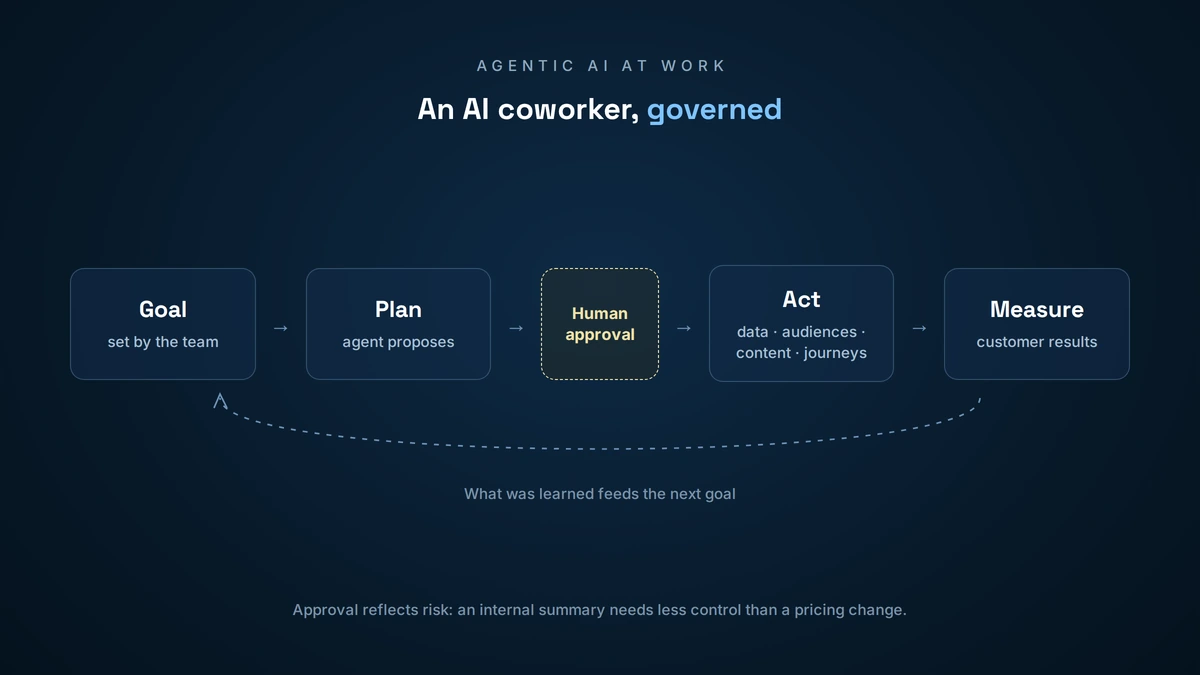
An agent given access to customer data and publishing systems can make mistakes far more quickly than a person working through each stage manually. Poor data, an ambiguous objective or an unsuitable permission can travel across the entire workflow.
Access to an AI agent alone is unlikely to confer much advantage, because similar capabilities will soon be widely available. The advantage will come from the context supplied to it: reliable data, clear commercial objectives, documented brand standards and carefully designed authority.
More content is not automatically better marketing
Generative AI has removed much of the mechanical difficulty from producing copy and images. It has not removed the need for a worthwhile idea.
Several Summit London sessions concentrated on the content supply chain: the people, systems and decisions involved in planning, creating, approving, distributing and measuring marketing material.
Adobe showed how products including GenStudio, Workfront and Firefly could be connected so that a campaign brief leads to production plans, channel variations, brand checks and approval stages.
For organisations managing large numbers of products, markets or channels, the attraction is obvious. Adapting an approved campaign for different formats and regions can consume a considerable amount of time. Automating some of that work gives creative teams more space for the decisions that actually require creativity.
Faster production also makes it easier to fill every channel with competent but forgettable material.
Brand governance needs to mean more than checking the correct logo, typeface and colour palette. It should include the brand’s point of view, evidence standards, vocabulary and creative boundaries. A system can reproduce those decisions consistently, but somebody still has to make them.
The useful question is not how much more content a team can produce. It is which content is worth producing, and how to adapt it without losing what made it effective.
Customer experience is becoming an operating model
The event’s customer sessions made another point that is easily lost among product demonstrations: customer experience is not a layer that can simply be added to a fragmented organisation.
Adobe’s programme included a NatWest marketing-operations transformation story, a session on Farrow & Ball’s connected digital and retail experience, and a discussion of Card Factory’s move from a store-first business towards deeper digital relationships.
The details differed, but the organisational problem was familiar. Customer data may sit in one system, content in another and campaign activity somewhere else. Ecommerce, CRM, customer service and paid media are often managed by separate teams with separate targets.
From the customer’s perspective, none of those boundaries exists. They experience one brand.
AI does not automatically resolve that fragmentation. In some cases it can conceal it for a while by moving information between systems more quickly. Sustainable improvement still requires shared definitions, compatible data and agreement about the customer outcome being pursued.
This is why the event’s move from isolated AI experiments towards operating models felt significant. Running a pilot is relatively easy. Redesigning responsibilities, approval processes and measurement around the technology is the harder work.
Personalisation needs restraint as well as data
Adobe Summit London placed considerable emphasis on real-time personalisation. Connecting customer data, content and journey tools can allow a brand to respond to behaviour far more quickly.
That capability is useful when it removes an obstacle or provides timely help. It becomes less persuasive when it simply produces more messages.
Customers do not experience relevance as a technical achievement. They experience it as the right information appearing at an appropriate moment. That may mean a useful product comparison, a reminder about an unfinished task or guidance based on an expressed preference.
It does not necessarily mean changing every headline, image and offer for every visitor.
Marketing teams should decide where personalisation genuinely improves the experience before investing in the machinery required to deliver it. Otherwise, considerable technical effort can be spent creating differences that customers neither notice nor value.
The same caution applies to predictive decisions. A customer’s past behaviour can suggest what might help next, but it should not trap that person inside a narrowing set of assumptions. Good personalisation leaves room for discovery and change.
What should UK marketing teams do next?
Most organisations will not need to rebuild their entire marketing operation around autonomous agents tomorrow. They do need a clearer view of where the change is heading.
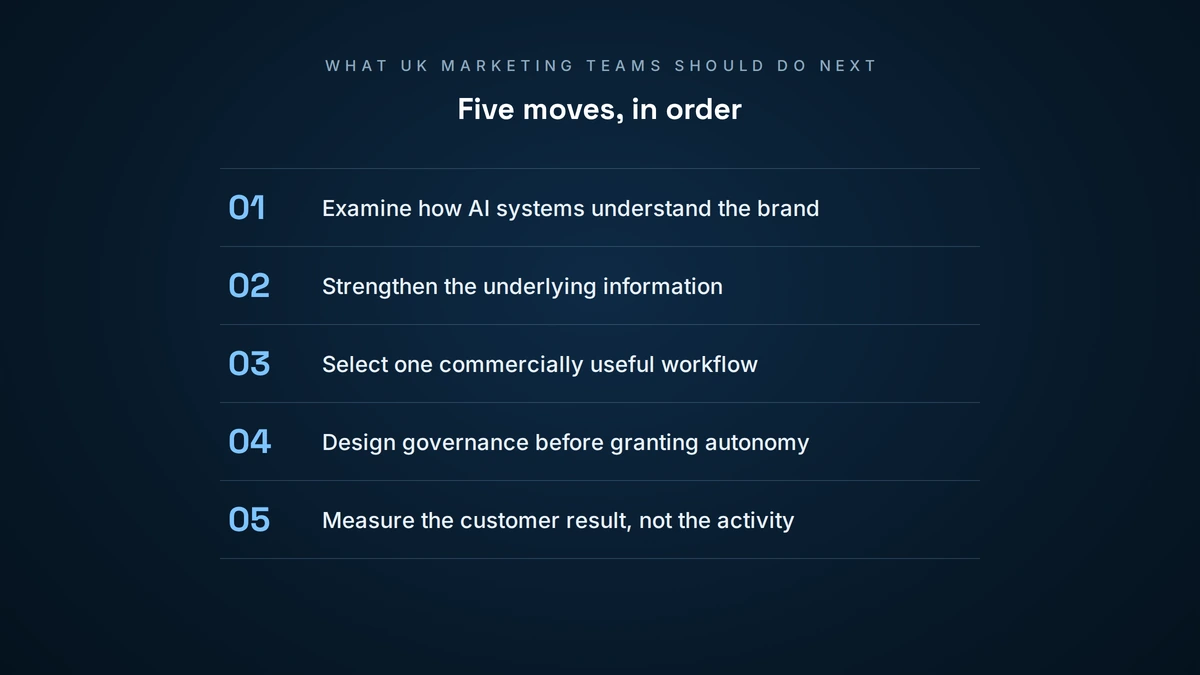
1. Examine how AI systems understand the brand
Ask major AI assistants the questions a prospective customer might use. Look at which companies are recommended, which sources are cited and how accurately your own business is described.
Treat this as research rather than a one-off ranking check. Different prompts reveal different stages of the buying journey.
2. Strengthen the underlying information
Make product, service, location, pricing and expertise information easy to find and interpret. Important claims should be specific and supported by credible evidence.
Clear authorship, consistent company details and well-organised pages help human visitors as well as automated systems.
3. Select one commercially useful workflow
Choose a repetitive process with a measurable outcome. This might be preparing campaign variations, analysing customer signals or building a post-purchase journey.
Define what the system may do, where approval is required and what would count as a successful test.
4. Design governance before granting autonomy
Document the data an agent may access, the actions it may take and the circumstances in which a person must intervene.
Approval should reflect risk. An internal summary does not need the same control as a pricing change, customer communication or automated media decision.
5. Measure the customer result
Production speed is the easiest thing to measure and the least meaningful on its own. Track conversion, retention, enquiry quality, customer satisfaction, unsubscribes and avoidable service contacts.
A marketing process has not improved simply because it produces more activity.
The real lesson from Adobe Summit London 2026
Adobe Summit London showed that agentic marketing is moving from presentation slides into working products and customer programmes. AI can now participate in research, planning, analysis, content production and journey orchestration.
The harder questions remain human ones.
What does the brand want to be known for? Which customer problems are genuinely worth solving? How much authority should an automated system receive? Who is responsible when its judgement is wrong?
Businesses that answer those questions well will be in a stronger position than those pursuing automation as an end in itself.
The next stage of digital marketing will be won by organisations that are easy to understand, useful at the right moment and trusted by both customers and the systems helping them decide. Sheer volume of AI-assisted content will not get anyone there.
For more on the changing relationship between advertising, discovery and automation, read our Google Marketing Live 2026 recap. If your organisation needs a practical plan for AI adoption, content, SEO or marketing automation, explore AIWIZ Digital Marketing’s services or contact our team.