



Microsoft Advertising Activate 2026 covered a lot of ground. Most of it points the same way: search, as UK marketing teams have run it for the past decade, is being remade from the bidding logic upwards.
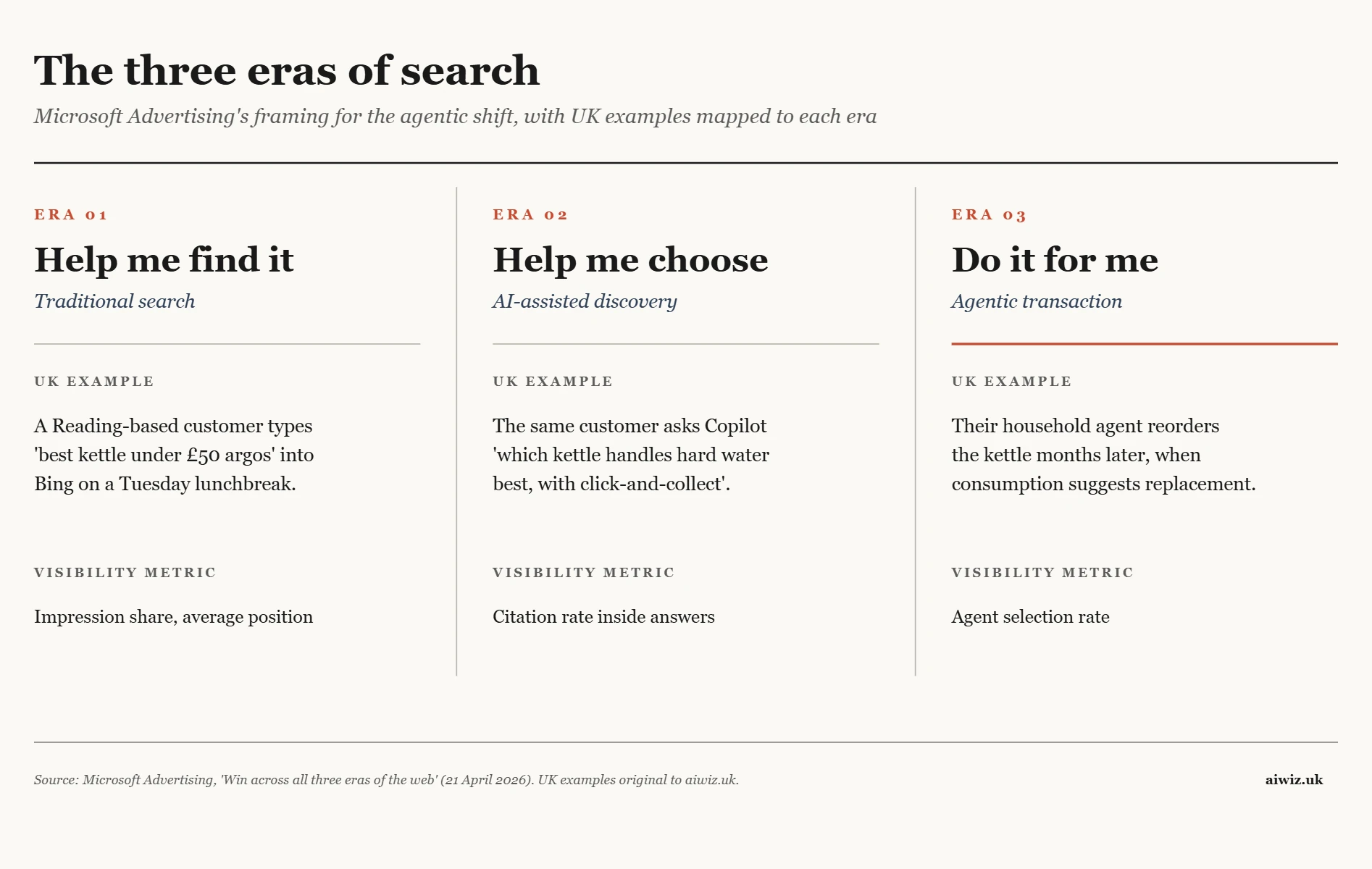
The pivot has a name. Microsoft now frames the present as three concurrent eras of the web, each running in parallel rather than replacing the last. ‘Help me find it’ is the human web of tabs, results pages and price-comparison sites that still delivers most UK traffic today. ‘Help me choose’ is the LLM web, where Copilot and similar assistants synthesise options. ‘Do it for me’ is the agentic web, where an AI agent finds, evaluates and completes the transaction on a person’s behalf. Each has direct consequences for how UK marketing teams will plan and measure paid search through the rest of 2026.
The temptation with an event of this scope is to file the announcements under ‘roadmap’ and carry on. That would be a mistake. Several updates are already live or in pilot. Two will land on agency operations within weeks. The strategic argument running underneath them deserves more than a five-minute review at the next planning meeting.
Why Activate 2026 Matters for UK Marketing Teams
Key takeaways
- AI Max is in open pilot from May 2026 on Bing, Copilot Search and Copilot Answers, with full search-term reporting from day one.
- Offer Highlights is live for retail in English-speaking markets, including the UK, surfacing product differentiators inside Copilot conversations.
- AI Visibility in Microsoft Clarity is expanding, giving brands sight of how AI assistants represent and cite them.
- The new Import Center and cross-account portfolio bidding cut the operational drag of running Microsoft Ads alongside Google and Meta.
- Data-driven attribution completed its rollout to all advertisers by the end of May 2026 for campaigns using compatible bid strategies.
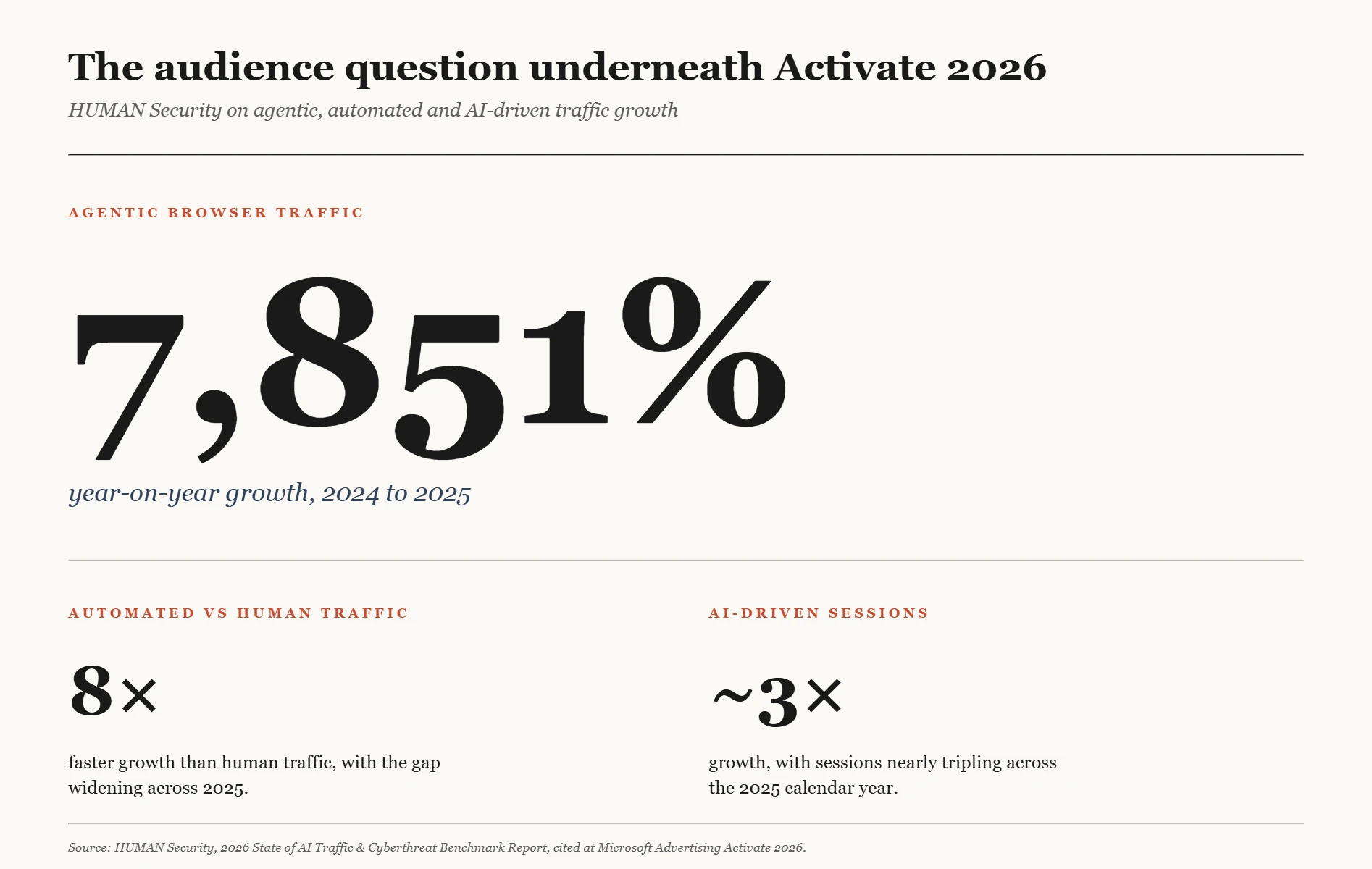
Microsoft cites figures from the HUMAN Security 2026 State of AI Traffic Report suggesting automated traffic is now growing roughly eight times faster than human traffic, with agentic browser traffic up 7,851% year on year. The Search Engine Land write-up is worth a look if you want the methodology. Treat the precise numbers with caution and verify against the primary source before you put them in a board paper. The direction is consistent with what UK retailers and B2B brands report internally, and it’s the direction the platform is now optimising for.
AI Max and the Agentic Web: A New Logic for Search
What Is the Agentic Web, in Practical Terms?
The agentic web is the layer of activity where AI agents act on behalf of a person rather than presenting them with options. An agent does not hover, scroll, or get prompted by a banner. It reads structured information, applies rules, and selects.
The practical consequence is straightforward. If your product feed, pricing logic and brand attributes aren’t legible to an agent inside Copilot, you can run a textbook bidding strategy and still lose. Selection happens upstream of the auction your team has been optimising.
How AI Max Changes Microsoft Ads Delivery
AI Max is in open pilot inside the Microsoft Advertising platform from May 2026. Per Microsoft’s 21 April announcement, it uses AI to improve Search campaign performance through expanded query matching, asset personalisation and smarter URL routing. It’s designed to deliver relevant ads on AI surfaces such as Copilot Search and Copilot Answers as well as on Bing, where queries are typically longer, more conversational and less keyword-shaped than the classic two-to-four-word query the auction was built around.
Two details deserve attention from PPC managers. Advertisers steer the system by opting in, with controls coming for brand inclusions and exclusions, term exclusions and messaging constraints. Microsoft has built in search-term and asset reporting from day one. That’s a deliberate contrast with how Performance Max landed on Google Ads, where reporting opacity made incrementality testing genuinely difficult for the first two years. The lesson appears to have been absorbed.
Microsoft also announced Audience generation alongside AI Max. The tool lets advertisers describe a target audience in natural language, with Microsoft AI translating that into demographics, locations and in-market signals without manual segment assembly. It’s in closed pilot in the US and Canada, so UK advertisers can’t activate it directly yet. Worth watching regardless, because segment-building is shifting from manual list selection to prompt-based description across every major platform, and the operational habits formed in the US pilot will set the template for the rest of the market.
Offer Highlights, AI Visibility, and the Rise of Selection
Offer Highlights is a new ad format inside Copilot conversations. Rather than placing traditional ads beneath an AI response, it pulls specific product differentiators (free shipping, in-store pickup, returns policy) into the moment a decision is being made. Brands feed the inputs in via Microsoft Merchant Center. Best Buy was an early launch partner. The format is live for retail in English-speaking markets, which covers UK advertisers.
AI Visibility in Microsoft Clarity does the corresponding job on the discovery side. It shows brands how AI assistants cite and represent them: which pages influence answers, which competitors are cited instead, and where the content gaps sit. For UK B2B brands that have been flying blind on generative search performance since ChatGPT introduced browsing, it turns an invisible problem into a measurable one.
The shared logic is the unit of value. A click was the old benchmark for top-of-funnel performance. Selection inside an AI answer is becoming the new one, and the tooling is finally catching up.
Universal Commerce Protocol and Shopify Catalog in Copilot
Two related commerce updates first announced on 21 April at Microsoft’s Spring Summit and reinforced at Activate are worth flagging separately.
Microsoft Merchant Center now supports Universal Commerce Protocol (UCP) feeds in the US. UCP is the open product-data standard co-developed by Google and Shopify, with Walmart, Target, Etsy and Wayfair among the retailers backing it. Target was named as Microsoft’s early launch partner, with Copilot account linking surfacing Target Circle loyalty benefits during AI-assisted shopping. UK rollout is pending. For cross-border retailers selling into the US, a UCP-ready feed is now worth maintaining ahead of the wider expansion.
Microsoft also integrated Shopify Catalog directly into Copilot via its commerce API. Shopify Catalog structures, enriches and syndicates product data in real time, which removes the bespoke-integration overhead that traditionally slowed Copilot onboarding for non-Shopify merchants. Microsoft’s own internal data showed the top 100,000 Shopify merchants by GMV in the US and Canada achieved roughly 90% relative growth in impression share within Copilot Shopping over February to March 2026. UK retailers on Shopify can enable Catalog in admin settings and the products then syndicate to Copilot automatically without any further integration work.
Operational Updates: Import Center and Cross-Account Portfolio Bidding
The agentic web announcements get the column inches. The operational updates often move the P&L. Two from Activate 2026 deserve attention from anyone running Microsoft Ads at scale.
What the New Import Center Actually Does
The Import Center is a redesigned hub for moving campaigns into Microsoft Advertising from other platforms. Per the Microsoft Advertising May 2026 product update, it supports easier imports from Google Ads and Meta Ads, with better error handling, performance tips delivered immediately after import, and quicker access to reporting on imported campaigns.
For UK agencies onboarding a client whose budget currently sits with Google or Meta, the friction tax on running a parallel Microsoft test drops noticeably. Less time reconciling broken assets, fewer hours rebuilding tracking, faster first impression on the new platform. For retail clients on a January or July seasonal cycle, this is the difference between testing Microsoft inside the season or pushing it to the next one.
One caveat worth flagging for any UK agency planning a wave of Google imports through this tool: Microsoft PMax, broad match and automated bidding behave differently in practice from their Google equivalents, even when the campaign settings transfer cleanly. The Import Center makes copying easier; it doesn’t translate platform-specific behaviour. Audit the imported campaigns against Microsoft’s recommended setup before scaling, particularly around conversion-goal selection and bid-strategy defaults, both of which carry different downstream consequences from the Google account they were lifted out of.
Cross-Account Portfolio Bidding and What It Means for Agencies
Portfolio bid strategies pool signals across campaigns chasing a shared goal, so automated bidding can learn faster than it would inside a single thin campaign. Cross-account portfolio bidding extends that logic across multiple accounts and is now available for Search and Shopping campaigns. Three new metrics appear in the bid strategy report: average target ROAS, average target CPA and average target impression share, available at campaign, account and portfolio level.
Analyst commentary: the real beneficiary here is the multi-brand advertiser. UK holding-company structures where related brands sit in separate accounts have historically given up automation efficiency in exchange for clean reporting lines and budget hygiene. The new capability softens that trade-off without forcing a consolidation that finance teams tend to dislike. It also narrows a long-standing gap with the equivalent Google Ads feature, which matters whenever a procurement conversation asks why Microsoft is on the media plan at all.
Microsoft Performance Max Transparency
Alongside AI Max, Activate also pulled together what had been a year of incremental Performance Max work. Most of it has nothing to do with AI surfaces. It’s about advertiser visibility into a campaign type that, until early 2026, was harder to govern than its Google equivalent.
Self-serve negative keywords for PMax exited open beta in March 2026, so campaigns can be excluded from queries without raising a support ticket. Landing page (Final URL) reporting arrived in April, letting advertisers see PMax performance segmented by destination URL, asset group and custom parameters. The search-term column moved to default in the same release, with full reporting in that column rolling out from May. Auction insights and additional publisher URL metrics are flagged as next.
For UK retail teams whose Microsoft spend sits primarily in Performance Max rather than Search, this is the more directly actionable thread of the year. The audit logic is straightforward. Review the search-term report monthly, build a negative keyword list from observed waste, watch the landing page report for URL drift, and update the asset group when it appears. Plenty of accounts have left PMax under-governed because the visibility was poor for so long. That excuse has now gone.
The 3PS Partnership: Microsoft’s Identity Bet
Worth flagging separately from the product roadmap: 3PS. At CES on 7 January 2026, Microsoft Advertising announced that Epsilon data is now available on the Microsoft Advertising platform through a partnership with Publicis Media Exchange. The label is Third-Party Search, or 3PS. It covers search, native and display inventory. Microsoft’s travel-vertical pilot returned around 2x ROAS and 42% net-new audiences against conventional in-market targeting, with Search Engine Journal’s PPC Pulse coverage carrying the trade-press read.
Sitting behind 3PS is a bigger Microsoft and Publicis Groupe deal from 8 April 2026. Publicis is moving its data and agentic marketing stack onto Microsoft Azure and Fabric, with Epsilon’s identity graph providing the underlying layer. If your agency isn’t on the Publicis roster, none of this lands in your account directly. The interesting read isn’t the access. It’s the direction Microsoft is signalling: identity-led targeting via partners, rather than trying to match Google’s first-party data scale head-on. That’s a clearer read on the competitive thesis for the next two years than any single product launch at Activate.
Strategic Implications for UK Marketing Managers
The combined effect of these announcements pulls UK teams toward signal quality, machine-readable product data and a faster optimisation cadence.
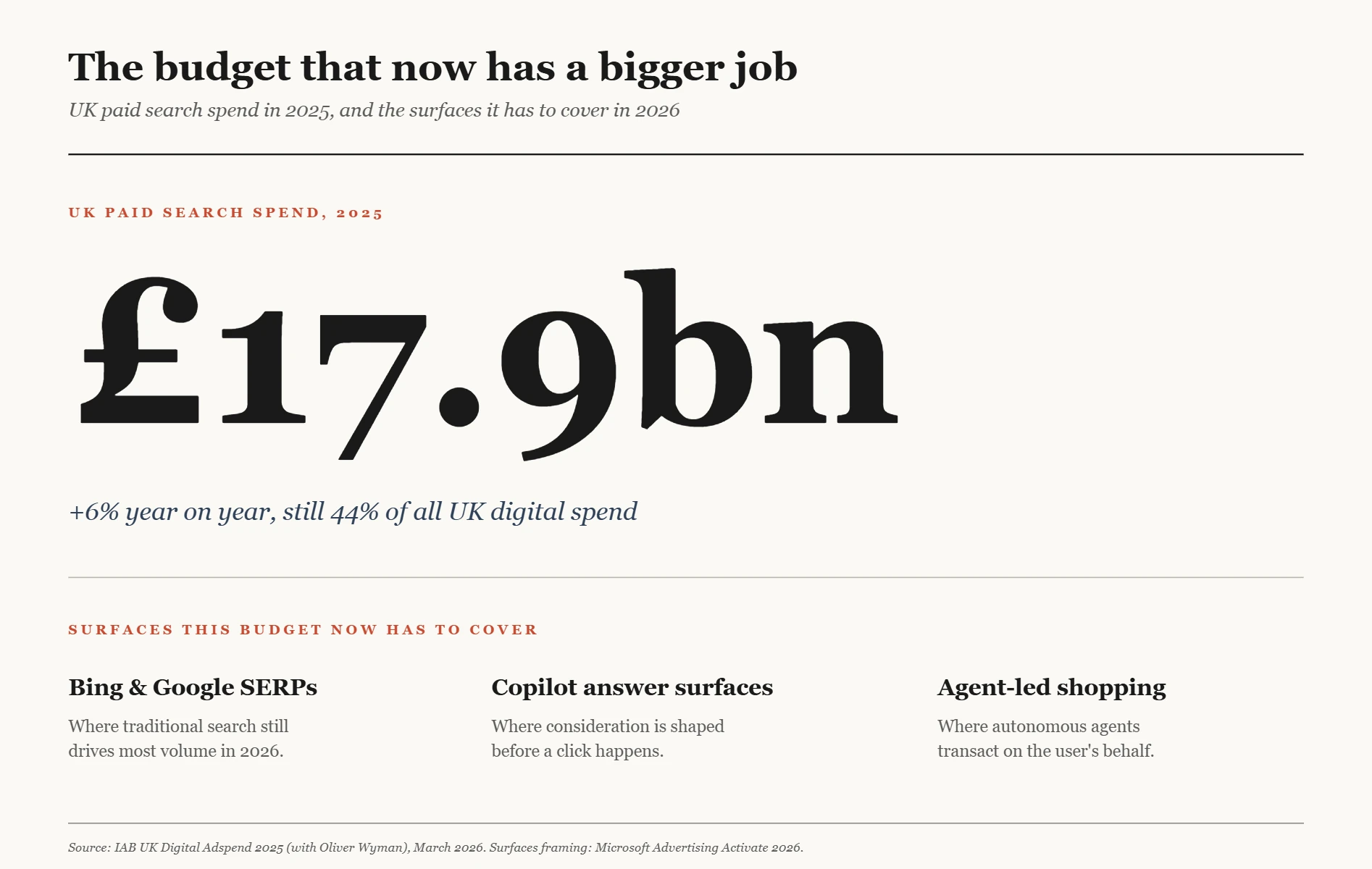
To anchor this in UK numbers: the IAB UK Digital Adspend 2025 study with Oliver Wyman put UK paid search at £17.9bn in 2025, a 6% increase year on year, still 44% of all UK digital spend. That spend now has a bigger job: the same pound has to work across more surfaces than it did 12 months ago.
Six practical areas will feel it first.
Media budgets. A growing share of paid search impressions will appear on AI surfaces (Copilot Search, Copilot Answers, Offer Highlights placements). Budget pacing built around classic Bing query volume needs recalibration through Q3 and Q4, and the case for testing Microsoft Ads against the dominant Google budget gets stronger by the month.
Team structure. The volume of work spent writing keyword lists shrinks. The work of feeding the system useful inputs grows: assets, audience descriptions, structured product data and brand guardrails. Expect more time inside Microsoft Merchant Center and Clarity, less inside the Keyword Planner.
Measurement. The May 2026 product update confirmed that data-driven attribution is rolling out to all advertisers by the end of May for campaigns using Maximize Conversions (with optional Target CPA), Maximize Conversion Value (with optional Target ROAS) and Enhanced CPC. The model assigns conversion credit across the full customer path. Last-click views still exist and will look increasingly out of step with how the platform actually optimises. One operational gotcha worth surfacing before any of this scales: audit your conversion goals before turning on automated bidding. AI Max and data-driven attribution both infer intent more broadly than older models did, so accounts still optimising toward soft micro-conversions like page views or scroll-depth events will see the system push spend toward low-quality traffic faster than the finance team is prepared for.
Attribution. AI Visibility shifts the focus from clicks to citations. Adding a citation-share metric to quarterly reporting alongside impression share and click share is sensible practice from this quarter onward. It’s a leading indicator of share of voice in generative answers, which is becoming a measurable surface in its own right.
Testing cadence. More automation raises the value of clean incrementality testing. Geo holdouts (Scotland against the rest of GB, or city-level splits) and proper conversion lift studies become more useful than ever for separating real lift from algorithmic reshuffling of credit.
Regulatory exposure. Section 80 of the Data (Use and Access) Act 2025 came into force on 5 February 2026, replacing Article 22 of the UK GDPR with new Articles 22A-D. Those articles cover automated decision-making, which is what AI Max, Audience generation and 3PS look like to the ICO. The ICO opened consultation on draft guidance interpreting them on 31 March 2026, with that consultation closing on 29 May 2026. Any UK team scaling these tools wants its consent flow and DPIA reviewed against the new framework now, while the ICO’s position is still being formed.
Traditional Search Marketing vs Agentic Web Marketing
If the table extends beyond the screen, scroll sideways to view all columns.
| Dimension | Traditional Search Marketing (Pre-2026) | Agentic Web Marketing (2026 Onward) |
|---|---|---|
| Primary user behaviour | Type a query, scan results, click a link | Ask Copilot to help choose, or delegate the task to an AI agent |
| Unit of value | Click | Selection or citation inside an AI answer |
| Match logic | Keyword-to-query, exact and phrase modifiers | Intent and context, expanded matching via AI Max |
| Asset strategy | Manually written headlines and descriptions | Asset personalisation steered by brand and term guardrails |
| Audience construction | Manual segments and in-market lists | Prompt-based Audience generation (closed US/Canada pilot) |
| Product visibility | Standard Shopping feed in Microsoft Merchant Center | UCP-ready feed legible to AI agents and Copilot Checkout |
| Measurement | Last-click and rules-based attribution | Data-driven attribution plus AI citation visibility |
| Optimisation lever | Bids, negatives, ad copy | Signals, structured data, guardrails, feed quality |
| UK regulatory framing | UK GDPR baseline, PECR cookies | DUAA Articles 22A-D, draft ICO ADM guidance |
Sources: Microsoft Advertising blog, April 2026; Microsoft Advertising May 2026 product update; analysis by aiwiz.uk.
Three Things to Do Before the End of Q3
The reflex with announcements of this scope is to file them under ‘discuss at offsite’ and carry on. Resist it. Three actions earn their place in the next 60 days.
- Run a controlled AI Max pilot on one campaign. Pick a campaign with enough monthly conversion volume to read a result inside four weeks (a hundred conversions is a sensible floor). Set proper guardrails: brand exclusions, term exclusions and a tight URL list. Hold a matched control campaign on classic match types. Read the search-term report weekly, not monthly, through the first month.
- Audit your Microsoft Merchant Center feed for agent readiness. Check that GTINs, pricing, availability, returns policy and offer differentiators are present, accurate and structured against the Microsoft Merchant Center product specification. If you sell to UK consumers, confirm Offer Highlights eligibility is enabled. The attribute fields most teams leave blank are usually the ones the agent reads first, and a weak feed will cap your performance regardless of budget.
- Baseline your AI citation share. Switch on AI Visibility in Microsoft Clarity, give it a clear sixty days of data, and treat the result as a benchmark. Note which pages drive citations, where competitors are taking ground, and where your content sits silent. Set a citation-share target for Q4.
These are not academic exercises. The teams that move first will accumulate operational learning while the rest of the market is still arguing about whether AI Max is worth a pilot budget.
Microsoft Ads AI Max Readiness and Agentic Web Audits
A written read on what’s working and what isn’t, with the workings shown. That’s what aiwiz.uk delivers as a structured audit of your Microsoft Ads account, covering AI Max pilot readiness, Microsoft Merchant Center feed quality against Offer Highlights, Performance Max transparency setup, attribution model configuration, and the conversion-goal audit data-driven attribution will expose if it hasn’t been done already. If you’d like a second pair of eyes on the account before scaling AI Max or rebuilding around the agentic web, get in touch.